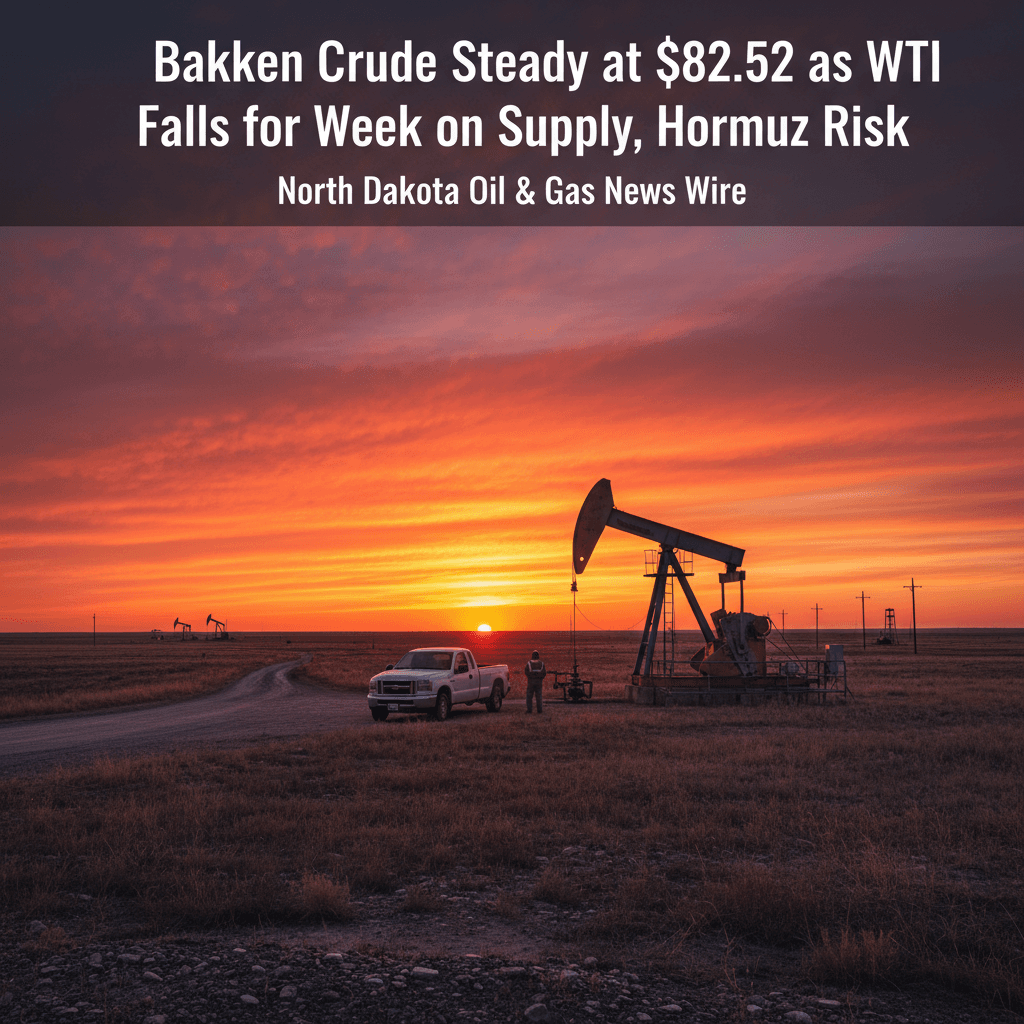
Bakken Crude Steady at $82.52 as WTI Falls for Week on Supply, Hormuz Risk
North Dakota’s benchmark differential stayed negative as traders weighed rising Gulf flows against repeated tanker attacks.
Oil prices were little changed intraday Friday, but the broader weekly trend remained lower as global supply gains and Middle East tanker attacks pulled in opposite directions, according to live Bakken Wire pricing data and OilPrice.com.
WTI crude was priced at $82.52, up $0.08, or 0.1%. Brent crude rose $0.17, or 0.19%, to $89.61. Natural gas was $3.6, down $0.08. The Bakken differential was minus $3.42 versus WTI.
January WTI futures, however, were down more than 5% for the week, OilPrice.com reported. At 00:48 GMT Friday, January WTI futures were trading at $82.81, down $4.80, or 5.48%, for the week.
The decline suggests traders are putting more weight on barrels reaching the market than on the threat of future disruptions, according to OilPrice.com. The International Energy Agency said in its November report that global supply rose by 2.3 million barrels per day in October to 105.4 million barrels per day. The agency expects the global oil market to return to a surplus in the fourth quarter, with a larger surplus possible in 2027.
The U.S. Energy Information Administration reported that oil shipments through major Middle East chokepoints increased 19% in the third quarter. Companies have used smaller vessels and ship-to-ship transfers to move barrels, OilPrice.com reported.
At the same time, Iran has intensified attacks on tankers in the Strait of Hormuz in recent weeks, according to OilPrice.com. The number of attacks soared in October to the highest level since the Iran war began at the end of February and has continued at nearly daily occurrences so far in November, according to data compiled by Bloomberg.
Crude oil volumes flowing from the Strait of Hormuz have declined in recent days, although it is unclear whether the drop is entirely due to more frequent attacks, OilPrice.com reported.
“Security risks continue to weigh on tanker operations in the Gulf,” Maria Bertzeletou, senior market analyst at Signal Group, said in analysis cited by OilPrice.com. “Repeated attacks continue to restrict the pool of owners willing to accept Gulf employment, while elevated war-risk insurance costs and operational delays add to voyage expenses and limit effective vessel availability.”
Iran has reported nearly daily incidents of tankers hitting naval mines in corridors it has designated as “unauthorized” in the Strait of Hormuz. Five tankers were struck near Hormuz in the week between November 11 and 18, according to remote-sensing intelligence by Windward. ADNOC Logistics & Services, a unit of Abu Dhabi’s national oil company ADNOC, confirmed that one of its vessels was attacked while transiting the Strait of Hormuz on the evening of November 17.
Not all incidents are being reported to the UK Maritime Trade Operations and the International Maritime Organization, according to OilPrice.com.
Rigzone reported that oil prices swung on Middle East uncertainty, with renewed Iran tensions offsetting improving Middle East supplies.
For Bakken operators, the price picture remains mixed. The benchmark WTI level held near $82.52 in live pricing, but the weekly loss and the negative $3.42 Bakken differential point to weaker realized prices for North Dakota barrels. A softer natural gas price also adds pressure on associated gas revenue for Williston Basin producers.
Source
Bakken Wire live price data; OilPrice.com; Rigzone