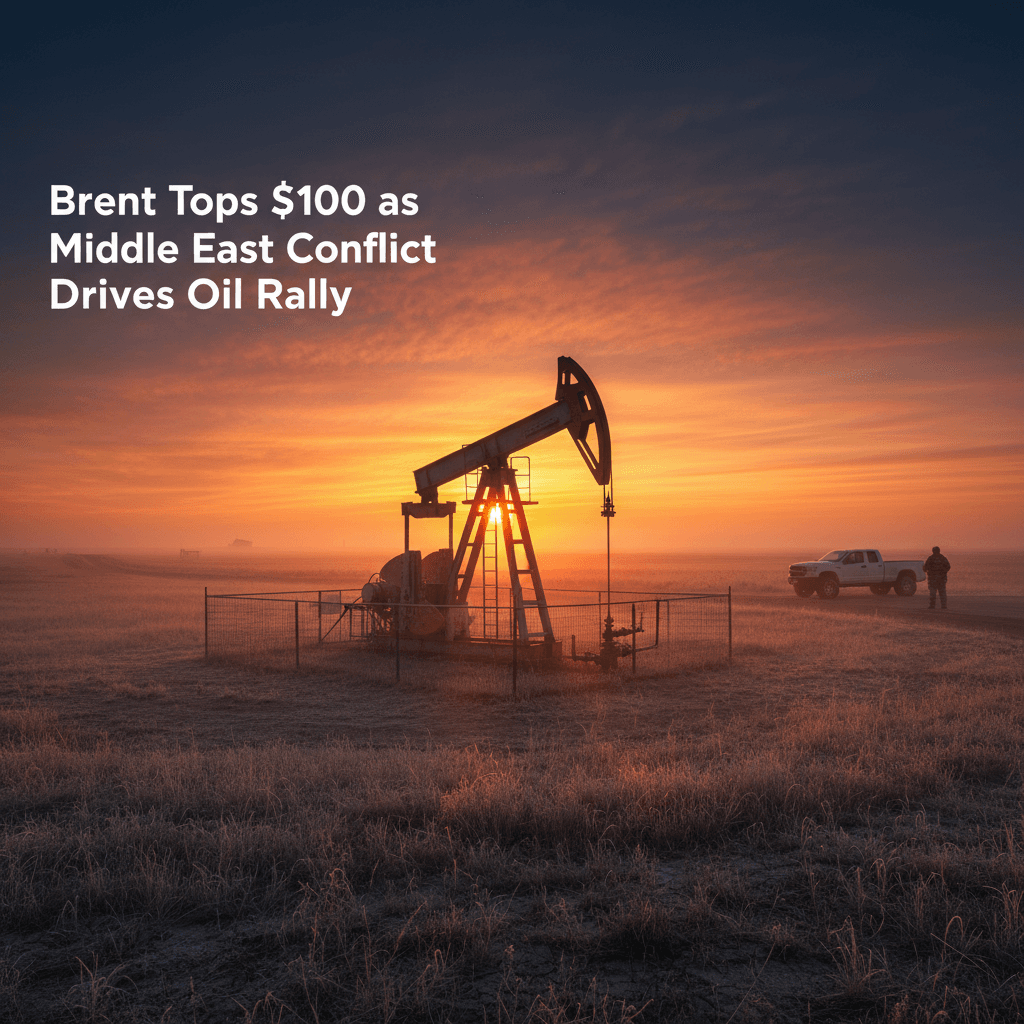
Brent Tops $100 as Middle East Conflict Drives Oil Rally
Bakken crude price strengthens as global benchmarks surge on heightened geopolitical risk and revised forecasts.
Global oil prices surged on Wednesday, with Brent crude breaking the $100 per barrel threshold for the first time since late July, driven by a major escalation of hostilities between the United States and Iran. The rally presents a significant price boost for Bakken producers, though tempered by a persistent regional discount.
As of Wednesday morning, the international benchmark Brent crude traded at $100.42 per barrel, a gain of $2.50 or 2.55%, according to live price data. The U.S. benchmark, West Texas Intermediate (WTI), rose $2.04 to $95.07 per barrel. The price for Bakken crude at the Clearbrook, Minnesota, hub is typically priced at a differential to WTI; the current discount is $3.42 per barrel, implying a Bakken price of approximately $91.65.
The immediate catalyst for the price spike is renewed military conflict in the Middle East. According to a report from OilPrice.com, U.S. forces destroyed five Iranian crude oil carriers in the Gulf of Oman and near Kharg Island on Tuesday. Iran retaliated by firing ballistic missiles toward Jordan. These actions have severely diminished hopes for near-term diplomatic talks and a return to normal oil flows from the region, injecting a substantial risk premium into the market.
"Recent developments only reinforce the view that we’re still some way from a restart in talks. In the meantime, the market is likely to continue to price in a sizeable risk premium," ING commodities strategists Warren Patterson and Ewa Manthey wrote in a note cited by OilPrice.com.
The sustained high prices are beginning to impact global demand dynamics, particularly in China. A separate OilPrice.com report notes that China's independent refiners, known as "teapots," are seeing their margins squeezed to breakeven levels, which may force them to reduce processing rates. While China's crude imports recovered to 8.93 million barrels per day in August from a decade low in June, they remain 23.4% below last year's level. With Venezuelan and Iranian crude supply constrained, Chinese refiners may lean more on Russian crude, but rising global prices could further dampen demand.
In response to the tightened market outlook, analysts at HSBC have significantly raised their price forecasts. According to Rigzone, HSBC analysts, including Senior Global Oil and Gas Analyst Kim Fustier, raised their 2026 oil price forecast by $10 per barrel and their 2027 forecast by $20 per barrel.
For operators in the North Dakota Bakken, the rally in WTI directly translates to higher wellhead revenues. The current price environment, bolstered by geopolitical risk and revised analyst outlooks, provides improved cash flow and could support sustained drilling and completion activity. However, the persistent Bakken differential, which reflects regional pipeline and rail takeaway capacity and quality adjustments, continues to capture value below the headline WTI price. Meanwhile, natural gas prices showed slight weakness, trading at $2.86 per barrel, down six cents.
Source
Live price data, OilPrice.com, Rigzone