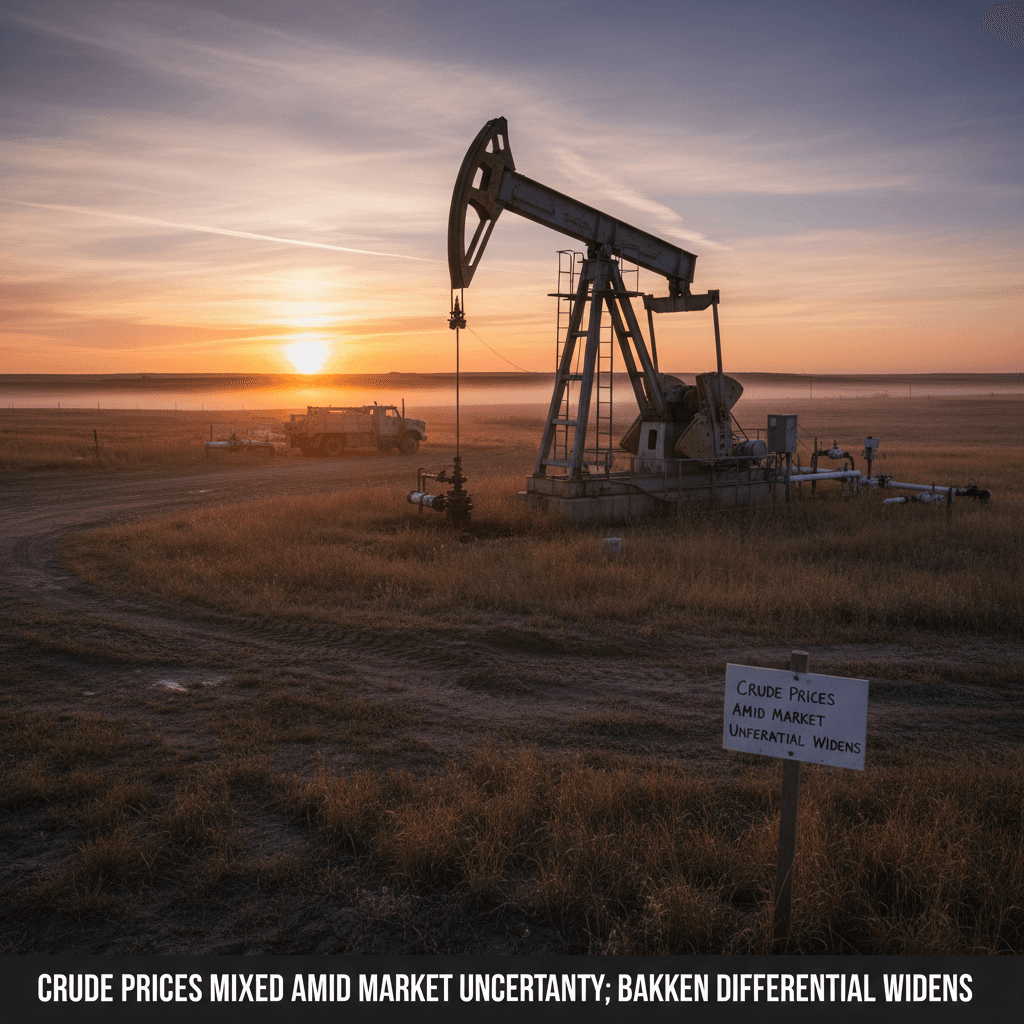
Crude Prices Plunge Over 6% as Geopolitical Shifts Overshadow Inventory Draw
WTI falls below $96, dragging Bakken prices down, after Trump halts "Project Freedom" amid reported progress with Iran.
Crude oil futures plummeted more than 6% on Wednesday, erasing gains from a supportive weekly U.S. inventory report, after a major geopolitical announcement rattled markets. The sharp drop pressures Bakken wellhead economics as the local price differential holds steady.
As of midday trading, West Texas Intermediate (WTI) crude was at $95.40 per barrel, down $6.87 or 6.72% on the day. The international benchmark Brent crude traded at $102.22, down $7.65 or 6.96%. The Bakken differential to WTI was -$3.42. According to live price data, this puts the implied Bakken wellhead price near $91.98.
The price collapse occurred despite a bullish U.S. inventory report from the Energy Information Administration (EIA). The EIA reported commercial crude oil inventories fell by 2.3 million barrels for the week ending May 1, bringing stockpiles to 457.2 million barrels, according to Oilprice.com. This draw was anticipated by analysts; Rigzone reported Macquarie strategists had expected another U.S. crude inventory draw "amidst elevated exports."
The primary driver for Wednesday's sell-off was geopolitical. Oilprice.com reported that crude prices crashed after President Trump halted "Project Freedom," citing great progress toward a final agreement with Iran. The market interpreted this as a potential easing of tensions that could lead to more Iranian oil supply entering the market, reversing recent risk premiums.
The inventory data itself showed mixed signals. While crude stocks drew down, total motor gasoline inventories fell by 2.5 million barrels, and distillate stocks decreased by 1.3 million barrels. Underlying demand remains robust. The EIA reported total products supplied, a proxy for demand, averaged 20.3 million barrels per day over the last four weeks, up 2.6% year-over-year.
For Bakken operators, the sudden price drop is a stark reminder of market volatility driven by factors far from the wellhead. The steady differential suggests local pipeline and rail logistics are functioning normally, but the nearly $9 per barrel week-over-week decline in WTI, as noted by Oilprice.com, directly impacts cash flow and drilling budgets. The price move may trigger renewed caution in capital spending plans if sustained, despite the fundamentally tight physical market indicated by falling inventories and strong demand.
Source
Live price data, Oilprice.com, Rigzone