WTI Crude--
Brent Crude--
Natural Gas--
ND Rig Count--
WTI Crude--
Brent Crude--
Natural Gas--
ND Rig Count--
Devon, Coterra Merger Creates Major Permian-Centric Operator - Bakken Wire
Operator News

Devon, Coterra Merger Creates Major Permian-Centric Operator

The $58 billion deal, completed this week, forms a large-cap shale company with a leading Delaware Basin position, while ExxonMobil faces shareholder opposition to its Texas move.

Bakken Wire Staff·🔆Midday Wire·

Devon Energy Corporation and Coterra Energy Inc. have completed their $58 billion merger, creating a new large-cap shale operator, according to a statement from Devon. The deal was finalized after receiving stockholder approval at special meetings on May 4.

The combined company will operate under the Devon Energy name and trade on the New York Stock Exchange under the ticker 'DVN'. Based in Houston, it will maintain a significant presence in Oklahoma City. Former Coterra shareholders now own approximately 46% of the combined company, with Devon shareholders owning the remaining 54%.

For Bakken observers, the merger underscores the ongoing industry consolidation into larger entities with deep inventory in core basins, primarily the Permian. The new company's leadership and operational focus are heavily weighted toward the Permian's Delaware Basin and other regions like the Anadarko, Eagle Ford, Marcellus, and Rockies. The statement highlighted the creation of a "premier large-cap shale operator with a high-quality asset base anchored by a leading position in the economic core of the Delaware Basin."

Clay M. Gaspar, named President and CEO of the combined company, called the merger "a defining moment for Devon Energy." He stated the union creates a company with the "scale, inventory depth and financial strength to deliver differentiated returns for shareholders through any commodity cycle."

The combined board of directors will have 11 members, with six from Devon and five from Coterra. Key executive appointments include Shannon E. Young III as CFO and Michael D. Deshazer as EVP of Exploration & Production for regions including the Rockies.

Separately, ExxonMobil faces investor pushback on its plan to redomicile from New Jersey to Texas. New York City Comptroller Mark D. Levine, a trustee for pension funds that are "a substantial long-term Exxon shareholder," is urging investors to vote against the move at the May 27 annual meeting.

Levine argued the redomicile and a related retail voting program "both appear designed to insulate Exxon's Board from accountability to shareholders." ExxonMobil announced the move in March, stating Texas offers a more enabling environment for the oil and gas industry and provides greater legal certainty.

ExxonMobil CEO Darren Woods said Texas has "created a policy and regulatory environment that can allow the company to maximize shareholder value." The company emphasized the move would not affect operations, management, or strategy.

These developments highlight the strategic and corporate governance currents shaping the major players in the U.S. oil patch. The Devon-Coterra merger creates a formidable Permian-centric competitor, while ExxonMobil's attempted jurisdictional shift reflects the industry's alignment with perceived favorable regulatory states.

Source

Rigzone (Devon, Coterra Complete $58B Merger; NY City Official Rallies Investors to Block ExxonMobil Move to Texas)
devon energycoterra energymergerexxonmobilcorporate governancepermian basindelaware basinshareholder vote

Share this article

Related Articles

Operator News

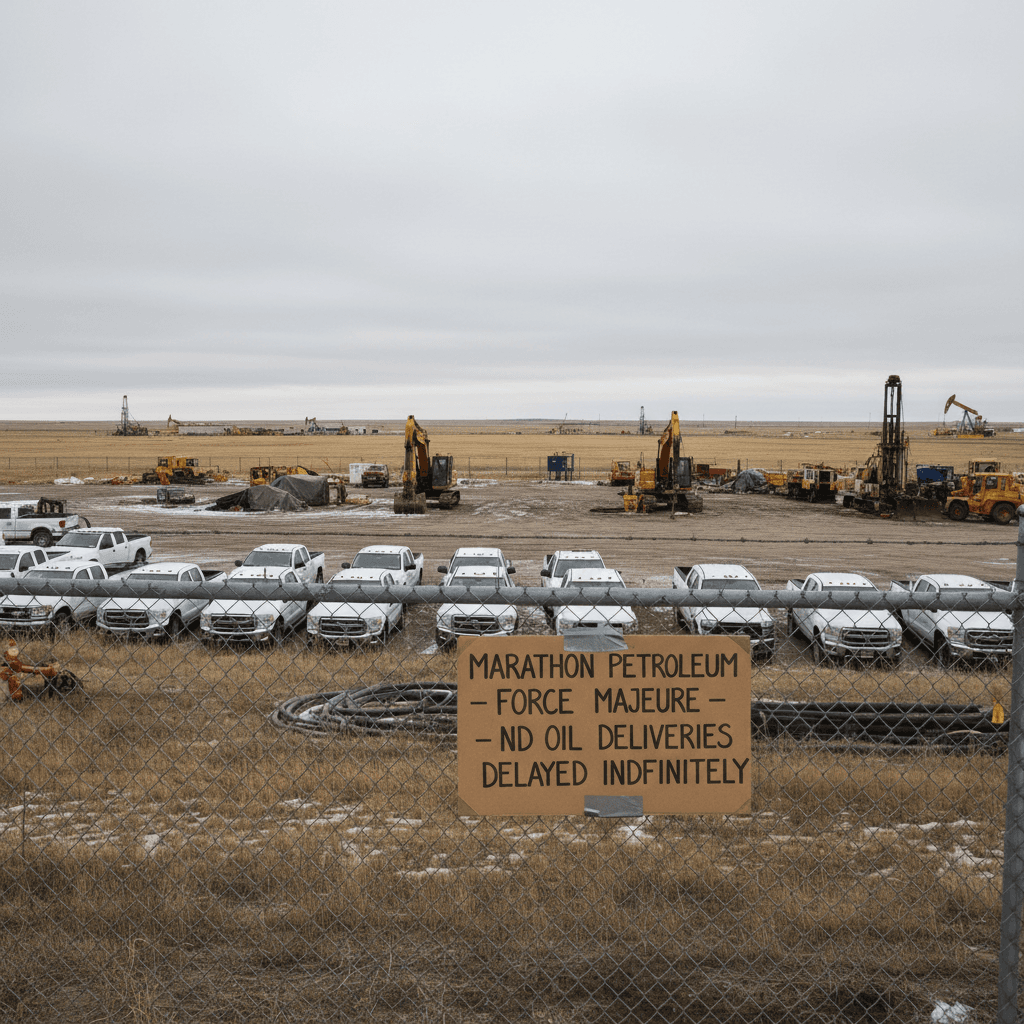
Marathon Petroleum Declares Force Majeure on ND Oil Deliveries

Marathon Petroleum has declared force majeure on oil pipeline deliveries from North Dakota, according to a report from Bing News. The announcement was made on November 19, 2026. The declaration follows what the source described as a flurry of crude contamination issues. Force majeure is a legal clause that frees parties from liability or obligation when an extraordinary event or circumstance occurs. For Bakken operators, this declaration creates immediate logistical and financial challenges. It can lead to involuntary well shut-ins if there is no alternative route to market for the affected crude. Even if production continues, operators may face significant price discounts for oil that must be rerouted to more expensive transportation methods, such as trucking or rail. The Bakken formation is a major oil-producing region where pipeline infrastructure is critical for moving crude to refineries and broader markets. Contamination issues can necessitate extensive cleaning of pipeline segments and storage...

☀️Morning Wire·Nov 21
Marathon Petroleum Declares Force Majeure on ND Oil Deliveries - Bakken Wire
Operator News

Marathon Petroleum Declares Force Majeure on ND Oil Deliveries

Marathon Petroleum Corp. has declared force majeure on North Dakota oil pipeline deliveries, according to a Bloomberg report. The announcement, made late Wednesday, November 18, comes after a series of crude contamination issues. The pipeline transporting Bakken crude has been operating intermittently since last week. The force majeure declaration is a legal provision invoked due to unforeseen circumstances that prevent a company from fulfilling its contracts. The immediate impact is a disruption to the flow of Bakken crude to market. For North Dakota producers and royalty owners, this creates logistical challenges and can lead to localized price volatility as barrels seek alternative routes, such as more expensive truck or rail transport. Pipeline operator Enbridge is involved in the situation, though specific details on the cause or remediation timeline were not provided in the report. Contamination events typically require flushing of the pipeline system and can lead to extended downtime. The...

🔆Midday Wire·Nov 20
Operator News

ExxonMobil Commits $12.5B to Offshore Guyana Gas Project

ExxonMobil has made a final investment decision to proceed with a major new $12.5-billion project offshore Guyana, according to Rigzone. The development, named Longtail, is the eighth project sanctioned in the Stabroek block and is described as the first primarily focused on gas and condensate. The announcement, reported on November 13, follows necessary government approvals. The Longtail project represents another multi-billion dollar capital commitment by the supermajor to its prolific offshore Guyana assets, which have become a cornerstone of its global production growth strategy. For operators in the Bakken, ExxonMobil's continued large-scale investments outside the lower 48 states underscore the competitive landscape for capital allocation. While ExxonMobil, through its subsidiary XTO Energy, remains a significant operator in the Williston Basin, major international projects often command larger portions of corporate capex budgets. The Bakken formation remains a vital source of U.S. oil supply, but it operates within a global portfolio for...

☀️Morning Wire·Nov 15