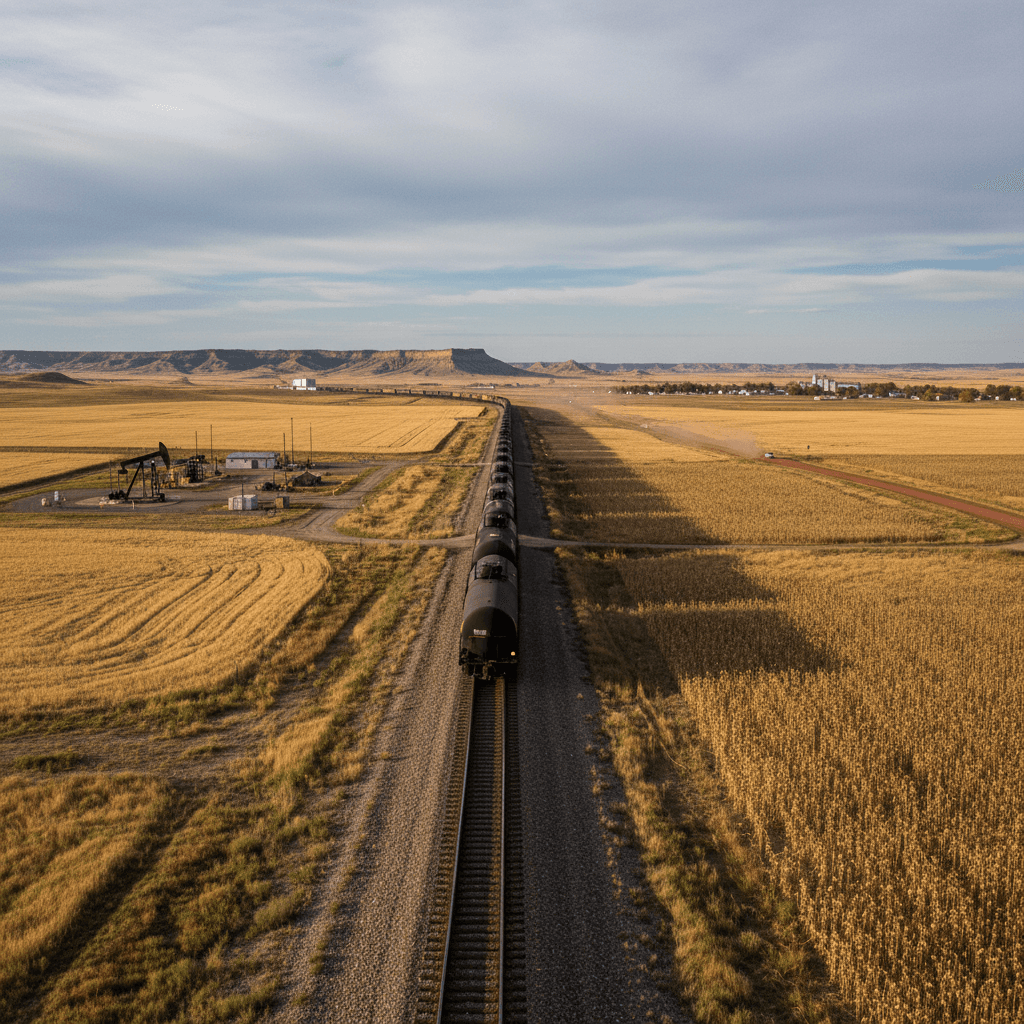
DOE Awards $36 Million for Bakken CO2 EOR Research Program
A $157 million initiative, led by UND, aims to unlock billions of barrels and extend the life of Bakken wells using captured carbon.
The U.S. Department of Energy will invest $36 million to advance carbon dioxide-based enhanced oil recovery (EOR) in the Bakken shale through a program led by the University of North Dakota’s Energy & Environmental Research Center, according to a DOE release from May 8. The broader research effort represents a total investment of approximately $157 million, with work expected to intensify later this year.
The program, dubbed Bakken Enhanced Oil Recovery–Cracking the Code (Bakken EOR-CC), combines laboratory research, reservoir modeling, artificial intelligence, and field work to evaluate EOR strategies. The DOE stated the initiative could unlock billions of additional barrels of incremental oil and extend the life of North Dakota's coal-fired power plants by utilizing their captured CO2 for oil recovery.
North Dakota leaders unveiled the enhanced oil recovery initiative aimed at getting more oil from the Bakken formation, according to a separate report. The effort is seen as critical because unconventional formations like the Bakken typically yield only about 10% of the oil in place, leaving significant volumes unrecovered.
“This program is essential to maximize the full potential of our valuable hydrocarbon resources in the Bakken. By ‘cracking the code,’ these integrated pilot projects will help establish a clear path for the broad commercial deployment of enhanced energy recovery across the nation," said DOE Assistant Secretary for the Hydrocarbons and Geothermal Energy Office Kyle Haustveit.
The Bakken EOR-CC program will assess multiple injection strategies, reservoir conditions, and operational approaches across six pilot projects. The goal is to build a technical basis for commercial-scale EOR across the play. For one of the six pilots, the DOE's $36 million investment will be combined with $9 million in cost-share from UND's Energy & Environmental Research Center and project partners.
State and private sources are providing about $100 million in funding for the remaining five pilot projects, according to the DOE. AI and machine-learning tools will be deployed to analyze performance data from the pilots, identifying best practices and operational benchmarks to accelerate broader commercial deployment.
The integrated pilot effort is intended to create a unified technical foundation that supports wider adoption of EOR technologies across the Bakken and similar unconventional reservoirs nationwide. The prominent research center in North Dakota will play a lead role in the work, which is expected to kick into high gear later this year.
Source
According to the U.S. Department of Energy release via OGJ (May 8, 2026), Bing News summary (May 8, 2026), and Yahoo Finance summary (May 8, 2026).

