WTI Crude--
Brent Crude--
Natural Gas--
ND Rig Count--
WTI Crude--
Brent Crude--
Natural Gas--
ND Rig Count--
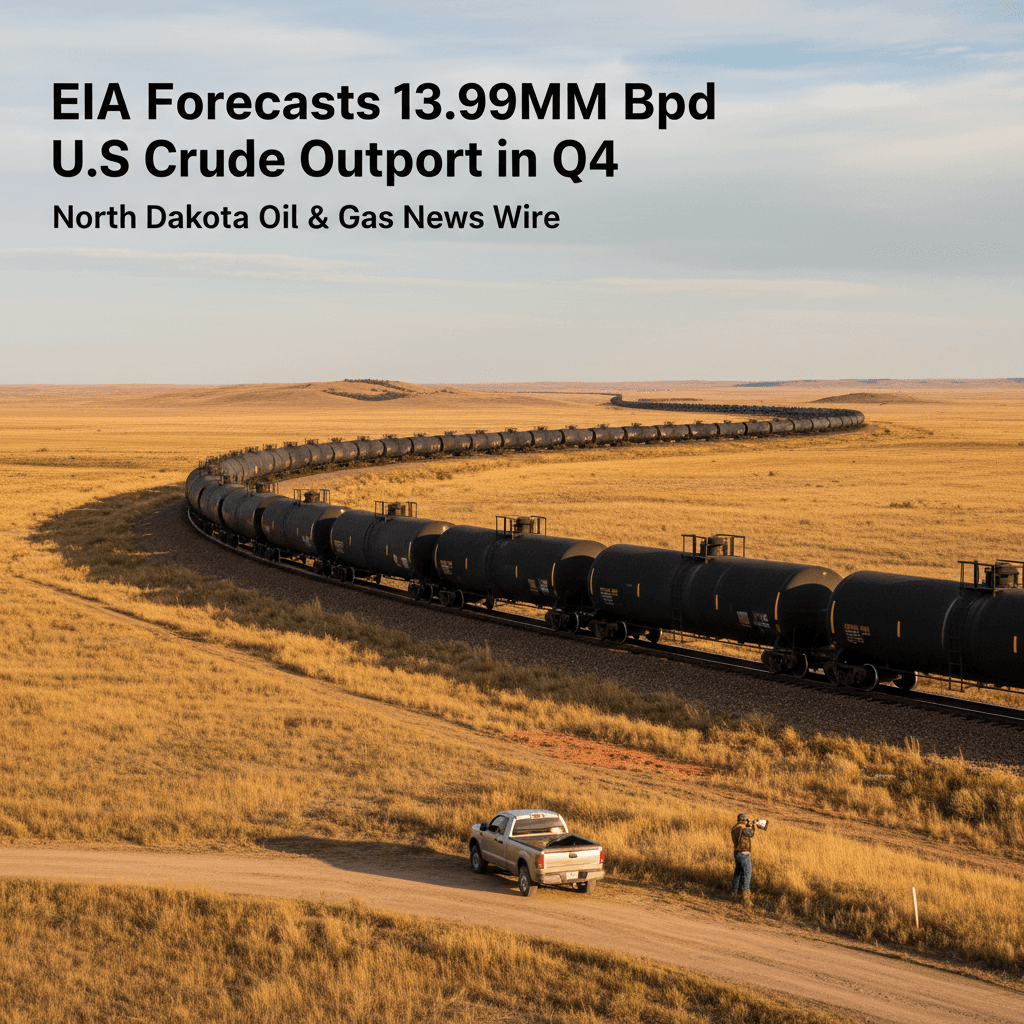
EIA Forecasts 13.99MM Bpd U.S. Crude Output in Q4 - Bakken Wire
Global Markets

EIA Forecasts 13.99MM Bpd U.S. Crude Output in Q4

U.S. production outlook and global energy-flow talks shape the supply, export logistics and pricing backdrop for Bakken operators.

Bakken Wire Staff·🔆Midday Wire·

U.S. crude oil production is expected to average 13.99 million barrels per day in the fourth quarter of 2026, according to the U.S. Energy Information Administration, as reported by Rigzone. The forecast provides a national supply benchmark that will influence global crude balances, benchmark pricing and the competitive environment for barrels from the Bakken and wider Williston Basin.

The EIA figure is a national average, so its effect on individual basins will depend on regional differentials, pipeline access and export economics. For North Dakota producers, a high U.S. output level can affect wellhead realizations in two ways. It may add to global supply pressure if exports and refinery demand do not keep pace, while also reinforcing the importance of takeaway capacity, crude quality and logistics flexibility. Bakken operators that can move barrels efficiently to refineries or export terminals may be better positioned when national volumes remain elevated.

The production outlook was published as OPEC, the International Energy Agency and the International Energy Forum convened industry experts for a dialogue on maritime energy flows, according to Rigzone. OPEC said the meeting convened industry experts “for crucial dialogue on maritime energy flows.”

For the Bakken, maritime flows matter because North America is a major source of crude for international markets. Pipeline and rail movements from the Williston Basin often connect to domestic refineries and export terminals. Changes in tanker routing, shipping costs, insurance conditions or trade flows can affect the netback that producers receive after transportation and logistics deductions. Those discussions do not directly set Bakken output, but they can shape the conditions under which barrels reach international buyers.

The EIA forecast and the maritime dialogue together point to a market environment where supply volumes and export pathways are central to pricing. Bakken operators and royalty owners will monitor how U.S. output trends interact with global shipping and trade discussions, particularly as fourth-quarter barrels move through the system.

Source

Rigzone reports on the EIA fourth-quarter U.S. crude output forecast and the OPEC/IEA/IEF maritime energy flows dialogue, published Nov. 17, 2026.
eiaopecieaiefbakkenwilliston basincrude oil productionglobal markets

Share this article

Related Articles

Global Markets

Ukrainian Drone Strikes on Russian Refineries Reported; Bakken Watches

According to Rigzone, Ukraine reported drone strikes Tuesday against two oil refineries deep inside Russia. The available summary did not provide further details on the locations, impact or follow-on market effects. For Bakken operators, royalty owners and North Dakota producers, the significance lies less in the direct effect on any single refinery than in what such attacks signal for global oil markets. The Bakken is an export-oriented crude production basin, and its producers are exposed to international supply disruptions, refining capacity constraints and shipping risk. When attacks target refining infrastructure in a major oil-producing country, markets often reassess the balance between crude supply, refinery throughput and product availability. That can affect the way traders price crude, especially light sweet barrels like Bakken crude that compete in global markets. If refineries in Europe or Asia lose capacity, crude may need to move differently, potentially widening or narrowing the discount between Bakken...

🌅Afternoon Wire·Nov 17
The Morning Take - Energy Market Briefing
Global Markets

Energy Market Briefing

Bakken Wire Morning Briefing — Tuesday, November 17, 2026 1. Headlines Market data shows WTI crude at $86.32, up $0.60 or 0.7%; Brent at $93.13, up $0.69 or 0.75%; natural gas at $3.15, up $0.03; and the Bakken differential at -$3.42 vs. WTI. That small rebound sits against Rigzone’s Monday report that oil fell more than 3% as growing global supplies outweighed Middle East tensions. No EIA or API inventory release and no OPEC production action appear in the provided reports. Argus Media, citing unnamed market sources, reported Enbridge’s 475,000 b/d North Dakota Pipeline system has been shut since Nov. 14 because of organic chloride contamination in Bakken crude arriving at Clearbrook, Minn. Enbridge did not confirm the shut-in; it said routine crude quality testing is causing delays and it is working with shippers to return to normal operations. Clearbrook supplies Flint Hills Resources’ 320,000 b/d Pine Bend refinery and...

☀️Morning Wire·Nov 17
Global Markets

Global Supply, Climate Levies Pressure Bakken Outlook

Oil prices fell more than 3% in a Rigzone report published Nov. 16, 2026, as growing global supplies outweighed ongoing Middle East tensions. The decline adds near-term pressure for North Dakota producers and royalty owners in the Bakken formation, whose revenues are tied to global crude benchmarks. For Bakken operators, the price move came alongside a report that European supply remained stable. The European Union's Oil Coordination Group said oil supply in the bloc continues to be “stable,” though oil markets remain tight, according to Rigzone. Stable supply in a major consuming region can temper upward price swings, while tight markets keep operators focused on logistics, export routes and storage. Separately, climate finance discussions are adding a policy overlay for the oil and gas sector. The UK is leading a drive to have countries consider small levies on polluting industries globally to raise funding for climate initiatives in developing countries,...

☀️Morning Wire·Nov 17