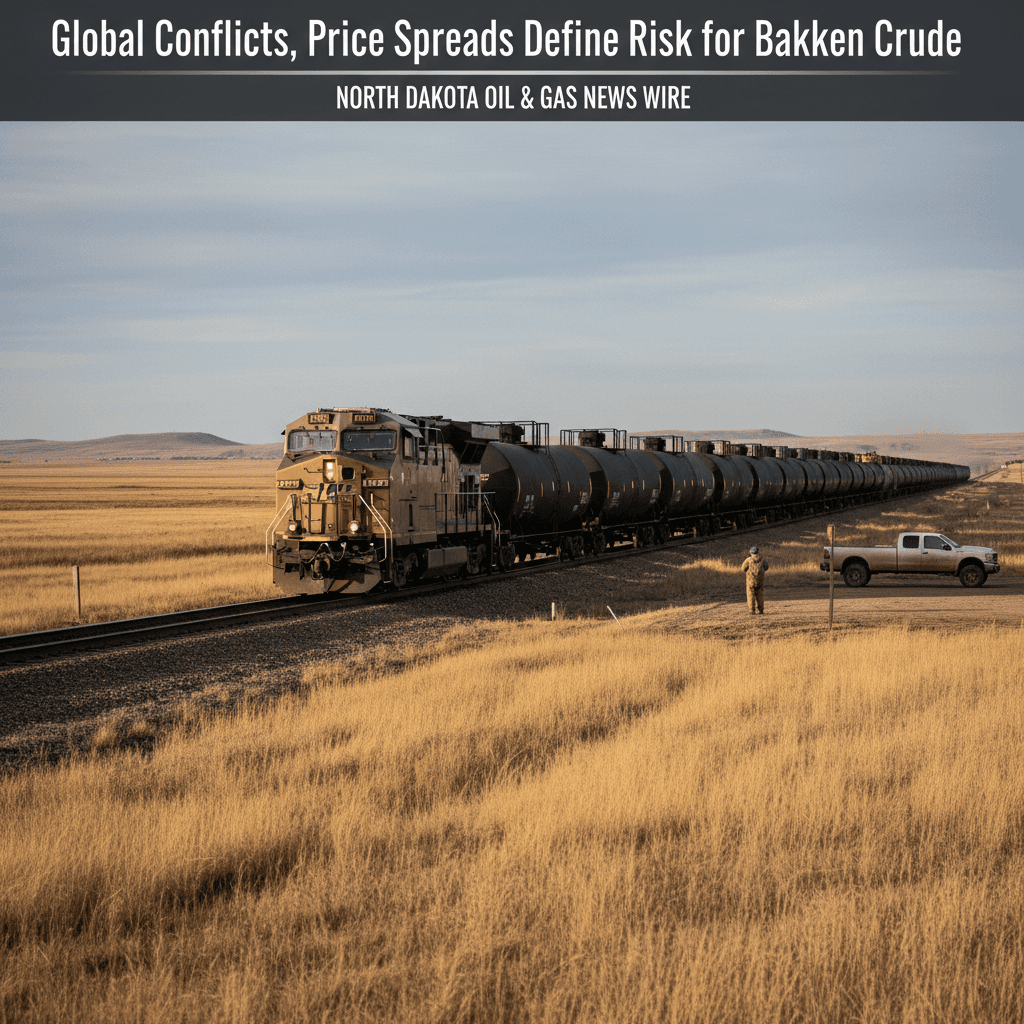
Global Conflicts, Price Spreads Define Risk for Bakken Crude
Houthi attacks on Saudi infrastructure and widening Brent-WTI differential create a volatile backdrop for North Dakota oil prices and exports.
Geopolitical tensions in the Middle East and Central Asia are injecting volatility into global energy markets, creating a complex price and risk environment for Bakken crude producers. The primary supply narrative this week centers on the Saudi-Houthi conflict, according to OilPrice.com.
Yemeni militias have extended strikes to Saudi Arabia's Shaybah oilfield, raising risks that the kingdom could be forced to shut in some production. This ongoing conflict is supporting global benchmark prices, with ICE Brent crude trading at $108 per barrel on Tuesday, October 20, 2026. Critically for North Dakota operators, the Brent-WTI spread has widened to $5 per barrel, according to OilPrice.com.
Simultaneously, the global liquefied natural gas (LNG) market is seeing a new war premium. Asian LNG prices have soared to their highest since December 2022, with the Japan Korea Marker (JKM) above $30 per MMBtu. Attacks on shipping, including the first Houthi strike on an LNG carrier near Yemen, are adding to the risk. Europe's LNG imports have averaged 175,000 tonnes over the past 30 days, up 9.5% from the five-year seasonal average, as the continent's storage builds have stalled with stocks below 75% capacity, OilPrice.com reported.
These developments underscore the global nature of energy price linkages. While Bakken production is domestically focused, the $5 differential between the international Brent benchmark and the U.S. WTI benchmark directly impacts the netback for exported barrels. A wider spread can enhance the economics for Bakken crude moving to coastal refineries or export terminals.
Separately, U.S. diplomatic efforts in Central Asia, a region historically within Russia's sphere of influence, could have long-term implications for global energy flows. U.S. Secretary of State Marco Rubio led a business delegation to Uzbekistan on October 19, securing $12 billion in deals across various sectors, including energy infrastructure and mineral extraction, OilPrice.com reported. This push for influence comes as China's Prime Minister Li Qiang also visited Tashkent, highlighting a portfolio of nearly $60 billion in joint projects.
Meanwhile, the shadow of the U.S.-Iran war continues to loom. Russian Foreign Minister Sergei Lavrov met with Iranian officials on October 19, with talks focused on the "comprehensive strategic partnership" between the two nations, according to a Russian statement cited by OilPrice.com. While the U.S. administration has publicly questioned the level of Russian support for Iran, analysts note that military-technical cooperation, including intelligence sharing, has been a factor.
For Bakken operators and royalty owners, the confluence of these events points to a market supported by geopolitical risk but also exposed to sudden shifts. The premium on Brent crude and the stressed global gas market reinforce the value of secure North American production, even as the wide WTI discount presents a persistent challenge for wellhead economics.
Source
OilPrice.com reports from October 20, 2026.