WTI Crude--
Brent Crude--
Natural Gas--
ND Rig Count--
WTI Crude--
Brent Crude--
Natural Gas--
ND Rig Count--
Global Energy Roundup: Equinor Growth, Russia Strike, Eskom Reliability - Bakken Wire
Operator News

Global Energy Roundup: Equinor Growth, Russia Strike, Eskom Reliability

International developments on production targets, refinery security, and grid stability hold implications for Bakken market dynamics.

Bakken Wire Staff·🌅Afternoon Wire·

Equinor ASA has announced a target to increase its production by 150,000 barrels of oil equivalent per day (boed) by 2030, according to a report from Rigzone. The majority state-owned energy major plans to achieve this through 6-8 tieback projects offshore Norway each year. While the plan focuses on Norwegian offshore assets, such aggressive production growth targets from a major international operator can influence global supply expectations and investment strategies, factors watched closely by Bakken producers.

Separately, Russia's Moscow Oil Refinery was hit in a record air bombardment overnight, Rigzone reported. The attack by Ukrainian drones disrupted airport operations and forced the closure of several major roads in and around the capital. Attacks on refining infrastructure in key oil-producing regions contribute to global market volatility, affecting the price benchmarks against which Bakken crude is sold.

In South Africa, state-owned utility Eskom is reporting sustained improvements in grid reliability, according to Rigzone. The utility has recorded nearly 400 consecutive days without power interruptions since mid-May, even as winter demand escalates. Reliable grid power is a critical, though often overlooked, component of global industrial and economic stability. Improvements in major economies can support broader energy demand, indirectly benefiting oil-producing regions like the Bakken.

For Bakken operators and royalty owners, these international developments underscore the interconnected nature of the global oil market. Production targets from majors like Equinor factor into long-term supply forecasts, while geopolitical events affecting Russian infrastructure can cause immediate price fluctuations. Furthermore, economic stability in key regions, supported by reliable electricity, underpins the demand side of the equation. North Dakota's oil sector remains sensitive to these global supply, security, and demand signals.

Source

Rigzone reported on Equinor's production target, the Moscow refinery strike, and Eskom's grid reliability.
equinorrussiageopoliticsrefiningproduction targetsgrid reliabilityglobal oil market

Share this article

Related Articles

Operator News

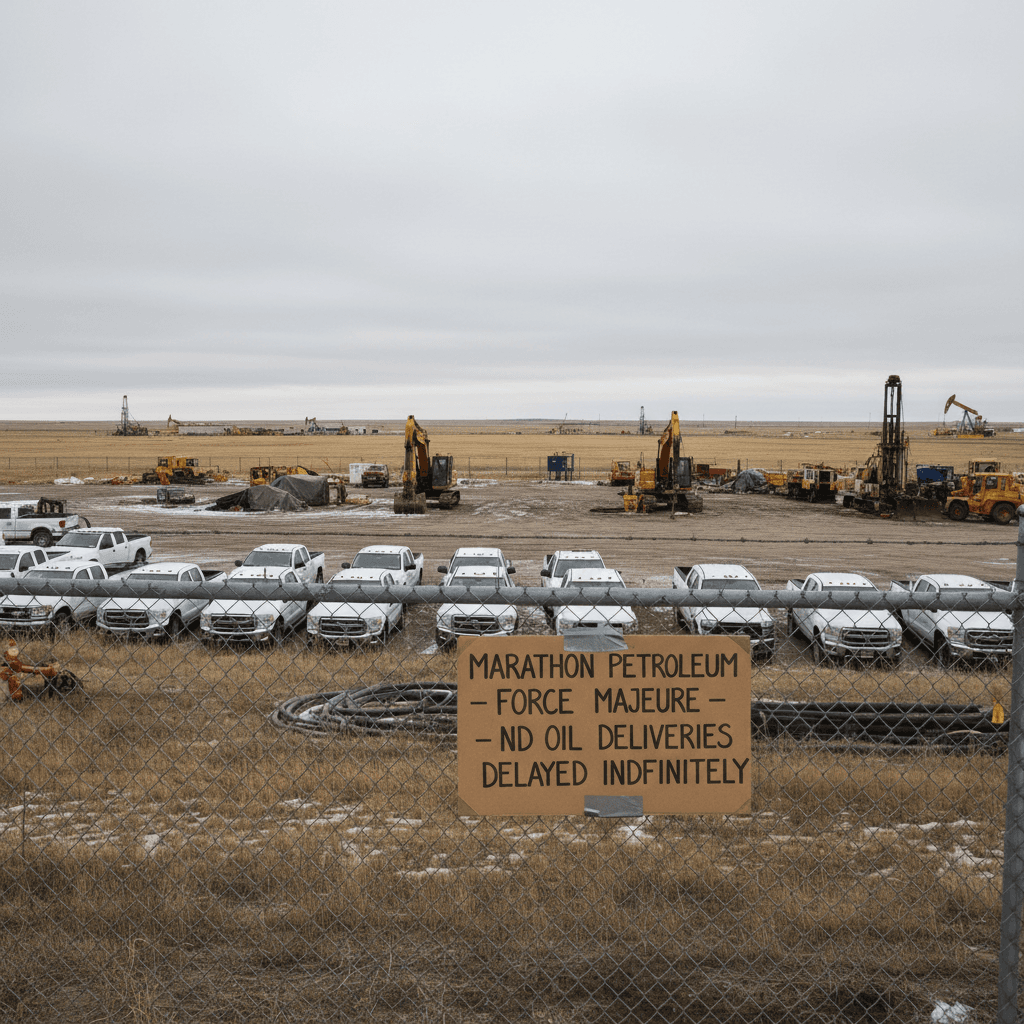
Marathon Petroleum Declares Force Majeure on ND Oil Deliveries

Marathon Petroleum has declared force majeure on oil pipeline deliveries from North Dakota, according to a report from Bing News. The announcement was made on November 19, 2026. The declaration follows what the source described as a flurry of crude contamination issues. Force majeure is a legal clause that frees parties from liability or obligation when an extraordinary event or circumstance occurs. For Bakken operators, this declaration creates immediate logistical and financial challenges. It can lead to involuntary well shut-ins if there is no alternative route to market for the affected crude. Even if production continues, operators may face significant price discounts for oil that must be rerouted to more expensive transportation methods, such as trucking or rail. The Bakken formation is a major oil-producing region where pipeline infrastructure is critical for moving crude to refineries and broader markets. Contamination issues can necessitate extensive cleaning of pipeline segments and storage...

☀️Morning Wire·Nov 21
Marathon Petroleum Declares Force Majeure on ND Oil Deliveries - Bakken Wire
Operator News

Marathon Petroleum Declares Force Majeure on ND Oil Deliveries

Marathon Petroleum Corp. has declared force majeure on North Dakota oil pipeline deliveries, according to a Bloomberg report. The announcement, made late Wednesday, November 18, comes after a series of crude contamination issues. The pipeline transporting Bakken crude has been operating intermittently since last week. The force majeure declaration is a legal provision invoked due to unforeseen circumstances that prevent a company from fulfilling its contracts. The immediate impact is a disruption to the flow of Bakken crude to market. For North Dakota producers and royalty owners, this creates logistical challenges and can lead to localized price volatility as barrels seek alternative routes, such as more expensive truck or rail transport. Pipeline operator Enbridge is involved in the situation, though specific details on the cause or remediation timeline were not provided in the report. Contamination events typically require flushing of the pipeline system and can lead to extended downtime. The...

🔆Midday Wire·Nov 20
Operator News

ExxonMobil Commits $12.5B to Offshore Guyana Gas Project

ExxonMobil has made a final investment decision to proceed with a major new $12.5-billion project offshore Guyana, according to Rigzone. The development, named Longtail, is the eighth project sanctioned in the Stabroek block and is described as the first primarily focused on gas and condensate. The announcement, reported on November 13, follows necessary government approvals. The Longtail project represents another multi-billion dollar capital commitment by the supermajor to its prolific offshore Guyana assets, which have become a cornerstone of its global production growth strategy. For operators in the Bakken, ExxonMobil's continued large-scale investments outside the lower 48 states underscore the competitive landscape for capital allocation. While ExxonMobil, through its subsidiary XTO Energy, remains a significant operator in the Williston Basin, major international projects often command larger portions of corporate capex budgets. The Bakken formation remains a vital source of U.S. oil supply, but it operates within a global portfolio for...

☀️Morning Wire·Nov 15