Global Energy Shifts, Fuel Supply Pact Create Uncertainty for Bakken
Long-term investment trends favor domestic energy security, while a new global supply agreement could impact near-term prices.
The strategic calculus for financing Bakken oil development is shifting as global energy security becomes a primary driver for capital allocation, according to an analysis from Rystad Energy. Simultaneously, the leaders of the U.S., China, and Russia have agreed to boost the global supply of fuels, Rigzone reported Thursday.
Rystad Energy's Global Energy Scenarios 2026, cited by OilPrice.com, suggests the energy crises of 2022 and the 2026 Strait of Hormuz disruption could lead to lasting structural change in global markets. The research firm indicates that a key outcome is the projected decline in import dependence among today's energy-importing countries, from approximately 40% to between 14% and 33%. This long-term trend toward domestic energy sources could reinforce the strategic value of stable, non-OPEC production regions like the Bakken.
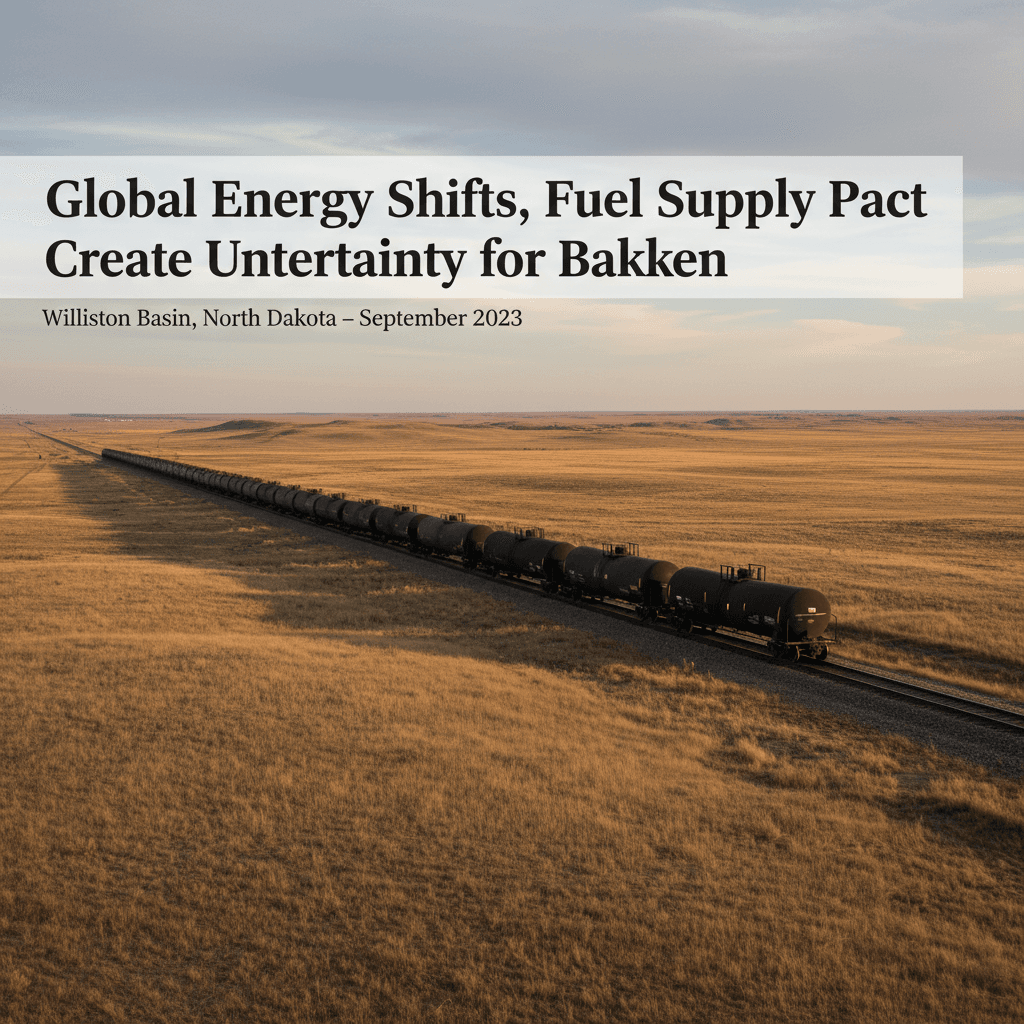
For Bakken operators and investors, the challenge is navigating between immediate market signals and long-term investment scenarios. The agreement between the U.S., China, and Russia to increase fuel supply, reported by Rigzone, introduces a new variable that could affect near-term oil prices and production economics in North Dakota. The details and implementation timeline of this pact were not specified.
According to the Rystad analysis, governments worldwide are enacting policies that could shape future energy demand. Since February 2026, 97 countries have introduced measures such as fuel tax reductions, subsidies, or price caps. The analysis notes that policies embedded in legislation are more likely to create lasting investment opportunities, a factor Bakken players must watch as U.S. energy policy evolves.
The broader energy transition also forms a backdrop for Bakken investment. Under Rystad's "Pragmatism" scenario, global solar generation grows by 9.1% annually, wind by 7.5%, and installed battery storage by 13%. Chinese battery-electric vehicle exports are on track to reach 6.84 million units in 2026, while EVs accounted for 33% of global vehicle sales this summer, according to OilPrice.com. These trends point to a complex long-term demand picture for oil.
Across Rystad's three scenarios, annual global energy investment is projected to average between $2.3 trillion and $3.8 trillion through 2050. The analysis highlights that net energy importers face the largest investment requirements as they seek to replace imported fuels. For the Bakken, a major domestic supply source, this global push for energy security could be a stabilizing factor, potentially attracting capital seeking geopolitical reliability.
The combined news of structural security-driven investment and a new international supply agreement creates a mixed outlook for North Dakota's oil industry, emphasizing the need for operators to balance short-term market moves with long-term strategic positioning.
Source
Analysis from Rystad Energy reported by OilPrice.com; news report from Rigzone.