WTI Crude--
Brent Crude--
Natural Gas--
ND Rig Count--
WTI Crude--
Brent Crude--
Natural Gas--
ND Rig Count--
Global Tensions Support $90 Oil, Bakken Price Floor - Bakken Wire
Global Markets

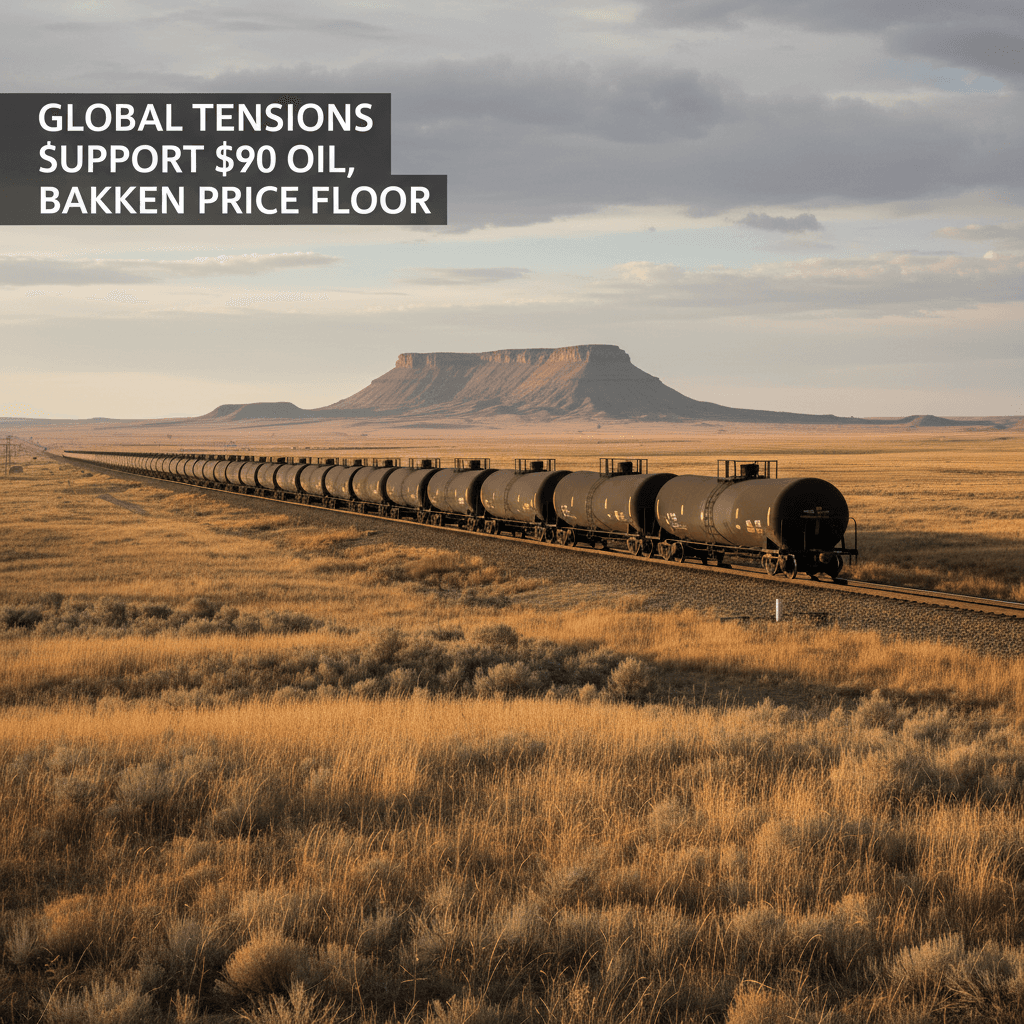
Global Tensions Support $90 Oil, Bakken Price Floor

Iran sanctions, refinery attacks, and supply chain disruptions create volatile but elevated global market for Bakken crude.

Bakken Wire Staff·🔆Midday Wire·

Global oil prices held near $90 per barrel on Friday despite major geopolitical developments, providing a stable price floor for North Dakota Bakken crude. According to OilPrice.com, the market shrugged off the Trump administration's announcement of the "toughest sanctions in history" against Iran, with uncertainty over shipping transits through the Strait of Hormuz keeping traders on edge.

The ongoing blockade of the Strait remains a key price driver. While Iran and Oman are negotiating a temporary shipping corridor, Tehran insists passage will stay blocked until U.S. sanctions are lifted, a blockade ends, and compensation is paid. This sustained disruption continues to underpin global benchmarks, directly benefiting the pricing of Bakken light sweet crude.

Further supply-side pressure came from a new Ukrainian drone attack on Russian refining capacity. Early Friday, Ukrainian forces struck the Slavneft-YANOS oil refinery in Yaroslavl, causing a fire. The facility, one of Russia's largest, can process about 300,000 barrels per day (bpd) of oil into fuels like gasoline and diesel. This attack follows a strike earlier this week on the 180,000 bpd Afipsky refinery, intensifying a campaign that has created a domestic fuel crisis in Russia since spring.

These repeated strikes on refining infrastructure, sometimes over 1,000 miles inside Russia, are aimed at crippling fuel supply to Russian military and domestic markets. The resulting reduction in global refined product output supports crack spreads, a positive signal for integrated operators and refiners that process Bakken crude.

Other global developments are shaping the energy landscape. Saudi Aramco has sold at least 4 million barrels of Arab Medium and Heavy crude to PetroChina for September loading outside the Hormuz strait, rerouting flows. Meanwhile, in Europe, diesel prices have surged over 70% since the Hormuz crisis began, compared to a 25% rise for crude, prompting six EU nations to seek talks on a new windfall profit tax.

For Bakken producers, the current environment presents a mixed outlook. Sustained high crude prices above $85 provide strong cash flow and support drilling budgets. However, the volatility driven by geopolitical events and the threat of windfall taxes in key export markets introduces uncertainty for long-term planning. The attacks on Russian refineries also highlight the continued global premium on secure energy supplies from stable regions like North America.

Source

According to reports from OilPrice.com published August 28, 2026.
crude oil pricesgeopoliticsglobal marketsrefiningbakken production

Share this article

Related Articles

The Midday Take - the U.S. announcement of what it calls the "toughest sanctions in history" against Iran. According to reporting from OilPrice.com, the market reaction has been muted, with prices holding near the $90 level for Brent as uncertainty over transit through the Strait of Hormuz persists.
Global Markets

the U.S. announcement of what it calls the "toughest sanctions in history" against Iran. According to reporting from OilPrice.com, the market reaction has been muted, with prices holding near the $90 level for Brent as uncertainty over transit through the Strait of Hormuz persists.

DAILY ENERGY BRIEFING Friday, August 28, 2026 1. Headlines Oil prices are edging lower midday Friday, with WTI trading at $83.03 (-0.6%) and Brent at $87.99 (-0.6%). The moves come despite a significant geopolitical headline: the U.S. announcement of what it calls the "toughest sanctions in history" against Iran. According to reporting from OilPrice.com, the market reaction has been muted, with prices holding near the $90 level for Brent as uncertainty over transit through the Strait of Hormuz persists. The weekly EIA inventory report, cited by Rigzone, shows U.S. crude stocks (excluding the SPR) rose slightly to 428.9 million barrels as of August 21. In other supply news, Goldman Sachs Group Inc. estimates, via Rigzone, that oil exports from the Persian Gulf have recovered to around two-thirds of their pre-war levels. Meanwhile, attacks on Russian refining infrastructure continue; Ukraine's General Staff claimed a drone strike sparked a fire at the...

🔆Midday Wire·Aug 28
The Morning Take - Energy Market Briefing
Global Markets

Energy Market Briefing

Energy Market Briefing Friday, August 28, 2026 1. Headlines Oil prices are modestly lower this morning, with WTI trading at $83.09 (-0.53%) and Brent at $88.17 (-0.4%). The Bakken differential to WTI stands at -$3.42. Natural gas is also down, priced at $2.86. This movement occurs despite fading hopes for a broader U.S.-Iran agreement, which had supported prices yesterday (Source 10). The dominant narrative today is the ongoing adaptation to the Iran war's disruption of Middle East oil flows. According to Goldman Sachs analysts cited by Bloomberg, oil volumes moving out of the Persian Gulf have recovered to about two-thirds of pre-war levels, with total Middle Eastern exports now at 15-16 million barrels per day (bpd) (Source 3). This rebound, facilitated by "dark crossings" and ship-to-ship transfers, is seen as a factor capping price upside. Conflicting reports exist on Strait of Hormuz traffic, however, with Reuters/Kpler data showing a slowdown...

☀️Morning Wire·Aug 28
Global Markets

China's Solar Sector Contraction May Ease Long-Term Pressure on Bakken Oil

A significant slowdown in China's solar power expansion could alter long-term global energy dynamics, with potential implications for fossil fuel demand and Bakken oil producers. According to a report from OilPrice.com, three of China's top solar market players—Jinko Solar, JA Solar Technology, and Tongwei—reported deepening losses over the first half of 2026. The downturn reflects weakening demand both domestically and abroad. New solar power capacity additions in China shrunk to 72.07 gigawatts (GW) in the first half of this year, compared with 212.2 GW a year earlier, according to the source. Part of this steep decline was attributed to a rush to connect projects before a June 1, 2025, electricity-pricing reform in China. "The full impact of policies requires a longer period for transmission and validation," JA Solar said in a statement quoted by Bloomberg. "In the short term, the actual effects of capacity reduction and consolidation have not yet...

☀️Morning Wire·Aug 28