WTI Crude--
Brent Crude--
Natural Gas--
ND Rig Count--
WTI Crude--
Brent Crude--
Natural Gas--
ND Rig Count--
National Workforce Grows, DOE Backs Nuclear, Norway Project Advances - Bakken Wire
Pipeline & Infrastructure

National Workforce Grows, DOE Backs Nuclear, Norway Project Advances

A roundup of energy industry developments with potential indirect implications for Bakken operations and investment.

Bakken Wire Staff·🔆Midday Wire·

The number of employees in the U.S. oil and gas extraction industry increased slightly from April to May, according to data from the U.S. Bureau of Labor Statistics cited by Rigzone. The report, published June 26, indicates a continuing, if modest, stabilization in industry employment.

In a separate development, the United States Department of Energy announced a conditional loan commitment of $17.5 billion to help five nuclear power projects procure long-lead items, Rigzone reported on June 26. The funding is intended to support the deployment of Westinghouse's advanced reactor technology.

Internationally, Var Energi and its partners have made a final investment decision to proceed with the Gjoa Subsea Projects on Norway's side of the North Sea, Rigzone reported June 26. The projects target approximately 76 million barrels of oil equivalent in gross proven and probable reserves.

For Bakken operators and service companies, the national workforce trend could signal a broader industry environment conducive to maintaining or slightly growing local operational headcount. A stable labor pool is critical for ongoing drilling and completion activities across the Williston Basin.

The DOE's move to back nuclear energy, while not directly related to oil and gas infrastructure, reflects a national policy emphasis on advancing all forms of energy development. Such large-scale federal investment in energy projects can influence the overall investment climate and capital availability for other energy sectors, including midstream.

The final investment decision on a major offshore project in Norway demonstrates continued global capital commitment to oil and gas development. This reinforces the ongoing international demand for hydrocarbons, which underpins the long-term market for Bakken crude. Major project approvals elsewhere can support investor confidence in the sector broadly.

Source

Rigzone (U.S. Bureau of Labor Statistics data, DOE announcement, Var Energi project decision)
employmentworkforcedepartment of energynuclearinvestmentnorth seabakken

Share this article

Related Articles

Pipeline & Infrastructure

Canada Moves to Fast-Track Oil Pipeline for Asian Markets

Canadian Prime Minister Mark Carney is invoking new powers to fast-track regulatory approval for a major new oil pipeline, according to a report from Rigzone. The move aims to expand Canada's access to Asian crude markets. While the specific pipeline project was not named in the report, the push for increased export capacity from Canada represents a significant shift in North American energy infrastructure policy. For Bakken operators, the development carries both competitive and logistical considerations. Increased pipeline capacity from Western Canada could influence crude pricing benchmarks across the continent, including the Bakken's own local price at Clearbrook, Minnesota. Greater volumes of Canadian crude reaching global markets can affect the supply-demand balance for similar light sweet crudes produced in the Williston Basin. Historically, pipeline constraints have limited Canadian crude to primarily U.S. Midwest markets, keeping a lid on prices. A new high-capacity outlet to Asia could alter that dynamic, potentially...

☀️Morning Wire·Oct 4
Canadian Prime Minister Fast-Tracks New Oil Pipeline for Asian Markets - Bakken Wire
Pipeline & Infrastructure

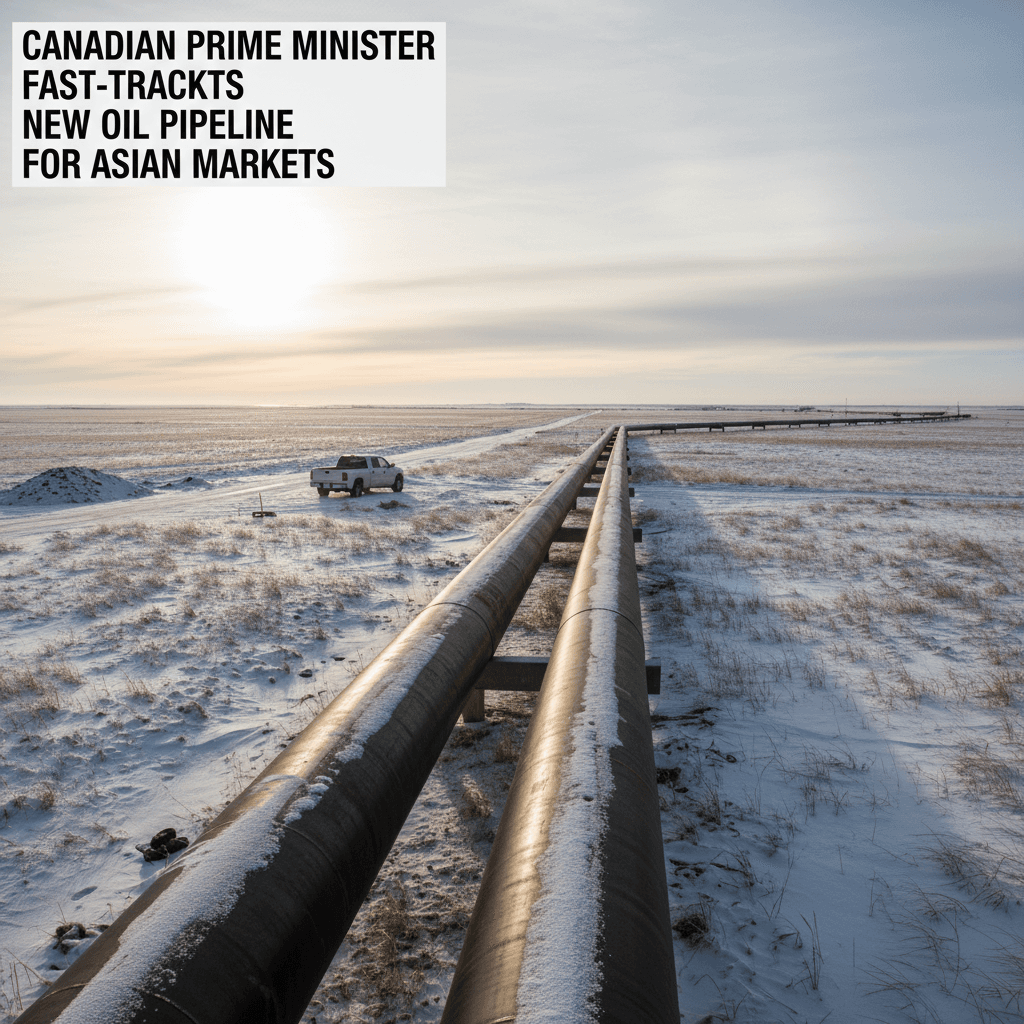
Canadian Prime Minister Fast-Tracks New Oil Pipeline for Asian Markets

Prime Minister Mark Carney has invoked new powers to expedite regulatory approval for a new, high-capacity oil pipeline, according to a report from Rigzone. The move aims to expand Canada's access to Asian markets. The development, reported on October 2, signals a renewed push by Canada to move its crude oil to West Coast export terminals. For Bakken operators in North Dakota, new Canadian pipeline capacity can influence regional market dynamics. Increased pipeline takeaway capacity from Western Canada can affect the flow of competing crudes, including Bakken barrels, through existing midcontinent pipeline systems. Changes in these flows can impact local basis differentials—the difference between the price of Bakken crude at the wellhead and the U.S. benchmark price. While the Rigzone report did not specify a pipeline route or capacity, any major new Canadian export conduit could alter crude oil logistics in North America. Bakken crude often moves to market via...

🔆Midday Wire·Oct 3
Pipeline & Infrastructure

Canada Moves to Fast-Track Oil Pipeline for Asian Market Access

Canadian Prime Minister Mark Carney is expediting regulatory approval for a new, high-capacity oil pipeline intended to expand Canada's access to Asian markets, according to a report from Rigzone. The report, published October 2, stated Carney has invoked new powers to fast-track the project. The development highlights ongoing efforts by North American producers to reach lucrative overseas markets beyond domestic and traditional refining hubs. Increased Canadian export capacity to Asia could influence global crude pricing benchmarks and shipping routes. For operators in North Dakota's Bakken formation, new Canadian pipeline capacity represents a shifting competitive landscape. Bakken crude, which primarily moves to market via pipelines, rail, and truck, often competes with Canadian heavy and light crude grades in the U.S. Midwest and Gulf Coast refining markets. Enhanced Canadian access to Asian buyers could, over time, alter flow patterns and competition for pipeline space within the continent. However, the specific impact on...

🌅Afternoon Wire·Oct 2