WTI Crude--
Brent Crude--
Natural Gas--
ND Rig Count--
WTI Crude--
Brent Crude--
Natural Gas--
ND Rig Count--
ND PSC Attorney Says Safety Not a Factor in State Pipeline Permitting - Bakken Wire
Pipeline & Infrastructure

ND PSC Attorney Says Safety Not a Factor in State Pipeline Permitting

Hearing on Summit Carbon Solutions permit appeal reveals state's limited regulatory role, raising questions for future Bakken infrastructure projects.

Bakken Wire Staff·☀️Morning Wire·

An attorney for North Dakota’s Public Service Commission argued Tuesday that the agency cannot consider public safety when issuing pipeline permits, according to a report from the North Dakota Monitor. The statement came during a court hearing over the permit for the Summit Carbon Solutions carbon dioxide pipeline.

Attorney Zachary Pelham, representing the PSC, stated that while the commission must consider public welfare, that does not include safety. “Welfare and safety are two distinct things,” Pelham said during the hearing. The case involves a lawsuit from two counties and a group of landowners seeking to rescind the permit and send the application back to the PSC for further review.

The plaintiffs' attorneys argued that a key flaw in the permit process was the commission's failure to consider evidence on the consequences of a pipeline rupture. Carbon dioxide is a hazardous material, and inhaling it in high concentrations can be fatal. Summit Carbon Solutions developed a plume dispersion model to assess the risks of a rupture, but the model was not made public or included in the PSC's permit record.

Attorney Randall Bakke, representing Burleigh County, said the model would help determine the safety risk posed by the carbon pipeline. Bakke noted that Summit provided the model to some individuals, including a Bismarck developer and an oil industry lobbyist, but did not provide it to attorneys representing stakeholders in the case.

The plume model was also cited as relevant for determining if pipeline setback ordinances passed by Burleigh and Emmons counties could be considered reasonable. These setbacks, which mandate a minimum distance between a pipeline and a residence, form another basis for the permit appeal.

In response, PSC attorney Pelham contended that pipeline safety is strictly a federal issue. When South Central Judicial District Court Judge Jackson Lofgren asked what role the PSC has in regulating a pipeline if it cannot direct its route or ensure its safety, Pelham answered that the commission can consider impacts to state-owned land, the environment, and wildlife. He said commissioners can ask questions about pipeline thickness and shut-off valves but have no authority over those areas.

Bakke argued that Pelham's position "simply defies logic." Attorneys for the landowners also argued the PSC did not properly address insurance liability concerns for landowners in the event of a rupture and that regulators did not adequately analyze the pipeline's financial assurance mechanisms. Judge Jackson Lofgren did not issue a ruling Tuesday.

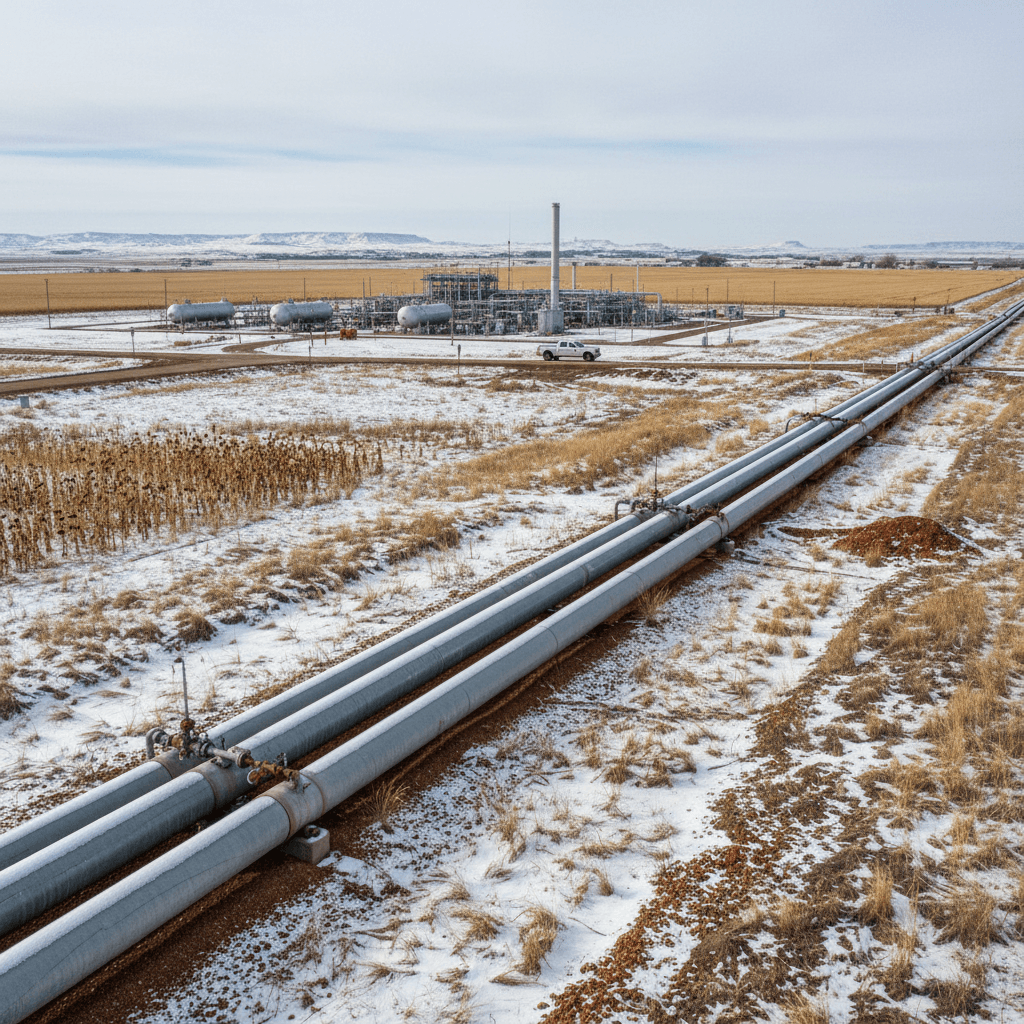
The hearing highlights the limited scope of state authority over pipeline routing and safety, a regulatory framework that applies to all pipelines crossing North Dakota, including those servicing the Bakken. The outcome could influence how future infrastructure projects for carbon capture, oil, or gas are permitted in the state.

Source

North Dakota Monitor
pipeline regulationpublic service commissionsummit carbon solutionscarbon captureinfrastructure permittingnorth dakotalegal

Share this article

Related Articles

Global Midstream Moves Highlight Strategic Shifts as Bakken Exports Compete - Bakken Wire
Pipeline & Infrastructure

Global Midstream Moves Highlight Strategic Shifts as Bakken Exports Compete

International midstream and refining developments reported this week highlight the complex global market in which Bakken crude competes for buyers and favorable transport routes. In Australia, Buru Energy said it plans to build a mini-refinery to supply the Kimberley region, according to Rigzone. The project is part of a new sales model for volumes from the Ungani field in the Canning Basin. While not directly related to North Dakota, such small-scale, localized refining projects represent a global trend toward securing regional fuel supply chains, a contrast to the Bakken's primary role as an exporter of light sweet crude to larger, distant refineries. Separately, the Dangote Group has offered East African countries a 30 percent equity stake in a giant refinery planned for the region, Rigzone reported, citing a Kenyan presidential adviser. The development of major new refining capacity in Africa could alter long-term crude flow patterns and competition for market...

☀️Morning Wire·Aug 22
Global Midstream News Highlights Refinery Plans, Shipping Risks - Bakken Wire
Pipeline & Infrastructure

Global Midstream News Highlights Refinery Plans, Shipping Risks

International midstream and refining developments reported Friday highlight the global context for North Dakota's oil exports, with new projects emerging and persistent shipping risks affecting crude flows. In Australia, Buru Energy said it plans to build a mini-refinery to supply the Kimberley region, according to Rigzone. The project is part of a new sales model for volumes from the Ungani field in the Canning Basin. While a small-scale project, it reflects a broader industry trend toward localized refining to capture value from stranded or marginal resources. Separately, the Dangote Group has offered East African countries a 30 percent equity stake in a giant refinery planned for the region, Rigzone reported, citing a Kenyan presidential adviser. This major infrastructure development aims to serve the East African market, potentially altering long-term refined product trade flows. Meanwhile, shipping disruptions continue to pose risks to global crude movements. Various tankers, including from the Sinokor...

🌅Afternoon Wire·Aug 21
Global Tensions Lift Oil Near $94; Mid-East Export Routes Shift - Bakken Wire
Pipeline & Infrastructure

Global Tensions Lift Oil Near $94; Mid-East Export Routes Shift

Global oil prices climbed to a one-month high near $94 per barrel this week as new U.S. threats against Iran raised fears of a prolonged conflict, according to Rigzone. The increase in geopolitical risk provides underlying support for Bakken crude prices, which are benchmarked against global markers. In response to security threats, Saudi Arabia is altering its crude export logistics. Shipowners, including Sinokor Group, are helping shuttle Saudi oil north to evade Houthi militants targeting exports via the Bab el Mandeb chokepoint in the southern Red Sea, Rigzone reported. This rerouting underscores ongoing volatility in key global shipping lanes that can affect crude flow and pricing. Meanwhile, Norway's natural gas production rose for a second consecutive month in July, with preliminary figures showing output of about 12.38 billion cubic feet per day, Rigzone reported. As a major supplier to Europe, sustained production from Norway helps balance global gas markets, indirectly...

🔆Midday Wire·Aug 21