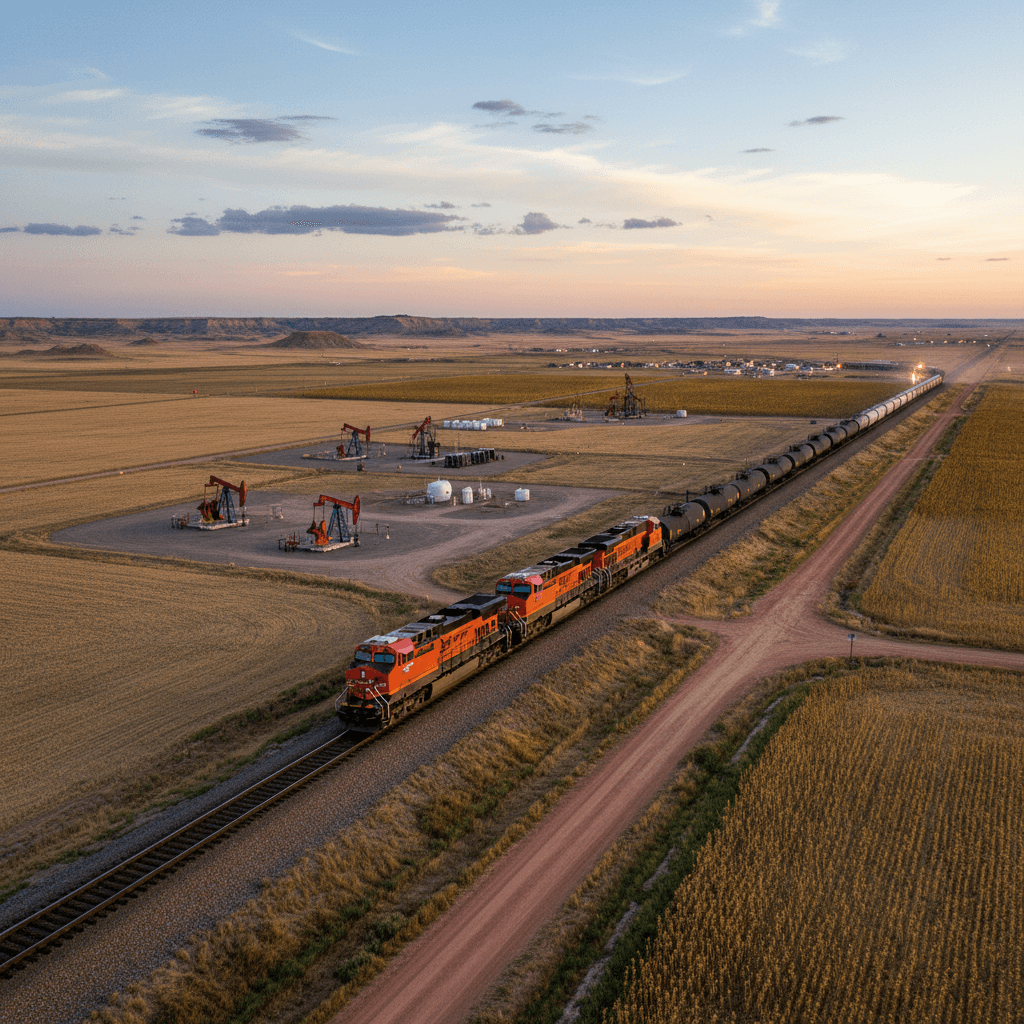
North Dakota Marks 75 Years Since Oil Discovery, Industry Faces Global Tech Shifts
The anniversary of the 1951 Clarence Iverson #1 well spotlights the state's transformation as global energy dynamics evolve.
The North Dakota oil industry this month marks the 75th anniversary of the discovery that launched it, even as operators worldwide navigate significant technological and economic shifts in the energy sector. The milestone traces back to April 4, 1951, when the Clarence Iverson #1 well struck oil near Tioga, according to a column in the Inforum.
That discovery sparked a transformation for the state. Today, North Dakota produces more than a million barrels of oil every day, a milestone it reaches daily by 8 p.m., according to Lynn Helms, director of the Department of Mineral Resources. Helms contrasted this with 1951, when it took the industry 18 months to produce its first 1 million barrels, calling the technological leap the difference "between a Model T and the space shuttle."
The industry's economic impact is substantial, supporting roughly 63,000 jobs and generating nearly $50 billion in annual economic impact for North Dakota, Inforum reported. More than $4 billion flows back each year in taxes, fees, and royalties, funding state and local services. Industry leaders emphasize the social impact, noting the reversal of decades of population decline. "We have flipped the age of North Dakotans to being one of the oldest states to being one of the youngest states," said North Dakota Petroleum Council President Ron Ness.
The oil is produced from the Williston Basin, a geological area covering much of North Dakota and extending into Canada, South Dakota, and Montana, according to a Bing News summary.
Globally, other energy sectors are seeing pivotal developments that could influence long-term markets and competition. According to a report from OilPrice.com, new nuclear power projects remain extremely expensive. A recently announced small modular reactor (SMR) project, a partnership between GE Hitachi and the Tennessee Valley Authority, is reported to cost $5.4 billion, or $18 million per megawatt.
Simultaneously, breakthroughs in perovskite solar technology could dramatically boost efficiency and disrupt traditional electricity markets if durability challenges are solved, OilPrice.com noted. In the realm of artificial intelligence, China is gaining a cost edge by offering significantly cheaper computing power, which could pressure U.S. firms on pricing and energy consumption dynamics.
For North Dakota, the anniversary underscores an industry that provides stability and opportunity. "It’s about the ability of North Dakotans to have an opportunity to live and work in North Dakota," Ness said. Geologist and NESET President Kathy Neset highlighted the state's youth as a key resource for the industry's technologically advanced future.
Source
According to *Inforum*, *OilPrice.com*, and *Bing News*.