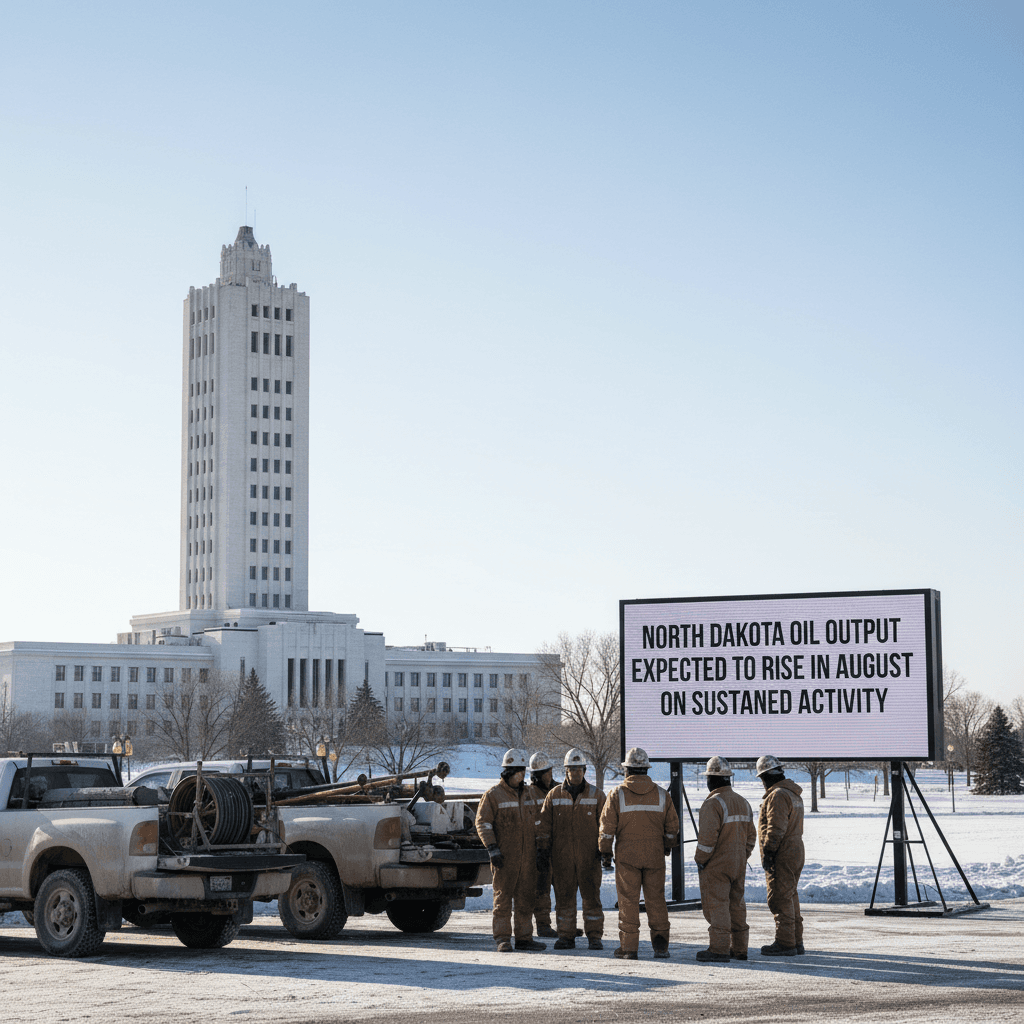
North Dakota Oil Output Expected to Rise in August on Sustained Activity
State regulators cite steady rig count, strong workover activity, and robust pricing as production momentum builds.
North Dakota crude oil production is expected to have climbed in August and maintain momentum in the following months, according to state regulators. Sustained drilling activity and robust crude prices are supporting output across the state, the Department of Mineral Resources said.
“Given activity levels and pricing, I suspect August will be a stronger month versus July,” Justin Kringstad, executive director of the North Dakota Pipeline Authority, told reporters during a monthly press briefing. Output in the United States’ third-largest oil-producing state rose marginally by 1,846 barrels per day to reach an average of 1.157 million bpd in July, according to the latest available production data.
The state’s active rig count stood at 34 in September, unchanged from August. North Dakota also recorded nine active hydraulic fracturing crews and a record 20,072 producing wells in July. Gunther Harms, a treating plant manager at the Department of Mineral Resources, said rig additions have leveled off following a late-summer increase, with operators that planned expansion programs for the second half of the year largely having deployed their equipment.
Most newly deployed rigs were reactivated from idle status within North Dakota or moved into the state from neighboring Montana, Harms said. State regulators also noted strong activity among workover rigs across western North Dakota. The elevated level of servicing activity suggests additional wells could be brought online in the coming months. “Operators are moving on these wells quicker and trying to get them on production as well,” Harms added.
Pricing remains a key factor. US crude futures for March delivery, a benchmark often watched by producers, were trading near $82 a barrel, compared with front-month prices of $95.78 a barrel at the time of the briefing. While producers continue to expect oil prices to remain relatively strong, Kringstad said forecasting crude prices remains difficult.
From a state budgeting perspective, North Dakota has left its production forecast unchanged despite July output exceeding the state’s forecast of 1.1 million bpd, Kringstad said. The ongoing geopolitical conflict involving Iran has been cited as a factor supporting higher crude prices, which in turn supports Bakken operator economics and state tax revenue.
In a separate industry development, Imperial Oil Ltd., a major Canadian integrated producer, came out against Alberta separatism, according to a Rigzone report. While not a direct Bakken operator, such political stability in the neighboring Canadian energy sector can influence cross-border investment and market dynamics relevant to North Dakota producers.
Source
North Dakota Department of Mineral Resources briefing as reported by Bing News (September 21, 2026); Bing News summary on production and geopolitics (September 21, 2026); Rigzone report on Imperial Oil (September 23, 2026)