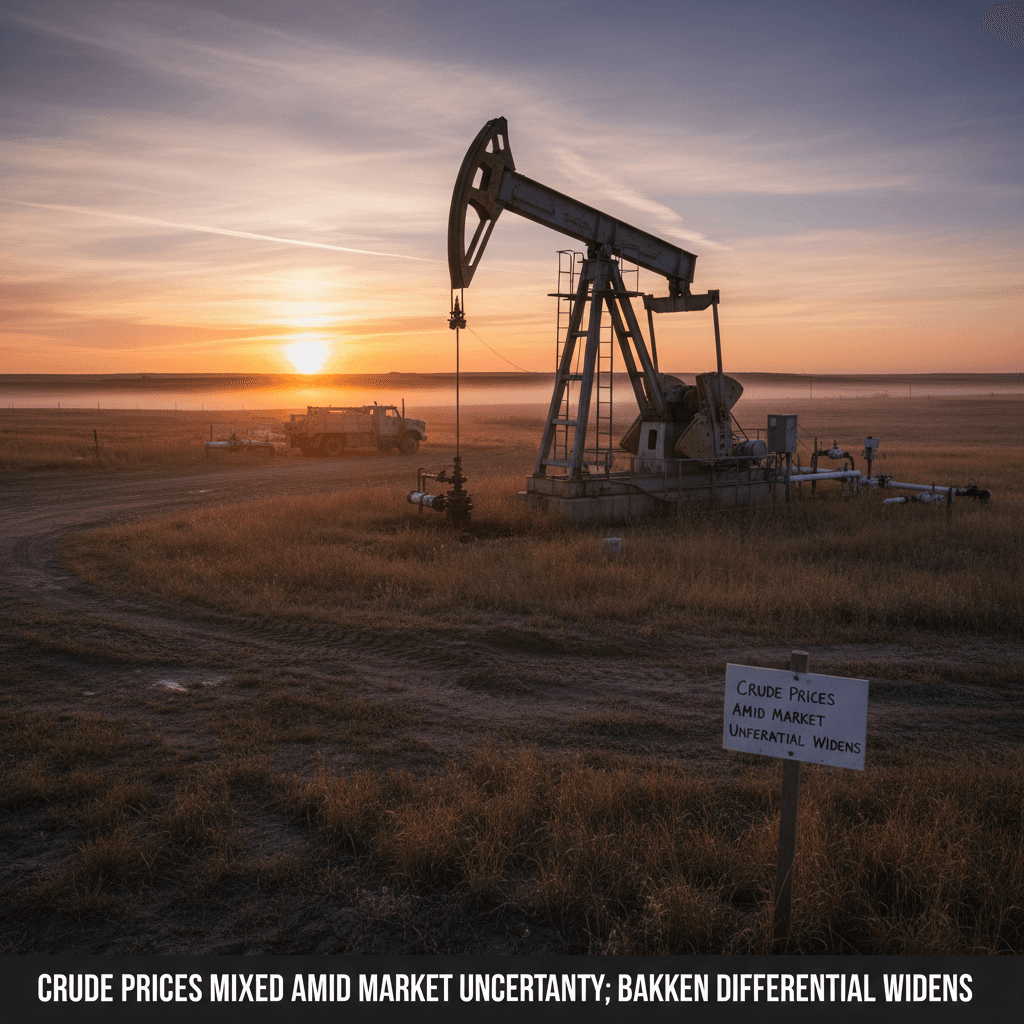
Oil Plunges Over 5% Amid Global Demand Fears, Bakken Differential Holds
WTI and Brent crude prices tumble sharply as concerns over Chinese industrial demand and Middle East supply disruptions create market volatility.
Crude oil prices experienced a steep selloff on Tuesday, with both major benchmarks falling more than five percent. West Texas Intermediate (WTI) crude was trading at $75.96 per barrel, down $4.38 (-5.45%), while Brent crude fell to $79.40, a drop of $4.37 (-5.22%), according to live price data. The price for Bakken crude at the wellhead was trading at a discount of $3.42 per barrel versus WTI.
The sharp decline appears linked to growing concerns over weakening industrial demand in China, a major global oil consumer. According to a report from OilPrice.com, iron ore prices hit a one-year low as a construction slump and soft steel demand in China deepened. Analysts at UBS noted that fundamentals for the steelmaking material are deteriorating, with supply lifting while demand remains soft, reinforcing expectations for a growing surplus. This signals potential weakness in broader industrial and manufacturing activity, which weighs on oil demand forecasts.
Simultaneously, supply chain disruptions from the ongoing Middle East conflict continue to reroute global crude flows. A separate OilPrice.com report detailed that India's Hindustan Petroleum Corporation Limited (HPCL) bought 2 million barrels of Nigerian crude to avoid the chokepoint at the Strait of Hormuz. HPCL's managing director stated the refiner "hardly got anything" from its Middle East term contracts in the first quarter because cargoes were trapped. This has forced major importers like India to seek more distant supplies from West Africa and South America, adding complexity and cost to global trade flows.
For Bakken operators, the immediate impact is a lower realized price. With WTI near $76 and the local differential holding at -$3.42, wellhead prices are pressured. However, the sustained global volatility and rerouting of supplies underscore the value of stable, domestic production from basins like the Bakken, which is insulated from maritime chokepoint risks.
In other markets, natural gas traded lower at $2.67, down $0.11. Despite the drop in crude, U.S. retail gasoline prices could be heading higher. Patrick De Haan, Head of Petroleum Analysis at GasBuddy, warned that by later this week, the national average could reach its highest level ever recorded for this point in the calendar year, according to Rigzone. This disconnect between falling crude inputs and strong seasonal gasoline demand highlights refining margins and downstream market dynamics.
The day's price action reflects a market balancing bearish demand signals from Asia against persistent physical supply dislocations from the Middle East, creating heightened volatility for producers.
Source
Live Price Data, OilPrice.com (Iron Ore Prices Hit One-Year Low), OilPrice.com (India's HPCL Snaps Up Nigerian Crude), Rigzone (USA Gas Prices Could Hit Record This Week)