Oil Prices Dip Slightly as Global Demand Pressures Mount
WTI falls near $98, while Asian import bills surge due to Middle East crisis and high LNG costs.
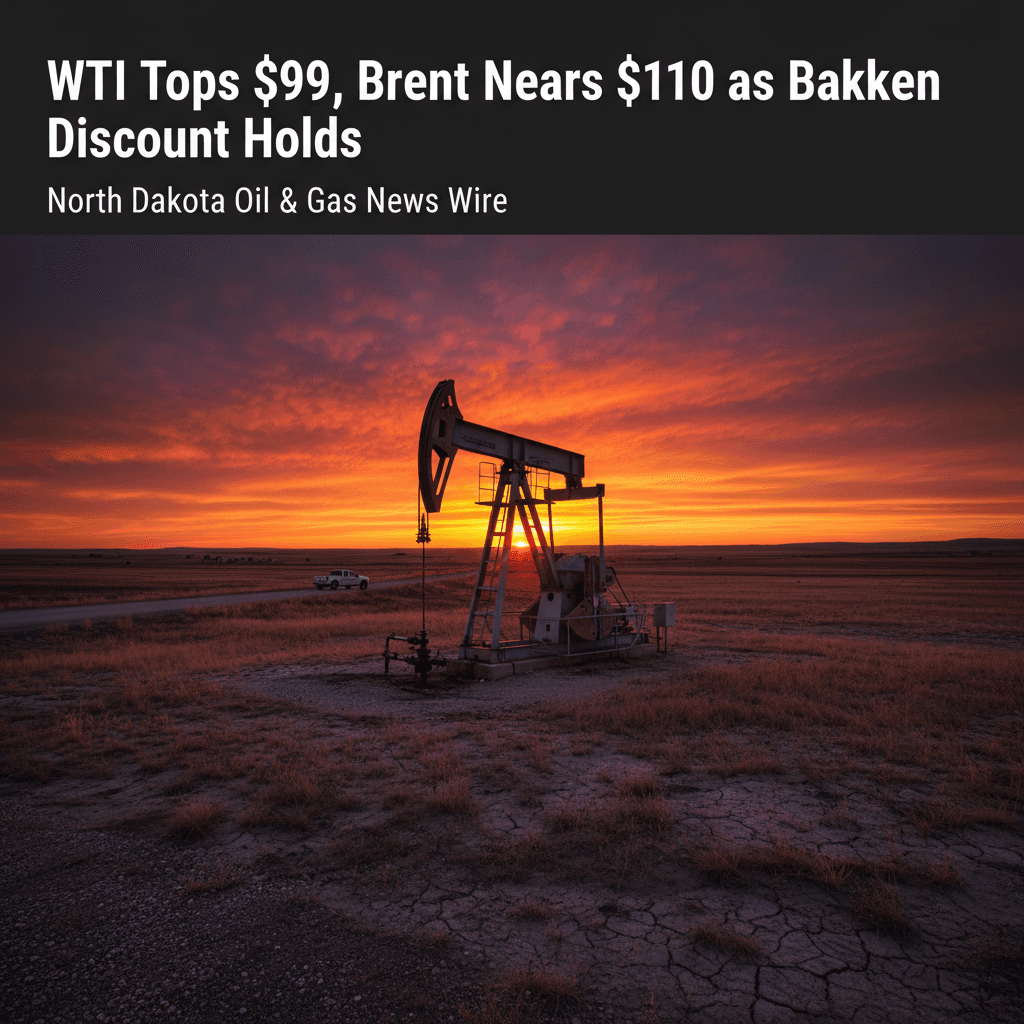
Global crude oil benchmarks edged lower on Monday, October 19, 2026, but remained at elevated levels that continue to strain major importers and support high-value production in the Bakken. West Texas Intermediate (WTI) crude traded at $98.20 per barrel, down 83 cents, while Brent crude was at $108.41, down $1.45, according to live price data. The Bakken crude differential held at a discount of $3.42 per barrel versus WTI.
The slight pullback comes amid stark evidence of the ongoing economic impact of high energy prices driven by the Middle East conflict. According to OilPrice.com, India's crude oil import bill soared 46 percent year-over-year to $15.4 billion in September alone. The Indian crude basket averaged $116.09 per barrel that month. For the April-September period, India's import bill hit $90.6 billion, up 46.3 percent from the same period last year, entirely due to higher prices.
The crisis has severely disrupted shipping, with freight rates from Saudi Arabia to India soaring three to four times since the Strait of Hormuz was closed in late February. OilPrice.com reported that India's import costs for October could exceed September's as its crude import price has averaged $121.25 a barrel so far this month.
Simultaneously, a global natural gas crunch is forcing a costly shift to coal power in Asia, further illustrating the strained energy landscape. Japan's average electricity prices surged over 25 percent week-on-week to $0.19 per kilowatt-hour on Monday, according to OilPrice.com. Soaring LNG prices, with December delivery into north-east Asia assessed at a four-year high of $29.30 per MMBtu, have pushed Japan to burn more coal. However, coal prices have also jumped, with Newcastle futures up 30 percent compared to pre-war levels.
For Bakken operators, the current price environment remains highly supportive. WTI near $98, even with the regional discount, translates to a Bakken price above $94 per barrel. This sustains strong cash flows and supports ongoing drilling and completion activity in the Williston Basin. The sustained high global prices, driven by supply risks and strong Asian demand, provide a favorable backdrop for North Dakota's oil production.
Natural gas prices also saw a modest increase Monday, trading at $3.15, up four cents. While this is below the levels causing distress in Asia and Europe, it contributes to operator economics in the gas-rich areas of the Bakken.
The key question for the market, as highlighted by a Rigzone analysis published today, is the direction of prices over the coming quarters. The current pressures from the Middle East conflict, soaring import costs in Asia, and competition for winter LNG supplies suggest continued volatility and price support in the near term.
Source
Live Price Data; OilPrice.com (Japan’s Electricity Prices Surge 25% as LNG and Coal Costs Soar, October 19, 2026); OilPrice.com (India's Crude Oil Import Bill Soars 46% as Middle East Crisis Drives Up Prices, October 19, 2026); Rigzone (What Will Happen to the Oil Price Over the Next Few Quarters?, October 19, 2026)