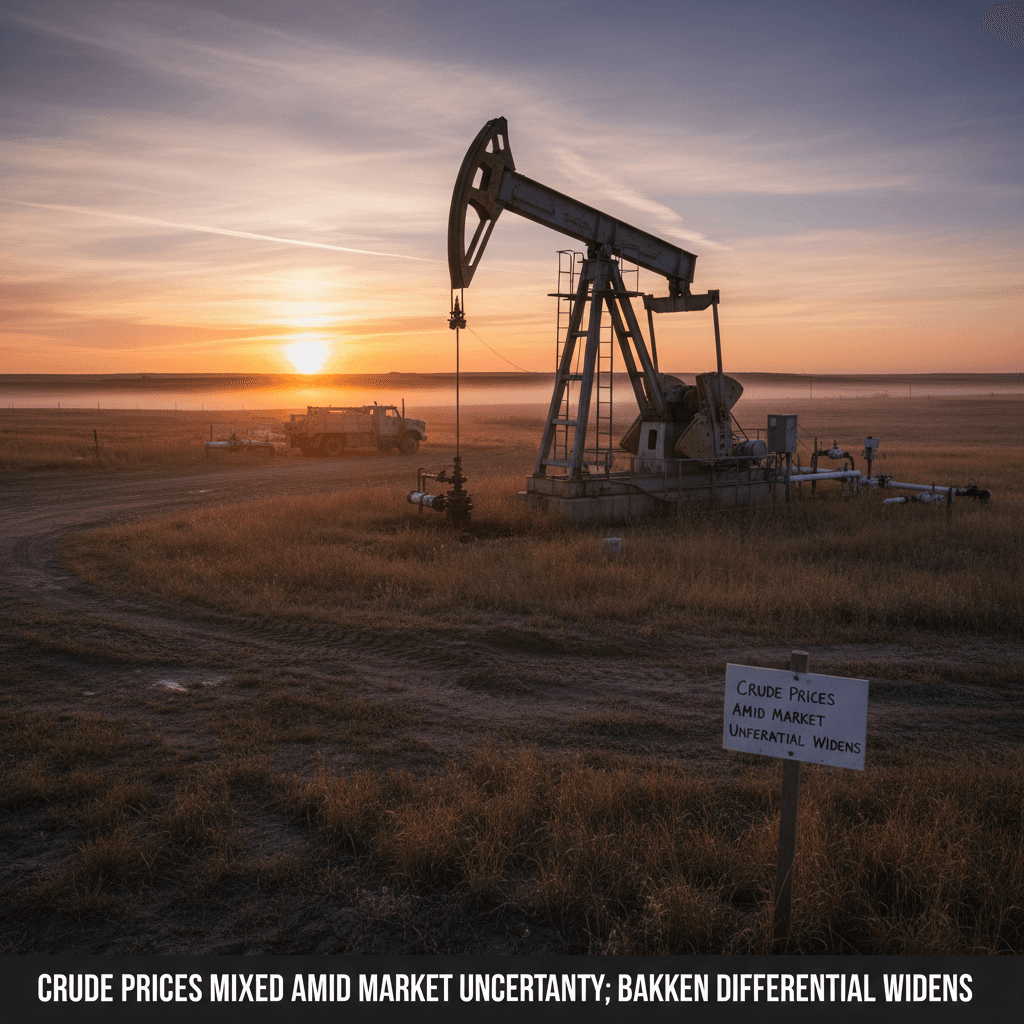
Oil Prices Drop Sharply, Bakken Differential Widens to -$3.42
WTI crude falls nearly 4% amid rising Gulf supplies, pressuring Bakken operators' realizations.
Oil prices fell sharply in midday trading Saturday, June 27, 2026, with West Texas Intermediate (WTI) crude trading at $69.23 per barrel, a drop of $2.69 (-3.74%). The international benchmark Brent crude traded at $72.60, down $2.90 (-3.84%). Natural gas prices saw a modest decline to $3.28.
The price drop was driven by concerns over rising crude supplies from the Persian Gulf. According to a report from Rigzone, increasing traffic through the Strait of Hormuz and higher exports from the Gulf region fueled oversupply concerns in the market. This surge in available supply is putting downward pressure on global benchmark prices.
For operators in North Dakota's Bakken formation, the decline is compounded by a widening price differential. The Bakken crude differential to WTI was recorded at -$3.42 per barrel. This means Bakken crude is currently priced approximately at $65.81 per barrel ($69.23 - $3.42).
A lower realized price directly impacts the cash flow and profitability of Bakken producers. The dual pressure of falling benchmark prices and a wider differential squeezes margins, potentially affecting drilling budgets and completion activity in the Williston Basin. The differential reflects local factors such as pipeline capacity and takeaway constraints relative to the Cushing, Oklahoma, WTI delivery point.
While the Rigzone report specifically cited rising Gulf supplies as the immediate catalyst, the broader market sentiment remains sensitive to global supply-and-demand balances. The price movement highlights the continued volatility in the crude market and the sensitivity of Bakken economics to both international events and local basis differentials.
Source
Live price data, Rigzone report published June 26, 2026.