WTI Crude--
Brent Crude--
Natural Gas--
ND Rig Count--
WTI Crude--
Brent Crude--
Natural Gas--
ND Rig Count--
Oil Prices Edge Higher as Bakken Operators Show Caution - Bakken Wire
Oil Prices

Oil Prices Edge Higher as Bakken Operators Show Caution

WTI nears $97, but North Dakota producers remain hesitant to significantly increase drilling activity despite the sustained price rally.

Bakken Wire Staff·🌅Afternoon Wire·

Oil prices posted modest gains on Friday, with West Texas Intermediate (WTI) crude trading at $96.84 per barrel, a 0.51% increase. The global benchmark Brent crude rose 1.1% to $103.71, according to live price data. The price for Bakken crude at the wellhead was discounted by $3.42 per barrel versus WTI. Natural gas prices fell to $3.03.

The price strength continues a rally largely driven by geopolitical tensions, but operators in North Dakota's Bakken formation are taking a measured approach to increasing activity. According to Reuters, U.S. oil operators in the state are cautious about ramping up drilling despite the sharp rise in oil prices caused by the Iran war, waiting to see if higher prices will last long enough to justify new investment.

Mark Bohrer, assistant director for the Oil and Gas Division of the North Dakota Industrial Commission, said most producers have stuck to budgets set at the end of last season, limiting any immediate drilling surge. "The output could increase in the short term, as more wells will be completed and drilling activity will pick up," Bohrer told Reuters.

The regulator reported that North Dakota had 26 active drilling rigs in May, unchanged from April. Thirteen hydraulic fracturing crews were also working in the state. While activity is steady, some additions are planned. Bohrer stated that Continental Resources, the state's second-largest producer, plans to add a drilling rig after laying one down earlier this year. He said other companies may add a few rigs if prices remain high.

The broader market is being supported by tightening inventories. According to Rigzone, U.S. crude oil stocks, excluding the Strategic Petroleum Reserve, fell by almost 8 million barrels week-on-week to 445.0 million barrels as of May 15, based on the latest Energy Information Administration data. This drawdown provides fundamental support for prices.

North Dakota's oil production was 1.142 million barrels per day in March, an increase of 9,000 bpd from February, according to the regulator. Production from the Bakken and Three Forks formations specifically rose by 11,000 bpd. Operators brought 49 new wells online during the month.

Bohrer expects the state's production to remain stable in the coming months, with a potential for slight short-term increases as the pace of well completions rises with more fracturing crews at work. The report noted that other large producers like ConocoPhillips, EOG Resources, and Diamondback Energy are primarily diverting resources to drill or expand wells in the Permian Basin to capitalize on the price environment.

The benchmark WTI contract has increased 44.1% in value since the start of the Iran war in late February, settling at $96.60 on Friday in the Reuters report. For Bakken operators, the sustained high prices present an opportunity, but the prevailing strategy remains one of capital discipline and measured response.

Source

Live Price Data, Reuters via Bing News, Rigzone

oil priceswtibrentbakken differentialdrillingproductionnorth dakotainventories

Share this article

Related Articles

Oil Prices Steady as Market Awaits OPEC+ Decision - Bakken Wire
Oil Prices

Oil Prices Steady as Market Awaits OPEC+ Decision

Front-month WTI crude oil futures were unchanged in Sunday trading, holding at $83.41 per barrel, according to live price data. The global benchmark, Brent crude, was also flat at $89.95 per barrel. The price stability comes as traders await a key decision from the OPEC+ alliance of oil-producing nations. The group is scheduled to meet virtually on December 4 to discuss production policy for 2027. Market analysts widely expect the meeting to focus on whether to extend or deepen existing output cuts into the new year, a move aimed at supporting prices. For Bakken operators, the local price benchmark is the Bakken differential, which represents the price difference between Bakken crude at the Clearbrook, Minnesota hub and the U.S. benchmark, WTI. On Sunday, that differential was reported at a discount of $3.42 per barrel. This means Bakken crude is effectively priced at approximately $79.99 per barrel. A steady WTI price...

🌅Afternoon Wire·Nov 22
WTI Climbs Above $83, Bakken Differential Holds Steady at -$3.42 - Bakken Wire
Oil Prices

WTI Climbs Above $83, Bakken Differential Holds Steady at -$3.42

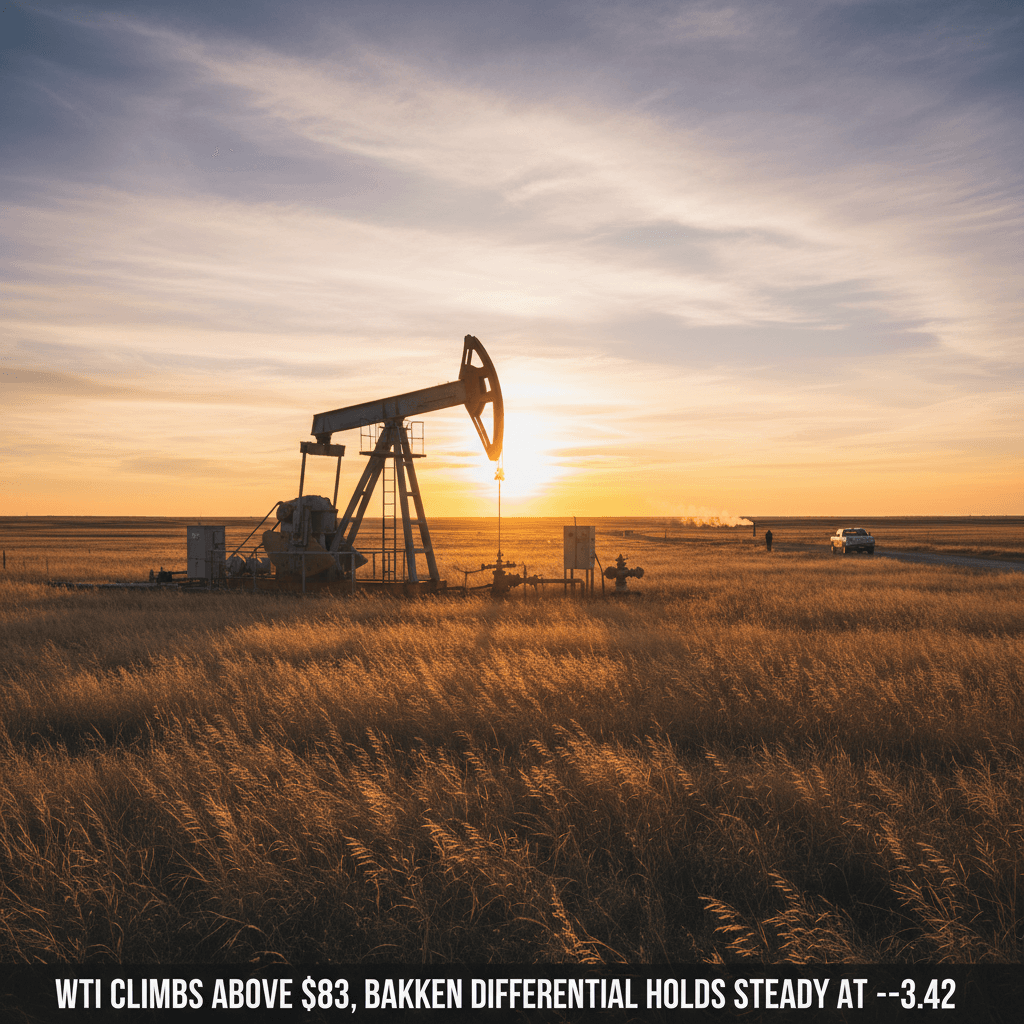
West Texas Intermediate crude oil traded at $83.41 per barrel on Sunday, gaining $0.97 or 1.18% for the session. The global benchmark Brent crude rose to $89.95, a more modest increase of $0.51. The price for Bakken crude, a key indicator for North Dakota producers, held at a differential of $3.42 per barrel below WTI. Natural gas prices also saw upward movement, with the commodity trading at $3.75 per MMBtu, a gain of $0.07. This near-term strength comes despite a longer-term bearish outlook from federal forecasters. According to Rigzone, the U.S. Energy Information Administration projected in its latest short-term energy outlook that the U.S. Henry Hub spot price will drop in both 2026 and 2027. The EIA's outlook, published November 20, suggests downward pressure on natural gas prices in the coming years, contrasting with the current session's gains. For Bakken operators, the current price environment provides a stable revenue outlook....

🔆Midday Wire·Nov 22
WTI Climbs Above $83, Bakken Differential Holds Steady - Bakken Wire
Oil Prices

WTI Climbs Above $83, Bakken Differential Holds Steady

Front-month WTI crude oil futures rose 1.18% to settle at $83.41 per barrel on Sunday, November 22, while Brent crude gained 0.57% to $89.95. The benchmark Bakken differential was recorded at $-3.42 versus WTI. Natural gas prices also moved higher, adding $0.07 to $3.75 per MMBtu. The price increase comes despite bearish U.S. inventory data reported last week. According to Rigzone, commercial crude oil stocks, excluding the Strategic Petroleum Reserve, rose by over 3 million barrels week-on-week to 417.797 million barrels as of November 13. Typically, a larger-than-expected build in inventories places downward pressure on prices. The market's ability to absorb the inventory build and move higher may be linked to shifting global crude dynamics. Rigzone also reported that the "war premium" for USA sour crude grades has vanished, indicating changing supply perceptions that can influence the pricing landscape for all crudes, including the light sweet oil produced in the...

☀️Morning Wire·Nov 22