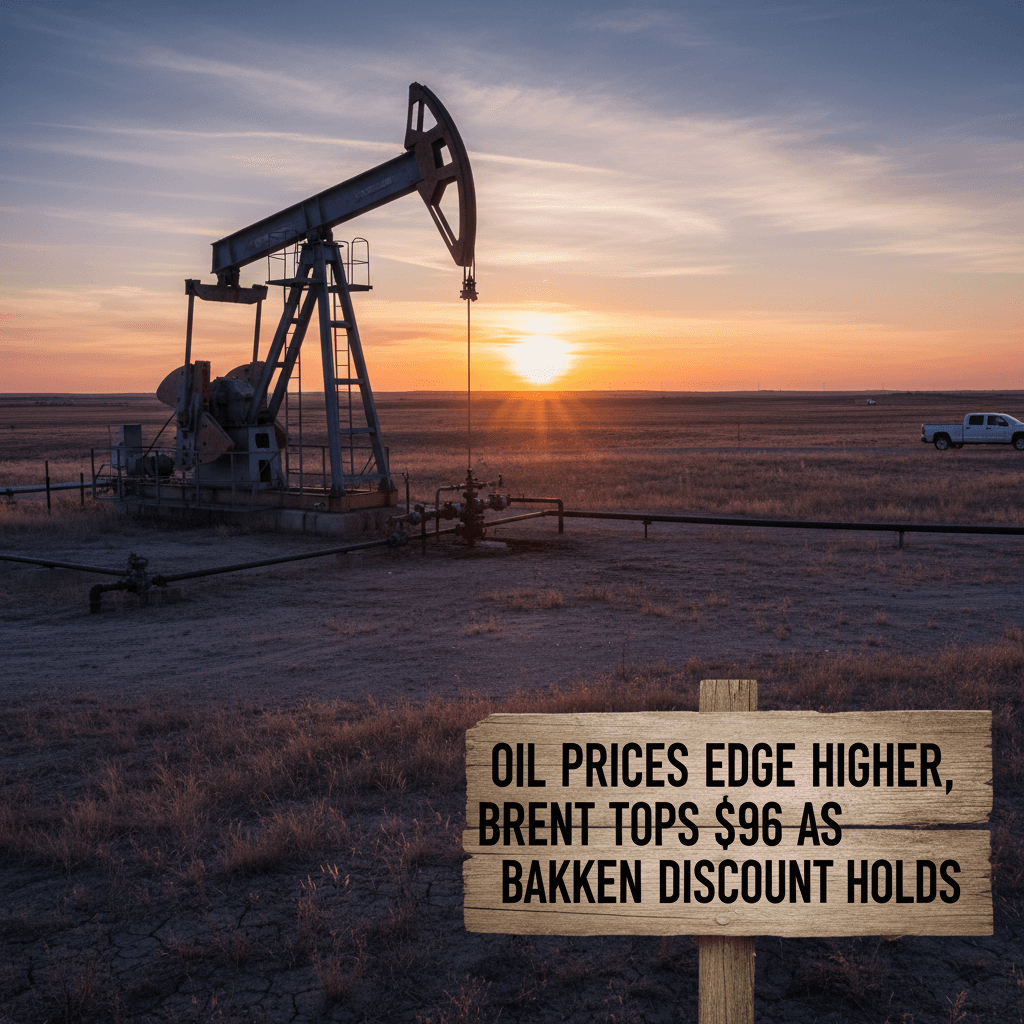
Oil Prices Edge Higher, Brent Tops $96 as Bakken Discount Holds
WTI gains modestly while global Brent benchmark rises more sharply; Bakken differential remains stable near $3.42 per barrel discount.
Oil prices posted modest gains in Saturday trading, with the global Brent benchmark climbing above $96 per barrel while U.S. West Texas Intermediate (WTI) saw a more subdued increase. The price movement provides steady, if unspectacular, support for Bakken Shale producers.
As of Saturday, September 5, 2026, front-month WTI crude futures settled at $91.48 per barrel, a gain of 18 cents or 0.2%. The international Brent crude benchmark rose more sharply, adding 76 cents to reach $96.28 per barrel, a 0.8% increase. The Bakken crude price differential to WTI was holding at a discount of $3.42 per barrel.
The stronger performance in Brent crude reflects ongoing geopolitical tensions and supply concerns in key global producing regions, which typically have a greater impact on the international benchmark. The steady rise in WTI indicates underlying market support, though its more muted gain suggests domestic factors are providing a counterbalance.
For operators in the North Dakota Bakken, the price environment translates to an effective wellhead price near $88.06 per barrel when accounting for the regional differential. This level continues to support active drilling and completion programs in the core of the play, though margins remain sensitive to operational costs.
In related energy markets, natural gas prices also saw an uptick, rising 6 cents to $2.98 per MMBtu. While not a primary driver for most Bakken operators, who are predominantly oil-focused, stronger gas prices can improve the economics of associated gas production and provide a modest revenue boost.
The current price stability is occurring amidst a backdrop of managed global supply. Market analysts point to ongoing production discipline from the OPEC+ alliance, which has maintained output cuts to prevent a surplus and support prices. This coordinated effort has helped establish a floor under the market despite concerns over global economic growth.
For Bakken producers, the sustained prices above $90 for WTI are critical for planning and capital allocation. The relatively narrow and stable Bakken differential is a positive sign for regional takeaway capacity and market access, ensuring a greater share of the headline price reaches producers. Operators will continue to monitor the spread closely, as pipeline and rail logistics directly impact netbacks.
The overall price picture suggests a balanced market heading into the autumn months, with sufficient revenue to maintain current activity levels in North Dakota's premier oil field. Any significant movement will likely hinge on upcoming inventory data, OPEC+ policy decisions, and broader macroeconomic trends.
Source
Live price data for WTI, Brent, Natural Gas, and Bakken Differential as of September 5, 2026.