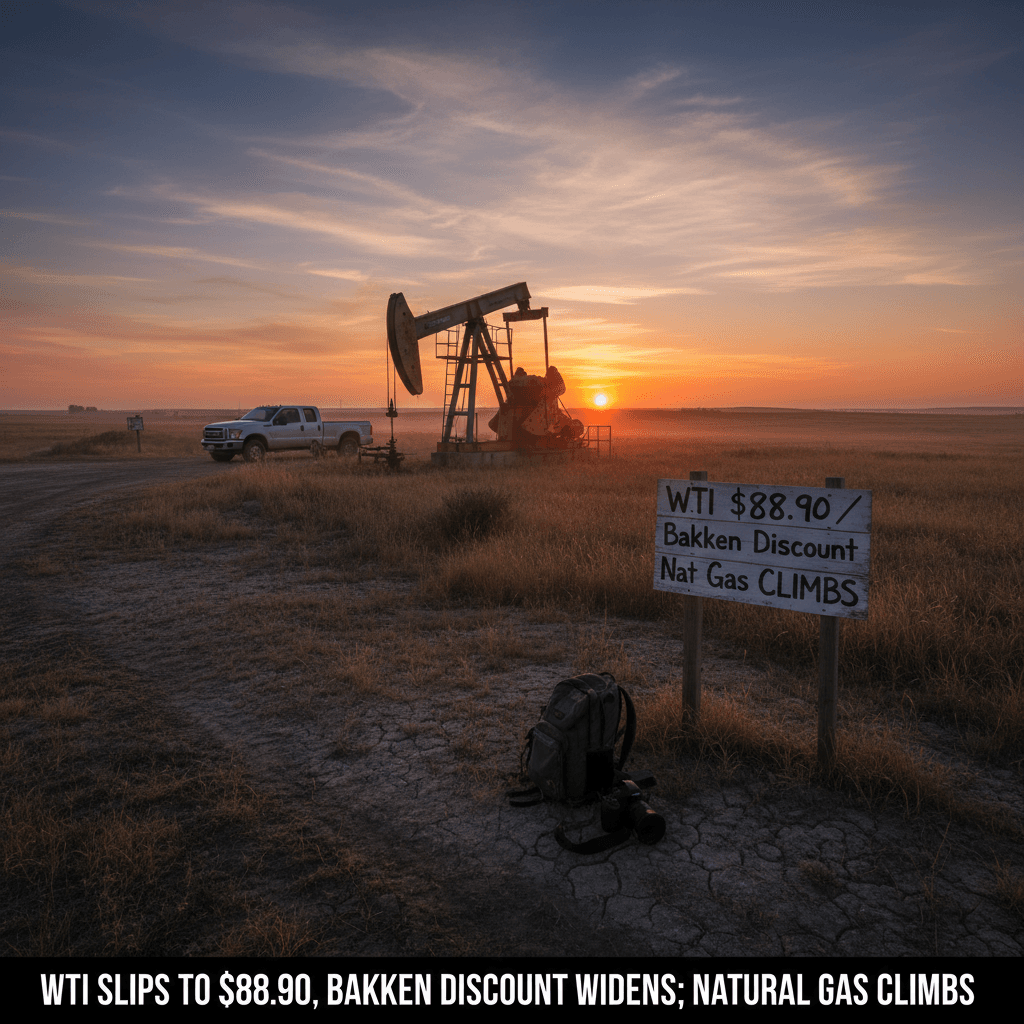
WTI Crude--
Brent Crude--
Natural Gas--
ND Rig Count--
WTI Crude--
Brent Crude--
Natural Gas--
ND Rig Count--
Oil Prices Edge Higher on Supply Risks, Falling U.S. Crude Stocks - Bakken Wire
Oil Prices

Oil Prices Edge Higher on Supply Risks, Falling U.S. Crude Stocks

WTI gains to near $80 as Bakken differential holds steady; global LNG market tightens on Mideast disruptions.

Bakken Wire Staff·☀️Morning Wire·

Crude oil prices rose modestly early Thursday, supported by a larger-than-expected draw in U.S. inventories and continued supply concerns in the Middle East affecting global energy markets. West Texas Intermediate (WTI) crude traded at $79.96 per barrel, up 0.45% on the day, according to live price data.

The U.S. Energy Information Administration reported a nearly 2 million barrel weekly draw in commercial crude oil stocks, excluding the Strategic Petroleum Reserve. Inventories stood at 409.7 million barrels as of July 10, according to Rigzone. The drawdown provided fundamental support for prices.

In the Bakken, the price differential for North Dakota light sweet crude versus the WTI benchmark was steady at -$3.42 per barrel. This relatively narrow discount indicates strong demand for Bakken crude, which is competitively priced and efficiently transported to refining markets.

Global supply concerns were highlighted by a significant disruption in liquefied natural gas (LNG) flows. According to OilPrice.com, Pakistan was forced to pay approximately $20.70 per MMBtu for a spot LNG cargo this week, its highest price in four years. The purchase was necessitated by the re-escalation of the Hormuz crisis, which has cut off cargoes from its primary supplier, Qatar. This underscores how geopolitical tensions in the Middle East continue to inject volatility and tightness into global energy markets, indirectly supporting oil prices.

On the natural gas front, the U.S. benchmark Henry Hub spot price was unchanged at $2.92 per MMBtu in early trading. However, the market outlook is strengthening. Rigzone reported that the U.S. Energy Information Administration has raised its Henry Hub price forecast for both 2026 and 2027 in its latest Short-Term Energy Outlook, signaling expectations for firmer prices ahead.

For Bakken operators, the current price environment remains supportive. WTI holding near $80, combined with a stable differential, provides solid cash flow for ongoing production and well maintenance. The tightening global LNG market, driven by Middle East supply disruptions, reinforces the strategic value of U.S. energy exports, including associated gas from the Bakken. The EIA's upward revision for future natural gas prices also offers a more optimistic revenue outlook for gas production in the region.

The market continues to balance robust U.S. production against inventory draws and persistent geopolitical risks, keeping prices in a tight range just below the $80 threshold for WTI.

Source

Live price data, OilPrice.com, Rigzone (EIA inventory report), Rigzone (EIA STEO forecast)
wtibrentbakken differentialcrude inventorylnghenry hubeiapakistan

Share this article

Related Articles

Oil Prices Steady as Bakken Discount Widens - Bakken Wire
Oil Prices

Oil Prices Steady as Bakken Discount Widens

Oil prices showed little movement in Sunday trading, with West Texas Intermediate (WTI) crude holding steady at $87.06 per barrel, according to live market data. The global benchmark, Brent crude, was also unchanged at $94.39. Natural gas prices were flat at $2.81 per MMBtu. For Bakken producers, the more critical figure is the regional price differential. Bakken crude at the Clearbrook, Minnesota, hub was trading at a discount of $3.42 per barrel below the WTI benchmark price. This spread is a direct determinant of the netback price received by North Dakota operators and directly impacts cash flow and drilling economics. The static price action follows a volatile week driven by mixed signals from global inventories and ongoing geopolitical tensions. Market analysts note that prices found a footing above $86 for WTI after U.S. government data showed a larger-than-expected drawdown in crude stockpiles last week, indicating robust demand. However, this was...

🌅Afternoon Wire·Aug 23
Oil Prices Edge Higher Midday as Bakken Discount Holds at $3.42 - Bakken Wire
Oil Prices

Oil Prices Edge Higher Midday as Bakken Discount Holds at $3.42

Oil prices posted modest gains in midday trading Sunday, with benchmark crudes holding near multi-week highs. West Texas Intermediate (WTI) crude was trading at $87.06 per barrel, a gain of $0.23 or 0.26%. The international benchmark Brent crude rose to $94.39, up $0.61 or 0.65%, according to live price data. Bakken crude priced at the Clearbrook, Minnesota, hub maintained a differential of negative $3.42 per barrel versus WTI. This places the effective price for Bakken barrels at approximately $83.64, factoring in the regional discount. Natural gas futures also saw upward movement, rising $0.05 to trade at $2.81 per million British thermal units. The midday price strength continues a trend of firming crude markets. Prices are being supported by a combination of sustained demand signals and ongoing supply discipline from major producing nations within the OPEC+ alliance. Geopolitical tensions in key oil-producing regions also continue to underpin a risk premium in...

🔆Midday Wire·Aug 23
WTI Holds Above $87 Amid Global Supply Concerns; Bakken Differential Widens - Bakken Wire
Oil Prices

WTI Holds Above $87 Amid Global Supply Concerns; Bakken Differential Widens

Oil prices edged higher on Sunday, with West Texas Intermediate (WTI) crude trading at $87.06 per barrel, a gain of 0.26% or $0.23, according to live market data. The global benchmark Brent crude rose 0.65% to $94.39, while natural gas prices increased by $0.05 to $2.81 per MMBtu. The Bakken crude differential, which measures the price of Bakken barrels delivered to Clearbrook, Minnesota, against WTI, was assessed at a discount of $3.42. This price spread is a key indicator of the competitiveness and market access for North Dakota's light sweet crude. Market support stems from tightening global crude supplies. According to a report from Rigzone, U.S. refiners are facing a looming supply drop from their biggest foreign crude supplier at a time of peak seasonal demand. While the source material did not specify the supplier, such a reduction in available imported crude typically increases competition for domestic barrels, including those...

☀️Morning Wire·Aug 23