WTI Crude--
Brent Crude--
Natural Gas--
ND Rig Count--
WTI Crude--
Brent Crude--
Natural Gas--
ND Rig Count--
Oil Prices Hold Steady Amid Geopolitical Uncertainty; Bakken Operators Remain Cautious - Bakken Wire
Oil Prices

Oil Prices Hold Steady Amid Geopolitical Uncertainty; Bakken Operators Remain Cautious

WTI crude holds at $96.60 as market weighs potential breakthrough in Iran conflict, while Bakken differential narrows.

Bakken Wire Staff·☀️Morning Wire·

Global oil markets opened the week in a holding pattern Monday morning, with front-month futures showing little movement after weekend reports of a potential diplomatic breakthrough in the U.S.-Iran conflict. West Texas Intermediate (WTI) crude was trading at $96.60 per barrel, unchanged from the previous session, while Brent crude held steady at $100.21, according to live price data.

The muted price action follows a significant rally in recent weeks driven by geopolitical tensions. Analysts pointed to weekend developments as a key factor in the stall. 'On late Saturday, there seemed to have been a breakthrough in the U.S.-Iran war,' Gaik June Goh, a senior oil market analyst at Sparta Commodities, told Rigzone. This potential de-escalation is tempering the risk premium that had buoyed prices.

For Bakken operators, the price for crude at the wellhead is reflected in the Bakken differential, which was quoted at a discount of $3.42 per barrel versus WTI on Monday morning. This narrower differential improves netbacks for North Dakota producers compared to wider spreads seen historically.

Despite the sustained higher price environment, operators in the state continue to exhibit caution regarding capital spending and drilling plans. According to a recent Reuters report, U.S. oil operators in North Dakota are moving cautiously on ramping up drilling despite a sharp rise in oil prices driven by the Iran war. Companies are reportedly waiting to see if higher prices will last long enough to justify significant increases in activity.

This hesitancy underscores a shift in industry discipline following previous boom-and-bust cycles. Many producers are prioritizing shareholder returns and debt reduction over aggressive volume growth, even with WTI prices flirting with the $100 mark. The current price stability, if it holds, may eventually translate into modest activity increases, but a rapid rig count surge is not widely anticipated.

Natural gas prices, often a secondary consideration for Bakken oil-focused operators, were quoted at $3.02 per barrel Monday. While not a primary driver for the region's drilling economics, sustained natural gas prices can impact the profitability of associated gas production.

The coming days will be critical for price direction as more details emerge on the geopolitical situation. Any confirmation of a durable ceasefire or diplomatic resolution could see further pressure on crude benchmarks. Conversely, a collapse in talks would likely reignite the risk premium and send prices higher.

For North Dakota's oil industry, the immediate focus remains on operational efficiency and capital discipline. The steady high prices provide a favorable revenue environment, but the prevailing operator sentiment suggests a measured, wait-and-see approach to expansion will continue in the near term.

Source

Live price data, Rigzone, Reuters

oil priceswtibrentbakken differentialgeopoliticsirandrillingcapital disciplinenorth dakota

Share this article

Related Articles

Oil Prices Steady as Market Awaits OPEC+ Decision - Bakken Wire
Oil Prices

Oil Prices Steady as Market Awaits OPEC+ Decision

Front-month WTI crude oil futures were unchanged in Sunday trading, holding at $83.41 per barrel, according to live price data. The global benchmark, Brent crude, was also flat at $89.95 per barrel. The price stability comes as traders await a key decision from the OPEC+ alliance of oil-producing nations. The group is scheduled to meet virtually on December 4 to discuss production policy for 2027. Market analysts widely expect the meeting to focus on whether to extend or deepen existing output cuts into the new year, a move aimed at supporting prices. For Bakken operators, the local price benchmark is the Bakken differential, which represents the price difference between Bakken crude at the Clearbrook, Minnesota hub and the U.S. benchmark, WTI. On Sunday, that differential was reported at a discount of $3.42 per barrel. This means Bakken crude is effectively priced at approximately $79.99 per barrel. A steady WTI price...

🌅Afternoon Wire·Nov 22
WTI Climbs Above $83, Bakken Differential Holds Steady at -$3.42 - Bakken Wire
Oil Prices

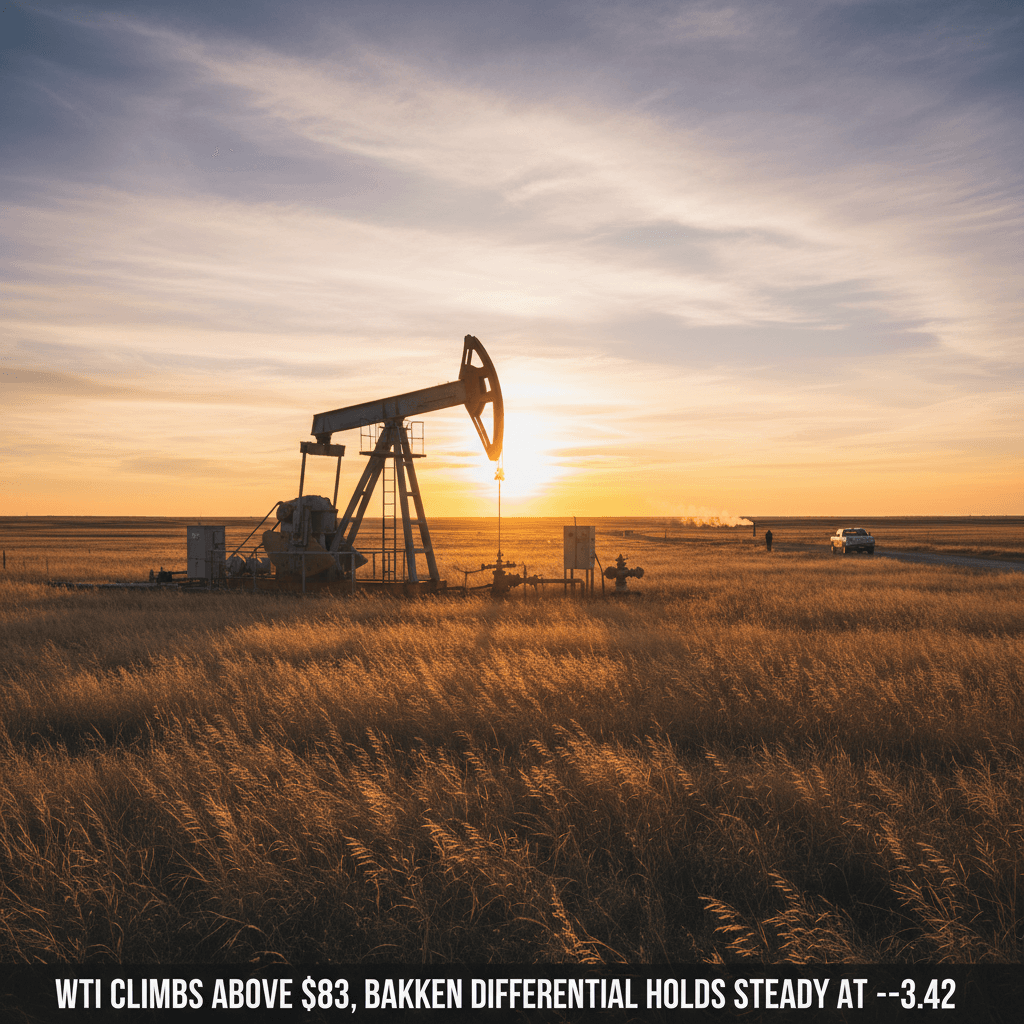
WTI Climbs Above $83, Bakken Differential Holds Steady at -$3.42

West Texas Intermediate crude oil traded at $83.41 per barrel on Sunday, gaining $0.97 or 1.18% for the session. The global benchmark Brent crude rose to $89.95, a more modest increase of $0.51. The price for Bakken crude, a key indicator for North Dakota producers, held at a differential of $3.42 per barrel below WTI. Natural gas prices also saw upward movement, with the commodity trading at $3.75 per MMBtu, a gain of $0.07. This near-term strength comes despite a longer-term bearish outlook from federal forecasters. According to Rigzone, the U.S. Energy Information Administration projected in its latest short-term energy outlook that the U.S. Henry Hub spot price will drop in both 2026 and 2027. The EIA's outlook, published November 20, suggests downward pressure on natural gas prices in the coming years, contrasting with the current session's gains. For Bakken operators, the current price environment provides a stable revenue outlook....

🔆Midday Wire·Nov 22
WTI Climbs Above $83, Bakken Differential Holds Steady - Bakken Wire
Oil Prices

WTI Climbs Above $83, Bakken Differential Holds Steady

Front-month WTI crude oil futures rose 1.18% to settle at $83.41 per barrel on Sunday, November 22, while Brent crude gained 0.57% to $89.95. The benchmark Bakken differential was recorded at $-3.42 versus WTI. Natural gas prices also moved higher, adding $0.07 to $3.75 per MMBtu. The price increase comes despite bearish U.S. inventory data reported last week. According to Rigzone, commercial crude oil stocks, excluding the Strategic Petroleum Reserve, rose by over 3 million barrels week-on-week to 417.797 million barrels as of November 13. Typically, a larger-than-expected build in inventories places downward pressure on prices. The market's ability to absorb the inventory build and move higher may be linked to shifting global crude dynamics. Rigzone also reported that the "war premium" for USA sour crude grades has vanished, indicating changing supply perceptions that can influence the pricing landscape for all crudes, including the light sweet oil produced in the...

☀️Morning Wire·Nov 22