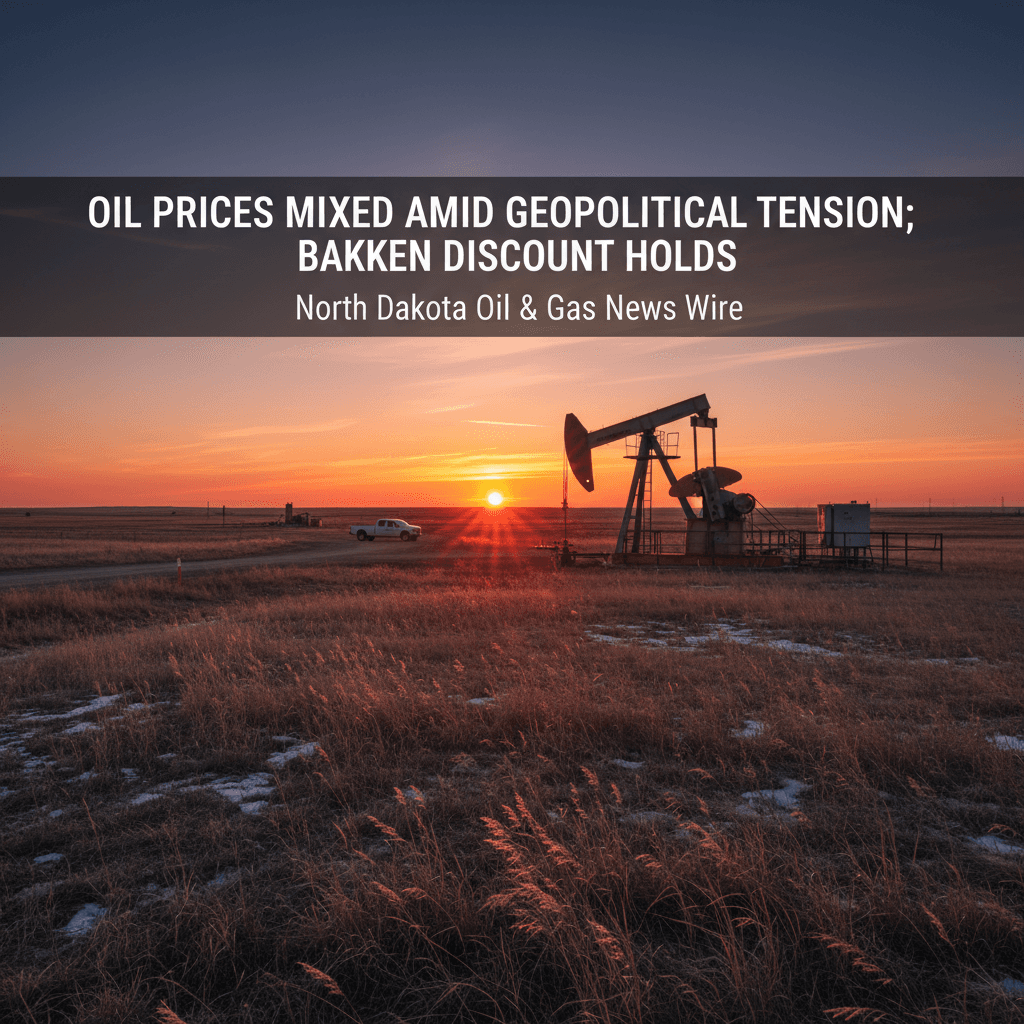
Oil Prices Mixed Amid Geopolitical Tension; Bakken Discount Holds
WTI edges up while Brent falls as Houthi attacks on Saudi Arabia highlight supply risks, with a persistent diesel premium squeezing downstream margins.
Crude oil prices showed a split performance on Tuesday, with West Texas Intermediate gaining slightly while Brent crude declined, as geopolitical tensions surrounding Saudi Arabia provided a volatile backdrop for the market. WTI crude traded at $93.94 per barrel, up 21 cents, while Brent crude fell 87 cents to $105.72, according to live price data. Bakken crude maintained a discount of $3.42 per barrel versus the WTI benchmark.
The primary focus for traders is rising supply risk in the Middle East. According to OilPrice.com, Saudi Arabia is becoming the oil market's biggest wild card, with Houthi attacks forcing a protracted shutdown of Riyadh's airport and threatening the kingdom's energy infrastructure. Simultaneously, missile strikes on tankers in the Strait of Hormuz are keeping Gulf oil flows at risk. This emerging conflict is defining the current trading range and providing underlying support to global benchmarks like Brent.
For Bakken producers, the stable local differential suggests regional pipeline and rail logistics are functioning normally, allowing operators to capture prices near $90.50 per barrel for their crude. The sustained high price environment, with WTI holding above $93, continues to support strong cash flows for drillers in the Williston Basin.
Downstream, a significant and persistent price gap between diesel and gasoline is applying pressure. OilPrice.com reported that diesel prices have been higher than gasoline almost continuously since 2004, a structural shift driven by the higher cost of producing ultra-low-sulfur diesel, strong global demand, and higher federal taxes. In 2026, this premium has been exacerbated by refinery disruptions, geopolitical conflicts, and low inventories.
This distillate tightness has direct political and economic ramifications. Since January 2025, U.S. diesel prices have surged 67%, far outpacing cumulative inflation of 5.4%, according to OilPrice.com. The Trump administration's recent deal with Russia for diesel has failed to substantially lower U.S. fuel prices, triggering a decline in heating oil futures and raising political risks ahead of the midterm elections.
For the Bakken, high diesel prices increase operational costs for drilling, completion, and transportation services. However, the region's high-quality light sweet crude is a preferred feedstock for complex refineries aiming to maximize distillate output, which could support demand and help maintain the relatively narrow differential to WTI. The overall high crude price environment, driven by geopolitical risk and structural market tightness, remains a net positive for operator economics, even as cost pressures mount.
Source
Live Price Data, OilPrice.com (Why Diesel Prices Are So Much Higher Than Gasoline; Saudi Arabia Becomes the Oil Market’s Biggest Wild Card)