WTI Crude--
Brent Crude--
Natural Gas--
ND Rig Count--
WTI Crude--
Brent Crude--
Natural Gas--
ND Rig Count--
Oil Prices Plunge Over 5%, Bakken Differential Widens - Bakken Wire
Oil Prices

Oil Prices Plunge Over 5%, Bakken Differential Widens

WTI and Brent crude post sharp declines amid broader market sell-off; EIA lowers natural gas price forecasts.

Bakken Wire Staff·🌅Afternoon Wire·

Front-month crude oil futures sold off sharply on Wednesday, with both major benchmarks falling more than 5%. The price drop puts immediate pressure on Bakken shale operators' revenue streams.

West Texas Intermediate (WTI) crude for June delivery settled at $98.87 per barrel, down $5.28 or 5.07% for the session. The global benchmark, Brent crude, fell $5.91 to $105.37 per barrel, a decline of 5.31%. The discount for Bakken crude at the Clearbrook, Minnesota, hub widened to $3.42 per barrel below WTI.

The steep decline coincided with a broader risk-off move in financial markets, driven by renewed concerns over global economic growth and its impact on fuel demand. Equity markets also fell sharply, contributing to the sell-off in commodity assets.

For Bakken producers, the sudden drop erodes the pricing advantage seen in recent weeks. The wider Bakken differential means wellhead realizations will be further pressured compared to the benchmark. Operators with unhedged production are most exposed to the day's volatility.

In related energy markets, natural gas prices also edged lower. The front-month contract settled at $3.04 per MMBtu, down $0.08. This weakness follows a downward revision in official price forecasts.

According to Rigzone, the U.S. Energy Information Administration (EIA) lowered its Henry Hub spot price forecasts for both 2026 and 2027 in its latest Short-Term Energy Outlook, published Wednesday. A lower long-term gas price environment could impact associated gas production economics in the Bakken and influence decisions on gas capture infrastructure investments.

The combined price action underscores the volatile and interconnected nature of energy markets. Bakken operators, who have been guiding capital spending based on prices above $90 WTI, may reassess activity plans if the sell-off is sustained. The focus now shifts to weekly U.S. inventory data and any signals from major producers regarding supply.

Source

Live Price Data, Rigzone reporting on EIA STEO (May 20, 2026)

oil priceswtibrentbakken differentialnatural gaseiamarket volatility

Share this article

Related Articles

Oil Prices Steady as Market Awaits OPEC+ Decision - Bakken Wire
Oil Prices

Oil Prices Steady as Market Awaits OPEC+ Decision

Front-month WTI crude oil futures were unchanged in Sunday trading, holding at $83.41 per barrel, according to live price data. The global benchmark, Brent crude, was also flat at $89.95 per barrel. The price stability comes as traders await a key decision from the OPEC+ alliance of oil-producing nations. The group is scheduled to meet virtually on December 4 to discuss production policy for 2027. Market analysts widely expect the meeting to focus on whether to extend or deepen existing output cuts into the new year, a move aimed at supporting prices. For Bakken operators, the local price benchmark is the Bakken differential, which represents the price difference between Bakken crude at the Clearbrook, Minnesota hub and the U.S. benchmark, WTI. On Sunday, that differential was reported at a discount of $3.42 per barrel. This means Bakken crude is effectively priced at approximately $79.99 per barrel. A steady WTI price...

🌅Afternoon Wire·Nov 22
WTI Climbs Above $83, Bakken Differential Holds Steady at -$3.42 - Bakken Wire
Oil Prices

WTI Climbs Above $83, Bakken Differential Holds Steady at -$3.42

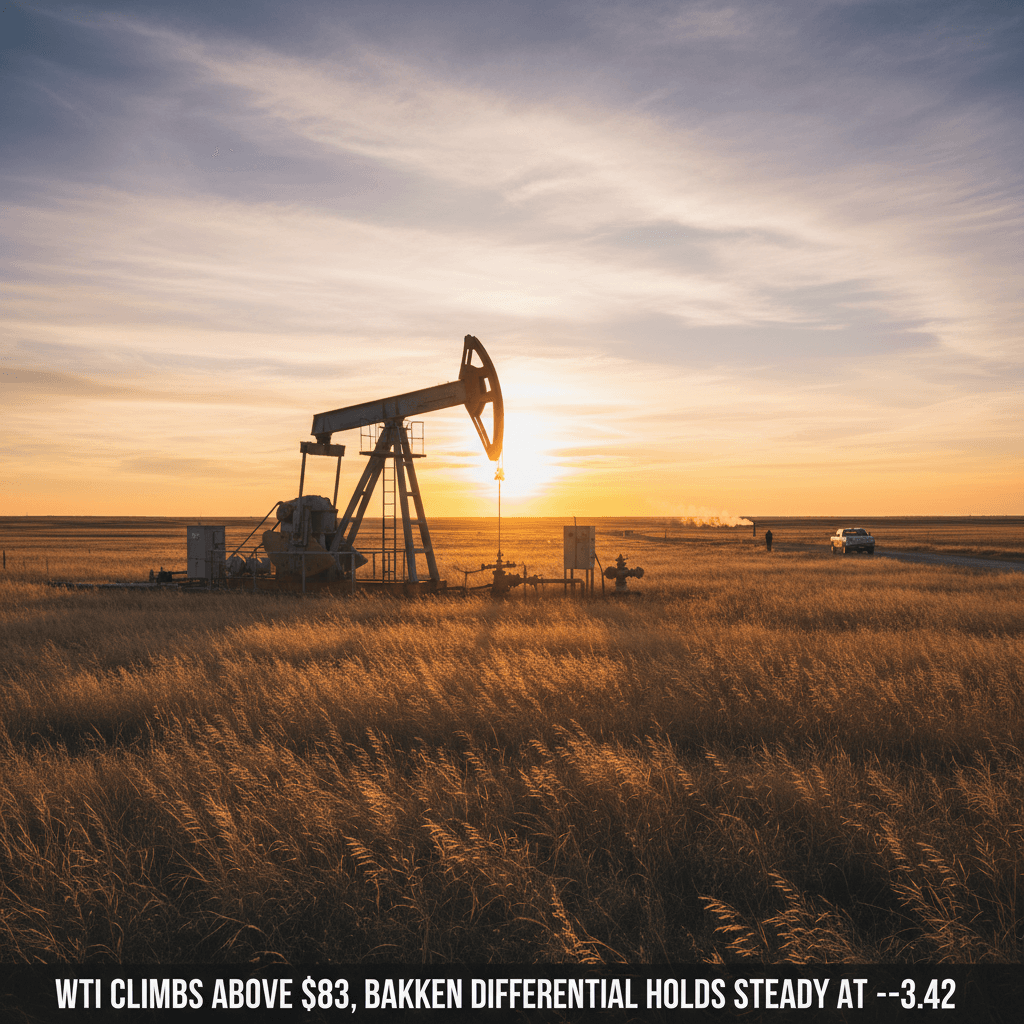
West Texas Intermediate crude oil traded at $83.41 per barrel on Sunday, gaining $0.97 or 1.18% for the session. The global benchmark Brent crude rose to $89.95, a more modest increase of $0.51. The price for Bakken crude, a key indicator for North Dakota producers, held at a differential of $3.42 per barrel below WTI. Natural gas prices also saw upward movement, with the commodity trading at $3.75 per MMBtu, a gain of $0.07. This near-term strength comes despite a longer-term bearish outlook from federal forecasters. According to Rigzone, the U.S. Energy Information Administration projected in its latest short-term energy outlook that the U.S. Henry Hub spot price will drop in both 2026 and 2027. The EIA's outlook, published November 20, suggests downward pressure on natural gas prices in the coming years, contrasting with the current session's gains. For Bakken operators, the current price environment provides a stable revenue outlook....

🔆Midday Wire·Nov 22
WTI Climbs Above $83, Bakken Differential Holds Steady - Bakken Wire
Oil Prices

WTI Climbs Above $83, Bakken Differential Holds Steady

Front-month WTI crude oil futures rose 1.18% to settle at $83.41 per barrel on Sunday, November 22, while Brent crude gained 0.57% to $89.95. The benchmark Bakken differential was recorded at $-3.42 versus WTI. Natural gas prices also moved higher, adding $0.07 to $3.75 per MMBtu. The price increase comes despite bearish U.S. inventory data reported last week. According to Rigzone, commercial crude oil stocks, excluding the Strategic Petroleum Reserve, rose by over 3 million barrels week-on-week to 417.797 million barrels as of November 13. Typically, a larger-than-expected build in inventories places downward pressure on prices. The market's ability to absorb the inventory build and move higher may be linked to shifting global crude dynamics. Rigzone also reported that the "war premium" for USA sour crude grades has vanished, indicating changing supply perceptions that can influence the pricing landscape for all crudes, including the light sweet oil produced in the...

☀️Morning Wire·Nov 22