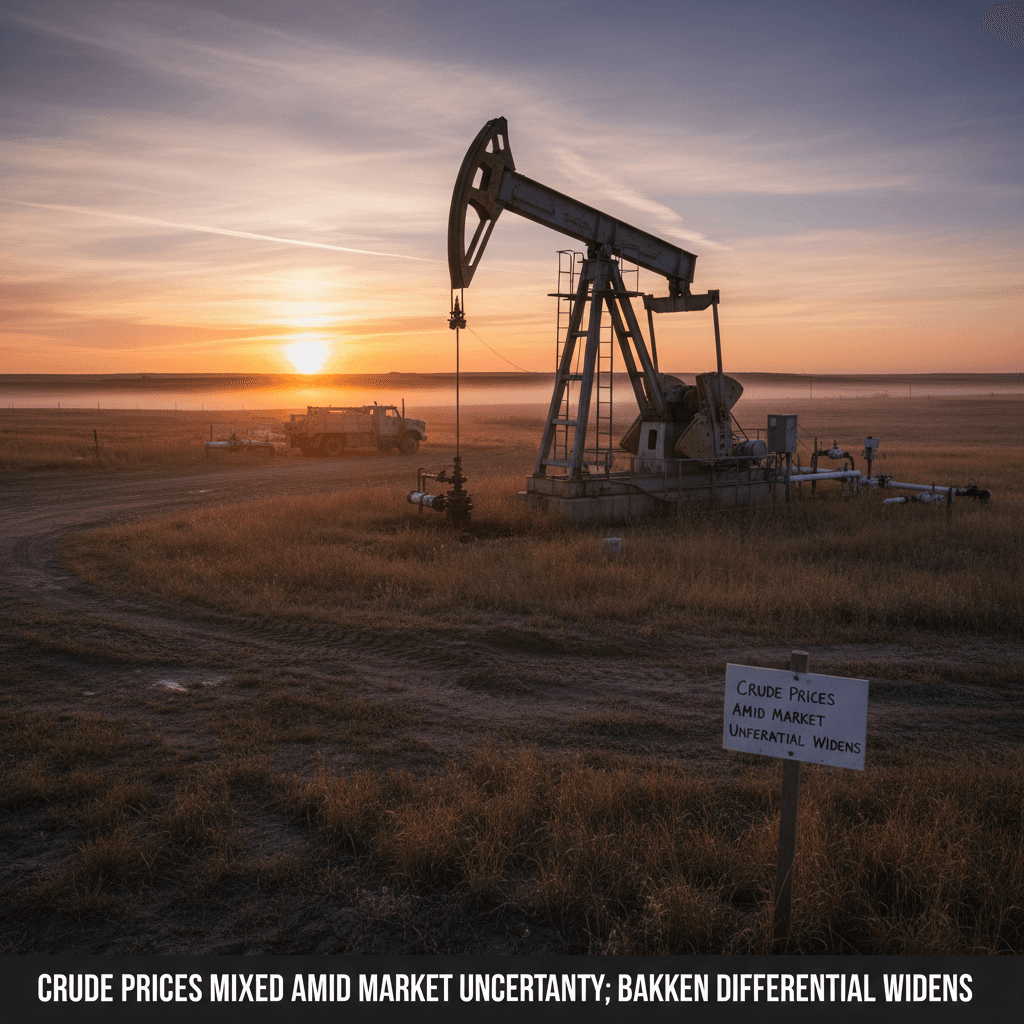
Oil Prices Rally Amid Physical Market Stress; Bakken Differential Widens
Brent surpasses $101 as analysts warn futures are understating severe supply tightness, while North Dakota crude trades at a discount.
Oil prices strengthened significantly on Friday, with Brent crude topping $101 per barrel and West Texas Intermediate (WTI) nearing $96, according to midday trading data. Brent rose 1.67% to $101.73, while WTI increased 1.14% to $95.89. The price for Bakken crude, a key grade for North Dakota producers, was trading at a discount of $3.42 below WTI.
The rally coincides with a stark warning from analysts about underlying market stress. According to a BMI report from Fitch Solutions cited by Rigzone, Brent futures prices are understating severe tightness in the physical crude market. BMI analysts noted that the spread between Dated Brent (for immediate delivery) and front-month futures has widened substantially, reflecting emerging shortages in physical supply.
"Dated Brent, representing physical barrels for prompt delivery, often trades at a premium to the front-month futures due to immediate demand, logistical constraints, or supply disruptions," the BMI analysts stated in the report. They highlighted that demand for immediate crude has pushed Dated Brent prices well above $130 per barrel, with some Middle Eastern grades exceeding $135, indicating a scramble for refining feedstock.
This physical market stress is compounded by elevated costs for refiners. "Additionally, elevated shipping rates, insurance and fuel costs are adding to cost pressures for refiners," the report warned, noting some refiners are reducing output, which could further draw down stocks and raise fuel costs.
For Bakken operators, the rising global benchmark prices are a positive signal, but the widening discount for Bakken crude to WTI, currently at -$3.42, represents a localized headwind. This differential affects the net revenue received for barrels produced in the Williston Basin.
The high-price environment is not translating into robust deal activity, however. According to a report from OilPrice.com, the collective monthly value of upstream oil and gas asset deals plunged to $5.55 billion in March, down from $32 billion in February. North American deal value specifically fell below $1 billion for the first time in 2026, totaling about $862 million.
The report, citing Rystad Energy data, noted that valuations for producing assets remained stable at around $4.6 per barrel of oil equivalent (boe). However, discovery-stage assets saw their valuation soften, slipping to $1.5 per boe from $1.7 per boe. This suggests that in a climate of price uncertainty, capital is favoring near-term cash flow over longer-term exploration projects.
BMI analysts forecast that elevated prices for the physical Dated Brent contract will persist through May before declining, "following a clear peace agreement and a move towards normalization of vessel traffic through the Persian Gulf." They concluded that the physical market should remain buoyant longer than paper markets due to refiners' immediate need to rebuild stocks.
Source
Bakken Wire Live Price Data, Rigzone, OilPrice.com