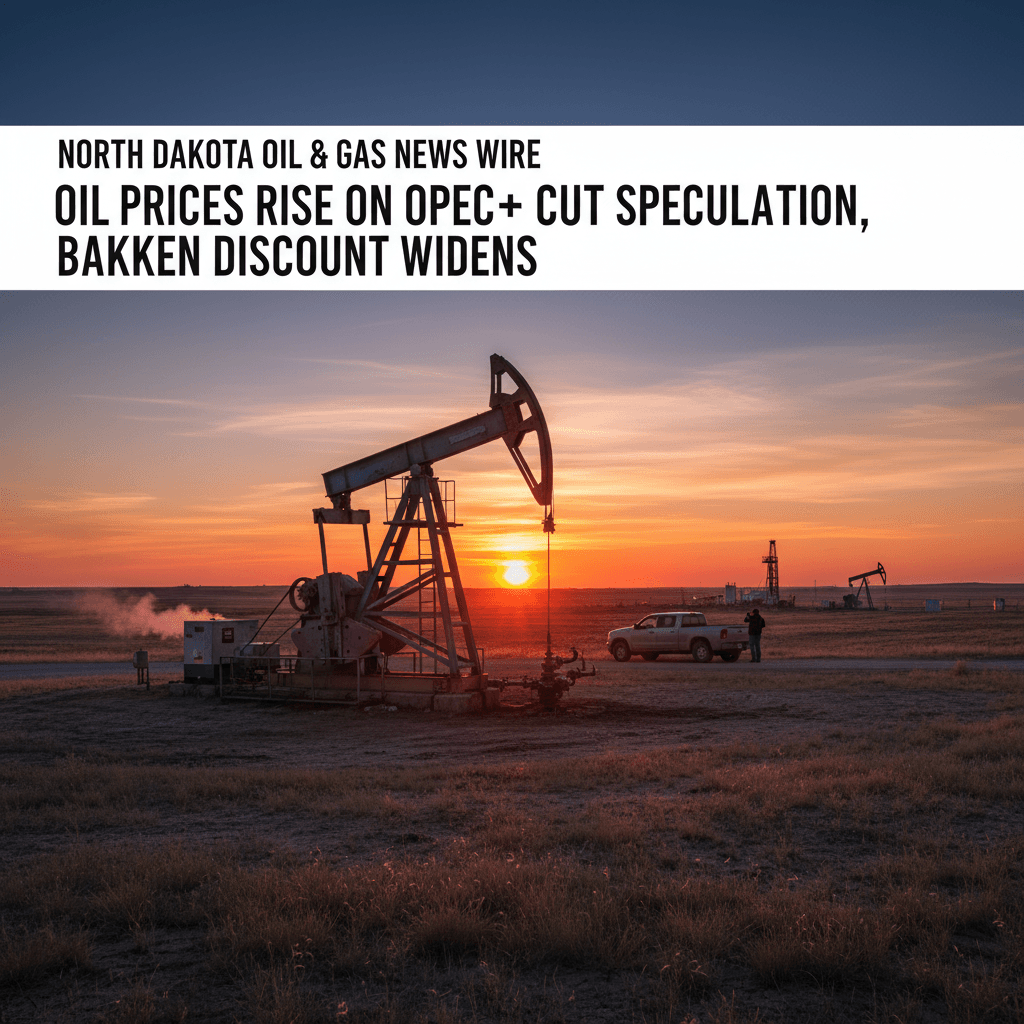
Oil Prices Rise on OPEC+ Cut Speculation, Bakken Discount Widens
WTI gains 1.2% to top $83, while the Bakken differential to the benchmark expands to -$3.42.
Oil prices climbed in trading Saturday, with U.S. benchmark West Texas Intermediate crude rising above $83 per barrel. The gains come amid market speculation about the potential extension of OPEC+ production cuts into 2027.
WTI crude for January delivery settled at $83.41 per barrel, an increase of $0.97 or 1.18% for the session. The global benchmark, Brent crude, rose a more modest 0.57% to $89.95 per barrel, according to live price data. Natural gas also saw gains, adding $0.07 to reach $3.75 per MMBtu.
The primary driver for the price increase appears to be anticipation surrounding the upcoming OPEC+ meeting. Analysts are widely expecting the producer group to prolong its current output reductions, which total over 5 million barrels per day, through the first half of next year. This expectation is providing a floor under prices despite ongoing concerns about global economic demand.
For Bakken operators, the positive movement in the headline benchmark is tempered by a widening local price discount. The Bakken differential to WTI widened to -$3.42 per barrel. This means Bakken crude is priced at approximately $79.99 per barrel at the wellhead, significantly below the Brent global benchmark.
The persistent discount for Bakken crude is a key factor for North Dakota producers' revenue and drilling economics. While a WTI price above $83 is generally supportive for activity, a differential near $3.50 can erode margins, particularly for operators with higher lifting costs. The discount reflects local logistical constraints and regional refinery demand compared to the Gulf Coast pricing point for WTI.
The strength in natural gas prices offers a secondary revenue stream for Bakken producers, many of whom operate in the rich gas condensate window of the play. The price above $3.75 provides improved economics for gas capture and processing infrastructure investments.
Market participants will now focus on official communication from OPEC+ regarding its production policy. A confirmed extension of cuts is likely to keep prices supported near current levels, while any surprise decision to increase output could trigger a swift reversal. For the Williston Basin, the trajectory of the Bakken differential will remain as critical to operator cash flow as the movement in the underlying benchmark.
Source
Live Price Data