
WTI Crude--
Brent Crude--
Natural Gas--
ND Rig Count--
WTI Crude--
Brent Crude--
Natural Gas--
ND Rig Count--
Oil Prices Slide Over 2% on Glut Fears, Narrowing Bakken Differential - Bakken Wire
Oil Prices

Oil Prices Slide Over 2% on Glut Fears, Narrowing Bakken Differential

WTI and Brent crude fell sharply Wednesday as recovering tanker traffic and rising supply weighed on markets, with Bakken crude holding a $3.42 discount.

Bakken Wire Staff·🌅Afternoon Wire·

Oil prices extended losses in Wednesday trading, with both major benchmarks dropping over two percent on mounting concerns about a global supply glut. West Texas Intermediate (WTI) crude for August delivery fell $1.39, or 2.0 percent, to settle at $68.11 per barrel. The global benchmark, Brent crude, dropped $1.76, or 2.41 percent, to $71.19, according to live price data.

The day's sell-off was driven by recovering tanker traffic through the critical Strait of Hormuz and rising global supplies, which reinforced expectations of an oversupplied market, Rigzone reported. The easing of logistical disruptions contributed to the bearish sentiment.

For Bakken producers, the price of crude at the wellhead closely tracks WTI, minus a regional price differential. That differential narrowed slightly Wednesday, with Bakken crude priced at a $3.42 per barrel discount to WTI. This puts the implied price for Bakken crude at approximately $64.69 per barrel.

The price pressure comes amid political focus on fuel costs. In a statement posted to his Truth Social page on Tuesday, U.S. President Donald J. Trump ordered U.S. gasoline retailers to cut their prices "immediately," Rigzone reported. Such directives, while aimed at the downstream sector, can contribute to market uncertainty and influence broader sentiment.

Looking beyond daily volatility, industry executives provided longer-term price expectations in the second-quarter Dallas Fed Energy Survey. Executives from oil and gas firms revealed where they expect the WTI crude oil price to be at various points in the future, according to a separate Rigzone report. While the specific forecasts were not detailed in the summary, such surveys are closely watched for indications of producer sentiment and capex planning.

For operators in the Williston Basin, sustained prices near or below $70 WTI apply pressure on cash flow and can influence decisions regarding drilling and completion activity. The current price environment, characterized by glut fears, tests the economic resilience of shale plays. Narrow differentials, like the current $3.42 discount, are favorable for Bakken shippers but are offset by the lower overall benchmark price.

Market attention now turns to weekly U.S. inventory data from the Energy Information Administration and any response from producing nations to the price slide. The combination of geopolitical, logistical, and fundamental supply factors is likely to keep volatility elevated in the near term.

Source

Live Price Data, Rigzone (Crude Extends Losses on Glut Fears, Oil Execs Predict Future WTI Oil Prices, Trump Tells Gasoline Retailers to Cut Prices Immediately)

oil priceswtibrentbakken differentialsupply glutstrait of hormuztrump administration

Share this article

Related Articles

Oil Prices Steady as Market Awaits OPEC+ Decision - Bakken Wire
Oil Prices

Oil Prices Steady as Market Awaits OPEC+ Decision

Front-month WTI crude oil futures were unchanged in Sunday trading, holding at $83.41 per barrel, according to live price data. The global benchmark, Brent crude, was also flat at $89.95 per barrel. The price stability comes as traders await a key decision from the OPEC+ alliance of oil-producing nations. The group is scheduled to meet virtually on December 4 to discuss production policy for 2027. Market analysts widely expect the meeting to focus on whether to extend or deepen existing output cuts into the new year, a move aimed at supporting prices. For Bakken operators, the local price benchmark is the Bakken differential, which represents the price difference between Bakken crude at the Clearbrook, Minnesota hub and the U.S. benchmark, WTI. On Sunday, that differential was reported at a discount of $3.42 per barrel. This means Bakken crude is effectively priced at approximately $79.99 per barrel. A steady WTI price...

🌅Afternoon Wire·Nov 22
WTI Climbs Above $83, Bakken Differential Holds Steady at -$3.42 - Bakken Wire
Oil Prices

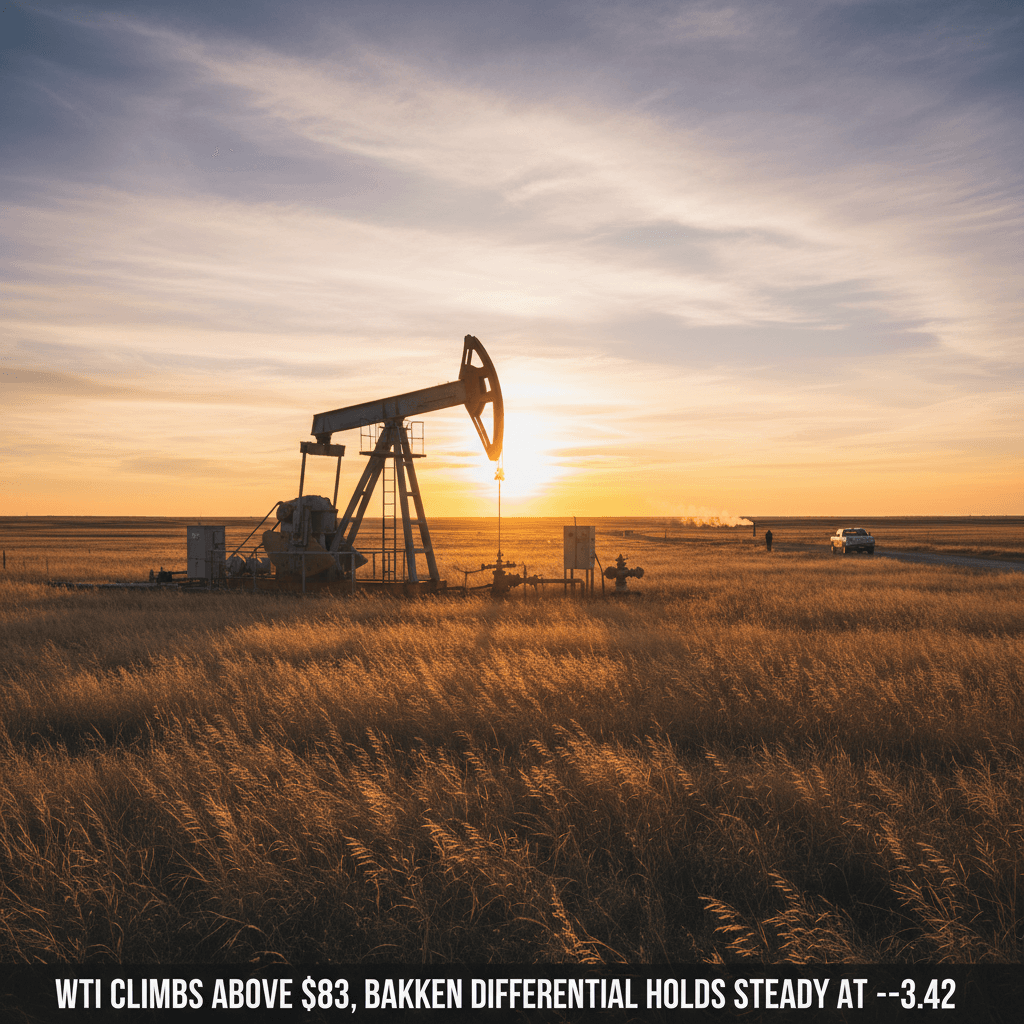
WTI Climbs Above $83, Bakken Differential Holds Steady at -$3.42

West Texas Intermediate crude oil traded at $83.41 per barrel on Sunday, gaining $0.97 or 1.18% for the session. The global benchmark Brent crude rose to $89.95, a more modest increase of $0.51. The price for Bakken crude, a key indicator for North Dakota producers, held at a differential of $3.42 per barrel below WTI. Natural gas prices also saw upward movement, with the commodity trading at $3.75 per MMBtu, a gain of $0.07. This near-term strength comes despite a longer-term bearish outlook from federal forecasters. According to Rigzone, the U.S. Energy Information Administration projected in its latest short-term energy outlook that the U.S. Henry Hub spot price will drop in both 2026 and 2027. The EIA's outlook, published November 20, suggests downward pressure on natural gas prices in the coming years, contrasting with the current session's gains. For Bakken operators, the current price environment provides a stable revenue outlook....

🔆Midday Wire·Nov 22
WTI Climbs Above $83, Bakken Differential Holds Steady - Bakken Wire
Oil Prices

WTI Climbs Above $83, Bakken Differential Holds Steady

Front-month WTI crude oil futures rose 1.18% to settle at $83.41 per barrel on Sunday, November 22, while Brent crude gained 0.57% to $89.95. The benchmark Bakken differential was recorded at $-3.42 versus WTI. Natural gas prices also moved higher, adding $0.07 to $3.75 per MMBtu. The price increase comes despite bearish U.S. inventory data reported last week. According to Rigzone, commercial crude oil stocks, excluding the Strategic Petroleum Reserve, rose by over 3 million barrels week-on-week to 417.797 million barrels as of November 13. Typically, a larger-than-expected build in inventories places downward pressure on prices. The market's ability to absorb the inventory build and move higher may be linked to shifting global crude dynamics. Rigzone also reported that the "war premium" for USA sour crude grades has vanished, indicating changing supply perceptions that can influence the pricing landscape for all crudes, including the light sweet oil produced in the...

☀️Morning Wire·Nov 22