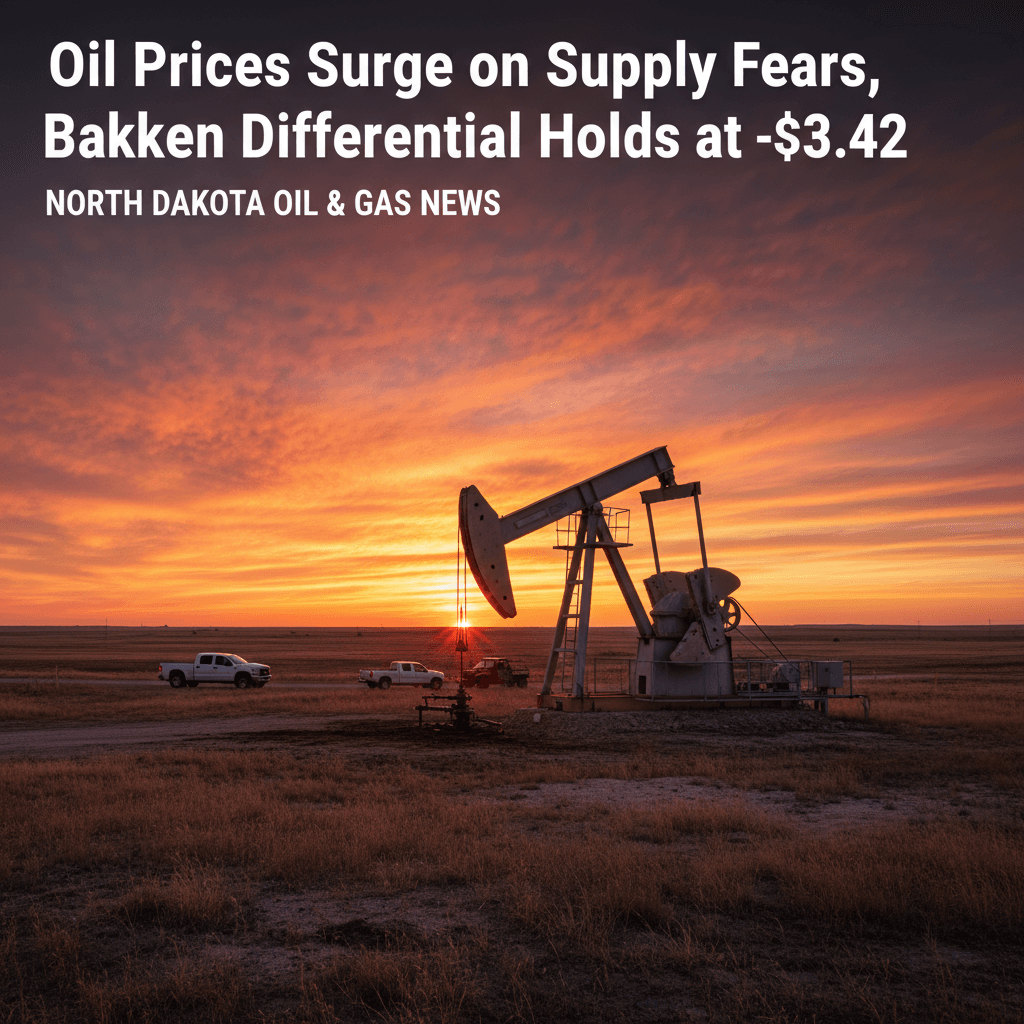
Oil Prices Surge on Supply Fears, Bakken Differential Holds at -$3.42
WTI jumps 2.2% to $87.65 as geopolitical tensions and robust global demand, particularly from price-sensitive buyers like India, support the market.
Oil prices climbed sharply in early Tuesday trading, with West Texas Intermediate (WTI) crude rising $1.89 to settle at $87.65 per barrel, a gain of 2.2%. The global benchmark, Brent crude, increased by $1.45 to $91.94. The price for Bakken crude at the Clearbrook, Minnesota, hub held a differential of -$3.42 versus WTI, according to live price data.
The price surge is largely attributed to escalating geopolitical tensions threatening global supply routes. Related news reports highlight ongoing market volatility stemming from the Iran war and disrupted flows through the critical Strait of Hormuz.
Market strength is being reinforced by robust physical demand from major importers. According to a report from OilPrice.com, India, the world's third-largest crude importer, is making its buying decisions primarily based on price for over 60% of its imports. Arun Kumar Singh, chairman and CEO of India’s state-owned ONGC, stated that "spot crudes are mostly decided cargo-to-cargo based on price."
This price-sensitive buying has opened doors for alternative suppliers. With traditional Middle Eastern term supplies disrupted, the report notes India has turned to sources including West Africa, Venezuela, Brazil, and the United States for spot cargoes to fill the gap.
For Bakken operators, the strong WTI price above $87 provides a healthy revenue environment. The stable local differential of -$3.42 means Bakken crude is effectively priced near $84.23 per barrel at the hub. The news that major importers like India are actively shopping the global spot market based on price is a positive signal for U.S. crude exports, which include barrels from the Bakken formation.
In contrast to the gains in oil, natural gas prices saw slight downward pressure, dipping $0.04 to $2.89 per MMBtu. This continues a trend of divergence between the oil and gas markets.
The ONGC executive's comments underscore a key market dynamic: while geopolitical events cause short-term disruptions, long-term flows are dictated by economics. "Geopolitical disturbances could be for some months or years, but ultimately world economy prevails," Singh said. This environment of competitive global pricing benefits efficient producers like those in the Bakken, who can deliver crude to the export market.
Source
Live Price Data, OilPrice.com report dated September 1, 2026