WTI Crude--
Brent Crude--
Natural Gas--
ND Rig Count--
WTI Crude--
Brent Crude--
Natural Gas--
ND Rig Count--
Oil Prices Surge Over 3% on Geopolitical Tensions; Bakken Differential Widens - Bakken Wire
Oil Prices

Oil Prices Surge Over 3% on Geopolitical Tensions; Bakken Differential Widens

WTI tops $101 as Trump's Iran ceasefire warning and prolonged Gulf repairs fuel supply concerns, while Bakken crude trades at a $3.42 discount.

Bakken Wire Staff·🔆Midday Wire·

Oil prices rallied sharply in midday trading Tuesday, with West Texas Intermediate (WTI) crude gaining $3.41 to settle at $101.48 per barrel, a 3.48% increase. The global benchmark, Brent crude, rose $3.42 to $107.63, according to live price data.

The primary driver for the surge is renewed geopolitical risk, with U.S. President Donald Trump warning that the Iran ceasefire is on "life support," OilPrice.com reported. Concurrently, Gulf producers Saudi Arabia and the UAE have signaled that full repairs to drone-damaged oil infrastructure may not be completed until 2027, extending supply concerns.

These factors offset bearish demand signals from China. Chinese crude imports averaged only 9.25 million barrels per day in April, a decline of 2.4 million b/d from March and the lowest pace since July 2022, according to OilPrice.com. Weakening demand and high crude costs have pushed independent Chinese refinery run rates down to approximately 50% so far in May.

For Bakken producers, the price rally is tempered by a widening differential. Bakken crude at the Clearbrook, Minnesota, hub was priced at a $3.42 per barrel discount to WTI on Tuesday. This means Bakken-grade crude is effectively trading around $98.06 per barrel. While the absolute price remains supportive for drilling and completion activity, a wider differential can pressure operator margins, especially for those with higher transportation costs.

The geopolitical premium in the market is being reinforced by other factors. The Trump administration announced new sanctions on Chinese and UAE companies facilitating Iran's oil shipments to China, further tightening the global supply picture, OilPrice.com noted. In Europe, an unplanned outage at Norway's Hammerfest LNG terminal is tightening natural gas supply, though U.S. natural gas prices dipped slightly to $2.81.

Downstream, the high crude environment poses risks for consumers. GasBuddy warned in a blog on Monday that another U.S. gasoline price surge could be coming, Rigzone reported. This suggests refining margins could come under pressure if demand destruction occurs.

The market's focus now turns to the upcoming summit between President Trump and China's Xi Jinping, which could dictate the macro mood for the week. Any escalation in tensions or further sanctions could add more volatility to an already tight market.

For North Dakota operators, the current price environment above $100 WTI continues to provide a strong revenue signal. However, managing the Bakken price differential and watching for potential demand softening in Asia will be key considerations alongside the overarching geopolitical risks supporting prices.

Source

Live Price Data, OilPrice.com, Rigzone

wtibrentoil pricesbakken differentialgeopoliticsiranchinagulf repairsnatural gas

Share this article

Related Articles

Oil Prices Steady as Market Awaits OPEC+ Decision - Bakken Wire
Oil Prices

Oil Prices Steady as Market Awaits OPEC+ Decision

Front-month WTI crude oil futures were unchanged in Sunday trading, holding at $83.41 per barrel, according to live price data. The global benchmark, Brent crude, was also flat at $89.95 per barrel. The price stability comes as traders await a key decision from the OPEC+ alliance of oil-producing nations. The group is scheduled to meet virtually on December 4 to discuss production policy for 2027. Market analysts widely expect the meeting to focus on whether to extend or deepen existing output cuts into the new year, a move aimed at supporting prices. For Bakken operators, the local price benchmark is the Bakken differential, which represents the price difference between Bakken crude at the Clearbrook, Minnesota hub and the U.S. benchmark, WTI. On Sunday, that differential was reported at a discount of $3.42 per barrel. This means Bakken crude is effectively priced at approximately $79.99 per barrel. A steady WTI price...

🌅Afternoon Wire·Nov 22
WTI Climbs Above $83, Bakken Differential Holds Steady at -$3.42 - Bakken Wire
Oil Prices

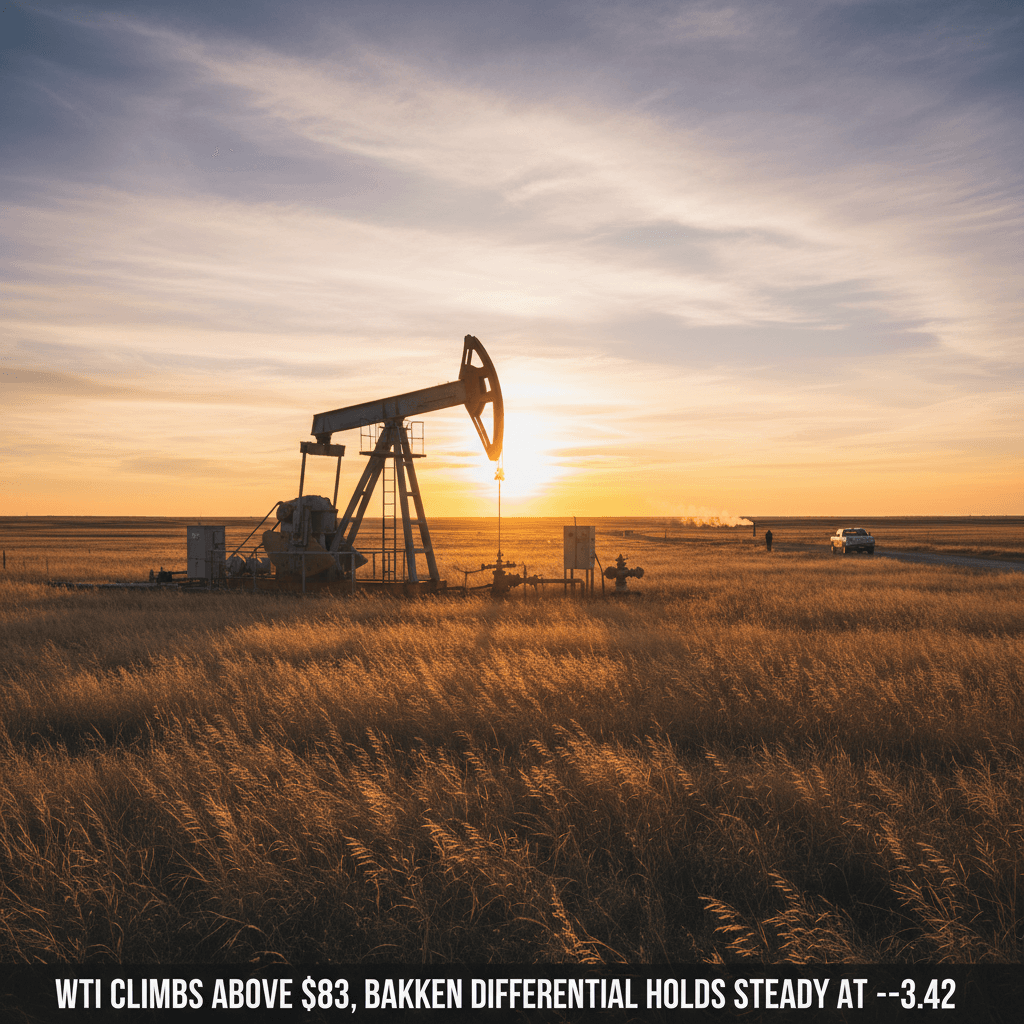
WTI Climbs Above $83, Bakken Differential Holds Steady at -$3.42

West Texas Intermediate crude oil traded at $83.41 per barrel on Sunday, gaining $0.97 or 1.18% for the session. The global benchmark Brent crude rose to $89.95, a more modest increase of $0.51. The price for Bakken crude, a key indicator for North Dakota producers, held at a differential of $3.42 per barrel below WTI. Natural gas prices also saw upward movement, with the commodity trading at $3.75 per MMBtu, a gain of $0.07. This near-term strength comes despite a longer-term bearish outlook from federal forecasters. According to Rigzone, the U.S. Energy Information Administration projected in its latest short-term energy outlook that the U.S. Henry Hub spot price will drop in both 2026 and 2027. The EIA's outlook, published November 20, suggests downward pressure on natural gas prices in the coming years, contrasting with the current session's gains. For Bakken operators, the current price environment provides a stable revenue outlook....

🔆Midday Wire·Nov 22
WTI Climbs Above $83, Bakken Differential Holds Steady - Bakken Wire
Oil Prices

WTI Climbs Above $83, Bakken Differential Holds Steady

Front-month WTI crude oil futures rose 1.18% to settle at $83.41 per barrel on Sunday, November 22, while Brent crude gained 0.57% to $89.95. The benchmark Bakken differential was recorded at $-3.42 versus WTI. Natural gas prices also moved higher, adding $0.07 to $3.75 per MMBtu. The price increase comes despite bearish U.S. inventory data reported last week. According to Rigzone, commercial crude oil stocks, excluding the Strategic Petroleum Reserve, rose by over 3 million barrels week-on-week to 417.797 million barrels as of November 13. Typically, a larger-than-expected build in inventories places downward pressure on prices. The market's ability to absorb the inventory build and move higher may be linked to shifting global crude dynamics. Rigzone also reported that the "war premium" for USA sour crude grades has vanished, indicating changing supply perceptions that can influence the pricing landscape for all crudes, including the light sweet oil produced in the...

☀️Morning Wire·Nov 22