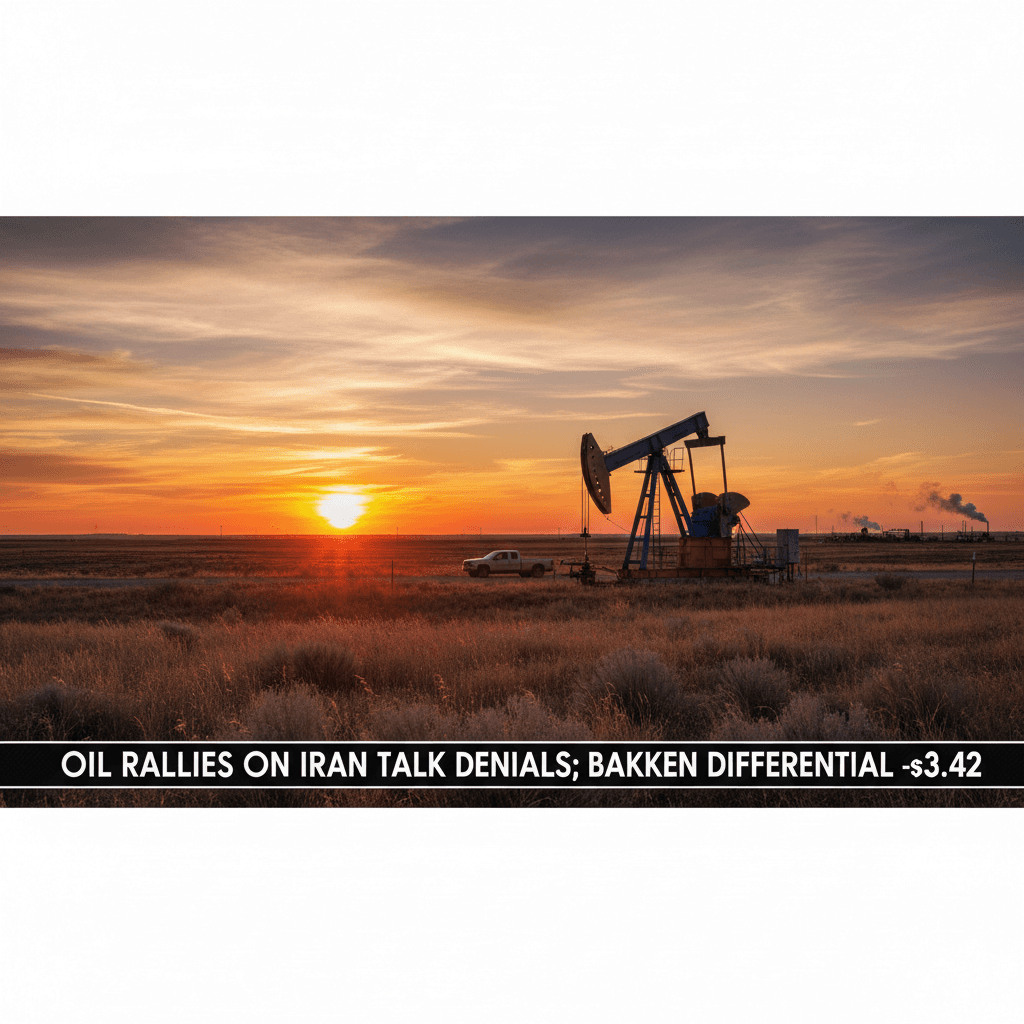
Oil Rallies on Iran Talk Denials; Bakken Differential -$3.42
Brent and WTI climbed after Iran denied negotiations with Washington, even as Saudi output recovery and a U.S. crude inventory build weighed on supply expectations.
Oil prices rose sharply Wednesday as geopolitical risk returned to the market. Live pricing data showed WTI crude at $87.70 per barrel, up $1.66, or 1.93%, while Brent crude climbed $2.13, or 2.33%, to $93.62. Natural gas was little changed at $3.29, down $0.01. The Bakken differential stood at $3.42 below WTI.
According to OilPrice.com, Brent rose nearly 3% to $93.90 and WTI gained almost 2% to $87.98 by 11:18 a.m. ET as Iran denied it was negotiating with Washington. Iranian top security official Mohsen Rezaei called reports of a recent meeting in Qatar “pure lies,” and President Masoud Pezeshkian accused the U.S. of conducting diplomacy through threats.
The move came after Brent had fallen about 21% since the start of November and WTI about 17% on expectations the war would wind down, OilPrice.com reported. UBS analyst Giovanni Staunovo pointed to “fading hopes of an imminent de-escalation.” Bloomberg columnist Javier Blas called Brent around $90 “an oddity,” too low if the U.S. and Iran escalate and too high if they sign a deal.
Supply concerns centered on the Strait of Hormuz. LSEG Oil Research said a deal would not quickly restore Gulf flows because shipping depends on mine clearing, insurance costs and shipowners’ willingness to take risk. The Washington Institute for Near East Policy reported attackers struck 37 ships in October, the most in any month since the war began, according to OilPrice.com. Allianz Trade estimated physical damage across Gulf countries at more than $200 billion and projected cumulative economic losses of up to $790 billion by 2030.
Higher prices were not driven by tight inventory data. OilPrice.com said traders looked past a 9-million-barrel build in U.S. crude inventories for the week ending Nov. 6, reported by the American Petroleum Institute. Saudi Arabia told OPEC it raised October output to 10.563 million barrels per day, up 26% from 8.372 million bpd in September, according to OilPrice.com. That was near pre-war levels and slightly above its OPEC quota of about 10.5 million bpd. OPEC+ total crude output rose 2.04 million bpd from September to 41.23 million bpd. Iran pumped about 1.91 million bpd, its lowest in 40 years, as a U.S. naval blockade kept exports shut in.
Diesel markets added support. OilPrice.com reported the U.S. diesel benchmark, heating oil, jumped 4.1% after a Ukrainian drone strike set off a fire at Russia’s Ust-Luga export hub. Ukrainian attacks have disrupted about 30% of Russia’s refining capacity since late October.
For Bakken producers, the rally improves benchmark oil values, but the $3.42 discount to WTI means regional barrels still realize less than the national price. The flat natural gas market gives little additional lift to associated gas revenue. North Dakota royalty owners may see higher oil royalties if the WTI rally holds, though Bakken pricing and wellhead differentials will determine the final share.
Source
Bakken Wire live pricing data; OilPrice.com, “Brent Jumps Nearly 3% as Iran Denies Any Talks With Washington,” Nov. 11, 2026; OilPrice.com, “Saudi Crude Output Jumps 26% as Riyadh Reports Near Pre-War Production,” Nov. 11, 2026