Oil Surges Past $101 as Gulf Risks, Tight Supply Lift Bakken Outlook
WTI crude rises over 2% as attacks on Gulf infrastructure and resilient global demand support high prices, tightening the Bakken differential.
Oil prices rallied sharply on Wednesday, with West Texas Intermediate crude settling above $101 per barrel, as renewed attacks in the Middle East and sustained supply tightness provided strong support for Bakken producers. WTI crude closed at $101.99, a gain of $2.09 or 2.09%, according to live price data. The global benchmark, Brent crude, rose 1.06% to $110.57.
The immediate price catalyst was a claimed ballistic missile strike by Houthi forces on Saudi Aramco’s 550,000-barrel-per-day Ras Tanura refinery, according to OilPrice.com. While Saudi authorities have not confirmed a direct hit, the attack underscores the persistent vulnerability of Gulf energy infrastructure. UBS highlighted that Gulf crude loadings remain below pre-war levels despite a recent recovery, and October has seen a record number of reported attacks on vessels around the Strait of Hormuz.
This geopolitical risk is exacerbating an already tight physical market. UBS has raised its year-end Brent forecast to $110 per barrel, noting that global inventories have fallen sharply and that pledged strategic reserve releases are largely complete, according to OilPrice.com. "An undersupplied market could push commercial stocks lower and should sustain oil prices," the bank said.
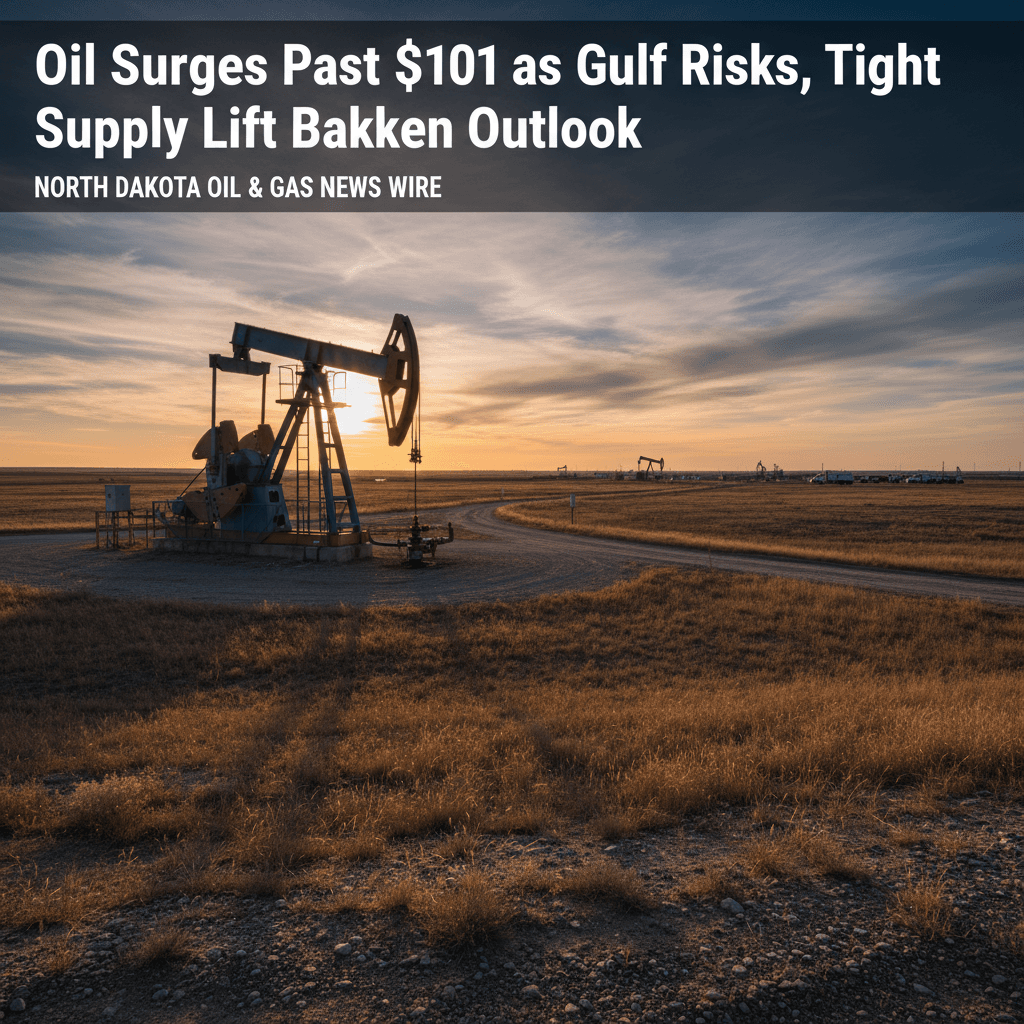
For Bakken operators, the high-price environment is tempered slightly by the region's differential. The Bakken crude differential was -$3.42 versus WTI on Wednesday, meaning Bakken barrels are priced at a discount. However, with WTI itself above $101, the absolute price received by North Dakota producers remains robust, supporting drilling and completion activity.
The strength in natural gas prices, which edged up to $3.03, is also being driven by global structural shifts, not just weather. OilPrice.com reported that India is on track for record LNG imports in October despite record-high prices, as domestic gas production declines and demand in politically sensitive sectors like fertilizer production remains resilient. This sustained global demand for energy provides a firm floor under both oil and gas markets.
Political commentary also acknowledged the high-price reality. At a rally in Corpus Christi, former President Donald Trump referred to high gasoline prices as a "short-term pain" for "long-term gain," according to Rigzone.
Source
Live Price Data, OilPrice.com, Rigzone