WTI Crude--
Brent Crude--
Natural Gas--
ND Rig Count--
WTI Crude--
Brent Crude--
Natural Gas--
ND Rig Count--
Global Markets

Sanctioned Iranian LPG Tanker Reaches China, U.S. Crude Blockade Holds

A single gas shipment evades enforcement, but analysts report the broader blockade continues to prevent Iranian crude exports, supporting global oil prices.

Bakken Wire Staff·🌅Afternoon Wire·

A sanctioned Iranian tanker successfully delivered a cargo of liquefied petroleum gas (LPG) to China after evading a U.S. naval blockade, according to a report from United Against Nuclear Iran (UANI) cited by OilPrice.com. The incident highlights persistent, though limited, challenges in enforcing total sanctions but comes alongside data showing the blockade remains fully effective against Iranian crude oil exports.

The vessel, the SOGL, carried approximately 500,000 barrels of Iranian LPG, loading at Assaluyeh Port in late August and transiting past the blockade on September 1. According to UANI, which says it filmed the ship, it delivered its cargo to Xinzhou Port in China after a stop in Malaysia. The U.S. Treasury Department sanctioned the SOGL on October 8, identifying it as part of a "shadow fleet" that has transported over two million barrels of Iranian propane and butane since September 2025.

Despite this breach, the broader enforcement effort against Iranian energy exports is described as effective, particularly for crude oil. UANI's October 29 shipping update states that "since July 12," it has not tracked a single tanker laden with Iranian crude that left the Gulf of Oman and avoided U.S. enforcement. The group's September monitoring also observed no crude oil loadings at Iranian export hubs, with loadings limited to small volumes of products like LPG, naphtha, and fuel oil.

UANI senior analyst Jemima Shelley explained the tactics used for product shipments, telling Fox News that small tankers switch off tracking systems, fly false flags, and conduct ship-to-ship transfers to attempt blockade runs. She noted that enforcing against these LPG shipments is riskier, leading U.S. forces to typically try to turn them around rather than use force. Since the blockade was reinstated in July, UANI estimates "only around nine small tankers carrying Iranian LPG have successfully passed the blockade line."

For Bakken operators and North Dakota royalty owners, the sustained effectiveness of the blockade on Iranian crude is a critical factor supporting the global oil market. By preventing a major source of supply from reaching the market, the U.S. enforcement action helps tighten global balances, providing a firmer price floor for domestic producers. While the successful transit of occasional product shipments demonstrates the difficulty of a perfect seal, the continued halt of Iran's roughly 1-1.5 million barrels per day of crude exports remains a more significant driver for the price of West Texas Intermediate, to which Bakken crude is closely linked.

The U.S. Treasury Department framed its sanctions as "starving the tyrannical regime in Tehran of the money it uses to wage war in the region," according to a statement from Treasury Secretary Scott Bessent. Market analysts watch such enforcement closely, as any material weakening of the blockade that allows Iranian crude to return could introduce new downward pressure on prices, directly impacting revenues in the Williston Basin.

Source

OilPrice.com report citing United Against Nuclear Iran (UANI) and Fox News.
iransanctionsglobal oil marketoil pricesexportsgeopolitics

Share this article

Related Articles

The Afternoon Take - Energy Market Briefing
Global Markets

Energy Market Briefing

Date: Monday, November 2, 2026 1. Headlines Oil prices are sharply lower today. As of this briefing, WTI crude is trading at $96.23, down $7.89 or 7.58%. Brent crude is at $104.19, down $9.24 or 8.15% (Rigzone, OilPrice.com). The primary driver cited across financial media is a signal from Iran that it is open to renewed peace talks, which the market interprets as a potential de-escalation of regional tensions (Rigzone). OPEC+ has reaffirmed its plan to keep production quotas unchanged for December, as conflict continues to curb output from some member nations (Rigzone). In corporate news, BP has completed the $6 billion sale of a majority stake in its Castrol lubricants business (Rigzone). 2. What's Really Happening Markets are reacting violently to headlines about Iran, but the details reveal a more complex and less definitive picture. The price plunge is attributed to Iranian Foreign Ministry spokesman Esmaeil Baqaei stating that...

🌅Afternoon Wire·Nov 2
The Midday Take - Energy Market Briefing
Global Markets

Energy Market Briefing

Date: Monday, November 2, 2026 1. Headlines Oil prices are plunging sharply in midday trading. According to data from OilPrice.com and Rigzone, WTI crude is down over 7% to $96.51, and Brent crude is down nearly 8% to $104.58. The primary driver cited across reports is a sudden diplomatic opening between the U.S. and Iran. Iranian President Masoud Pezeshkian stated the government has been granted “certain authorities” over peace talks and will “try to resolve the problem with dialogue.” Concurrently, U.S. Secretary of State Marco Rubio indicated President Trump prefers a diplomatic resolution, with reports noting Trump wants to give talks more time following tomorrow's midterm elections. The market is also digesting news from over the weekend that seven OPEC+ producers, including Saudi Arabia and Russia, agreed to keep December production targets unchanged, as reported by Rigzone. This comes amidst ongoing regional attacks, with OilPrice.com reporting the Houthis claimed fresh...

🔆Midday Wire·Nov 2
Russian refinery strikes tighten diesel market, raise Bakken fuel costs - Bakken Wire
Global Markets

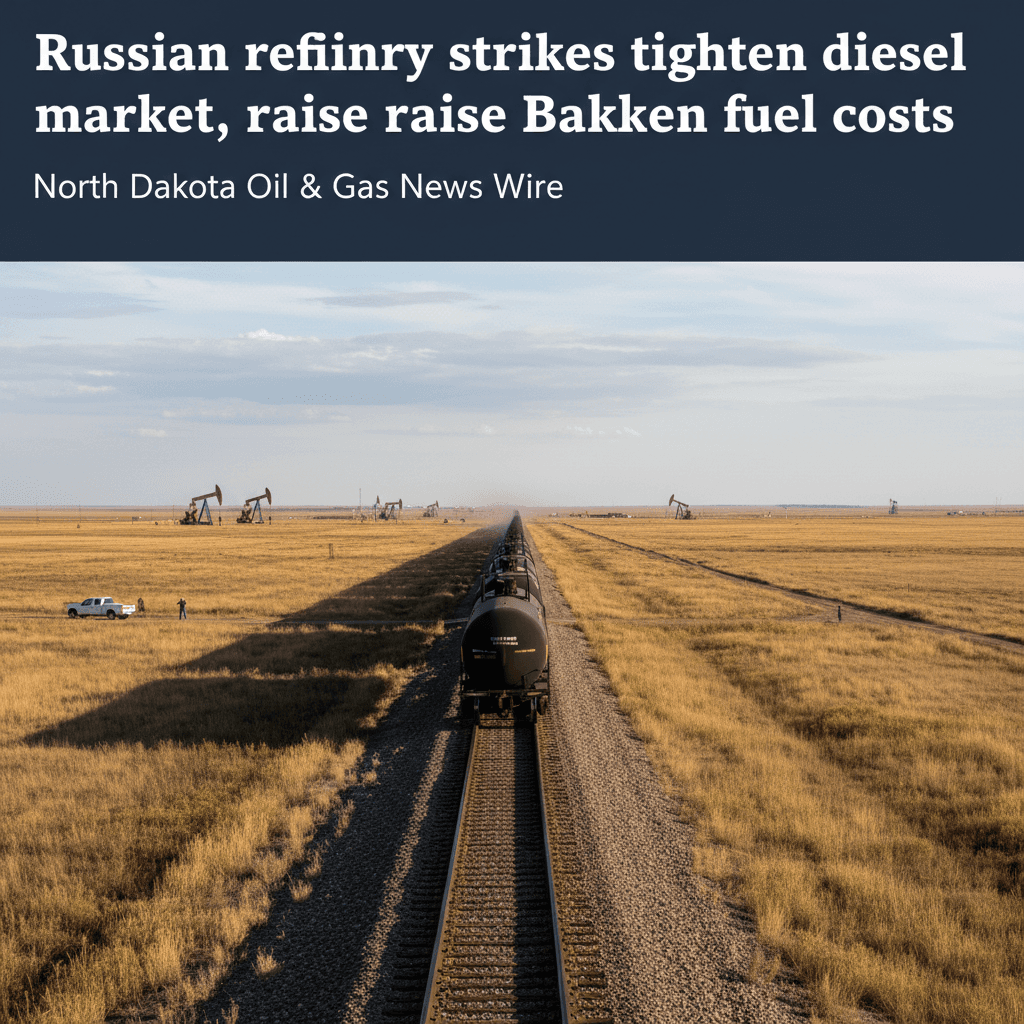
Russian refinery strikes tighten diesel market, raise Bakken fuel costs

Ukraine has hit three Russian refineries since Friday, according to OilPrice.com, a sequence of strikes that has renewed pressure on global diesel supplies and raised fuel costs relevant to North Dakota oil operations. The latest reported damage came Monday, when OilPrice.com cited Bloomberg and satellite imagery from NASA’s Fire Information for Resource Management System showing a relatively fresh heat anomaly at a major oil hub in Russia’s Volga region. The imagery suggested possible fires at the Samara crude oil pumping station. The attacks resumed late last week after a two-week pause. On Friday, a Ukrainian drone strike targeted the Novokuibyshevsk refinery, described by OilPrice.com as one of the leading oil refineries in the Volga region and part of Rosneft’s Samara Group. That was the first Ukrainian strike on a Russian refinery since Oct. 15. During the weekend, OilPrice.com reported that Ukrainian drone attacks hit a Rosneft refinery in the Bashkortostan...

🔆Midday Wire·Nov 2