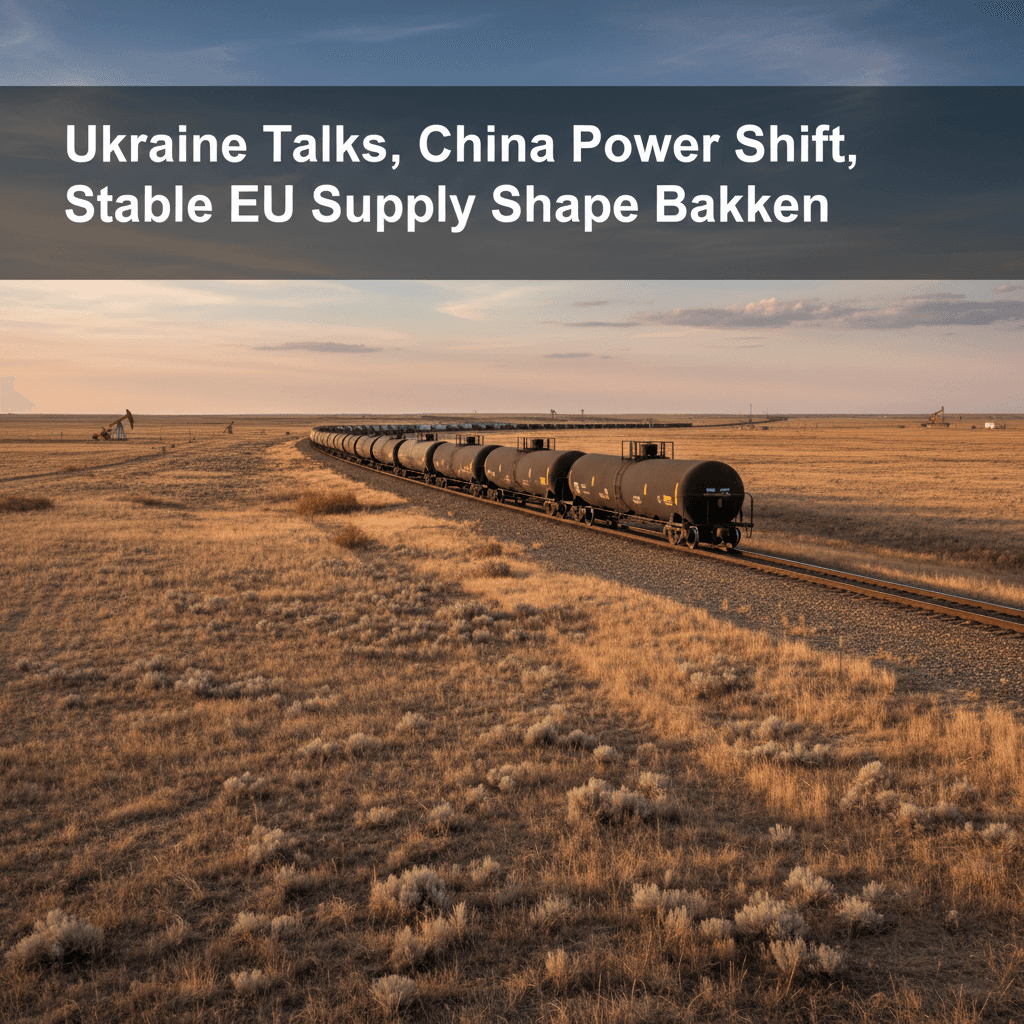
Ukraine Talks, China Power Shift, Stable EU Supply Shape Bakken
North Dakota producers face a global backdrop of tight oil markets, unresolved European conflict and changing Chinese power demand.
Global oil markets remain tight even as European supply is stable, while Ukraine diplomacy and China's power generation shift are adding variables for Bakken operators and royalty owners.
According to Rigzone, the European Union's Oil Coordination Group said oil supply in the bloc continues to be "stable," though oil markets remain tight. For North Dakota producers, that means the global balance is not currently signaling abundant supply, even as European deliveries are holding.
The tightness is emerging while Europe faces an unresolved conflict. OilPrice.com reported that Ukraine is bracing for a pivotal week of defense talks as air strikes continue and Russia shows no signs of compromise to end the war. Ukrainian President Volodymyr Zelenskyy said in his Nov. 15 nightly video address that a meeting of the Ukraine Defense Contact Group, informally known as the Ramstein Group, will take place in Brussels on Nov. 17.
"There will be a Ramstein meeting -- and it must deliver results," Zelenskyy said. "This will send a strong signal -- a signal to Russia that Ukraine will not be left without support."
Zelenskyy said Kyiv's priorities include bolstering air defenses, including additional Patriot missiles and National Advanced Antiaircraft Missile Systems, or NASAMS. He said, "The Russian ballistic missile threat remains very serious, and we have intelligence indicating that new strikes are being prepared."
The Ramstein Group coordinates military support for Ukraine among Western allies, and the Nov. 17 meeting will be led by the defense ministers of Germany and Britain, according to OilPrice.com. Ukraine is also preparing for a Berlin meeting of the Coalition of the Willing, which Zelenskyy called "an important meeting that could be historic." German Chancellor Friedrich Merz said more than 20 heads of state and government are expected. Merz said, "Our goal is to achieve two things: first, to secure funding for Ukraine's defense for 2027 and, second, to reach a unified position regarding upcoming peace talks."
For Bakken operators, the diplomatic track does not yet translate into a clear easing of geopolitical risk. The sources describe continued strikes, defense priorities and a coalition military exercise involving nearly 3,000 troops from 11 countries. That leaves energy-market effects uncertain.
China's power sector is providing a different signal. OilPrice.com reported that China's thermal power generation fell from a year earlier for the fourth consecutive month in October, with year-to-date thermal power output down 0.1%, according to official data compiled by Bloomberg. In October, fossil fuel power generation plunged 7.3% compared with the same month last year, data from China's National Bureau of Statistics showed Monday.
The report attributed the decline to rising renewable output: solar generation rose 31% in October from a year earlier, while wind farms generated 34% more power than last year because of stronger wind speeds. Lower fossil fuel output between July and October left China's fossil fuel power generation down 0.1% year to date through the end of October, according to Bloomberg estimates.
Coal's share of China's electricity output fell below 50% for the first time on record in the first half of 2026, averaging 49.7%, official data showed in July. Solar also became the single largest electricity capacity source in China this summer, the report said.
The change does not eliminate winter demand risks. OilPrice.com said lower temperatures could still raise fossil fuel power generation until the end of the year. But the trend points to a structural shift in the power mix of China, the world's biggest investor and installer of renewable energy.
Taken together, the sources describe a market in which European supply is stable but tight, Ukraine remains a geopolitical pressure point and China's fossil-power demand is weakening. For Bakken producers, that means monitoring global demand and conflict developments as they shape the outlook for oil and gas revenues.
Source
OilPrice.com; Rigzone