WTI Crude--
Brent Crude--
Natural Gas--
ND Rig Count--
WTI Crude--
Brent Crude--
Natural Gas--
ND Rig Count--
U.S.-Russia Diesel Deal, Global Shifts Hold Implications for Bakken - Bakken Wire
Global Markets

U.S.-Russia Diesel Deal, Global Shifts Hold Implications for Bakken

A new agreement to import Russian diesel and regulatory changes abroad could influence crude oil and diesel markets affecting North Dakota producers.

Bakken Wire Staff·🔆Midday Wire·

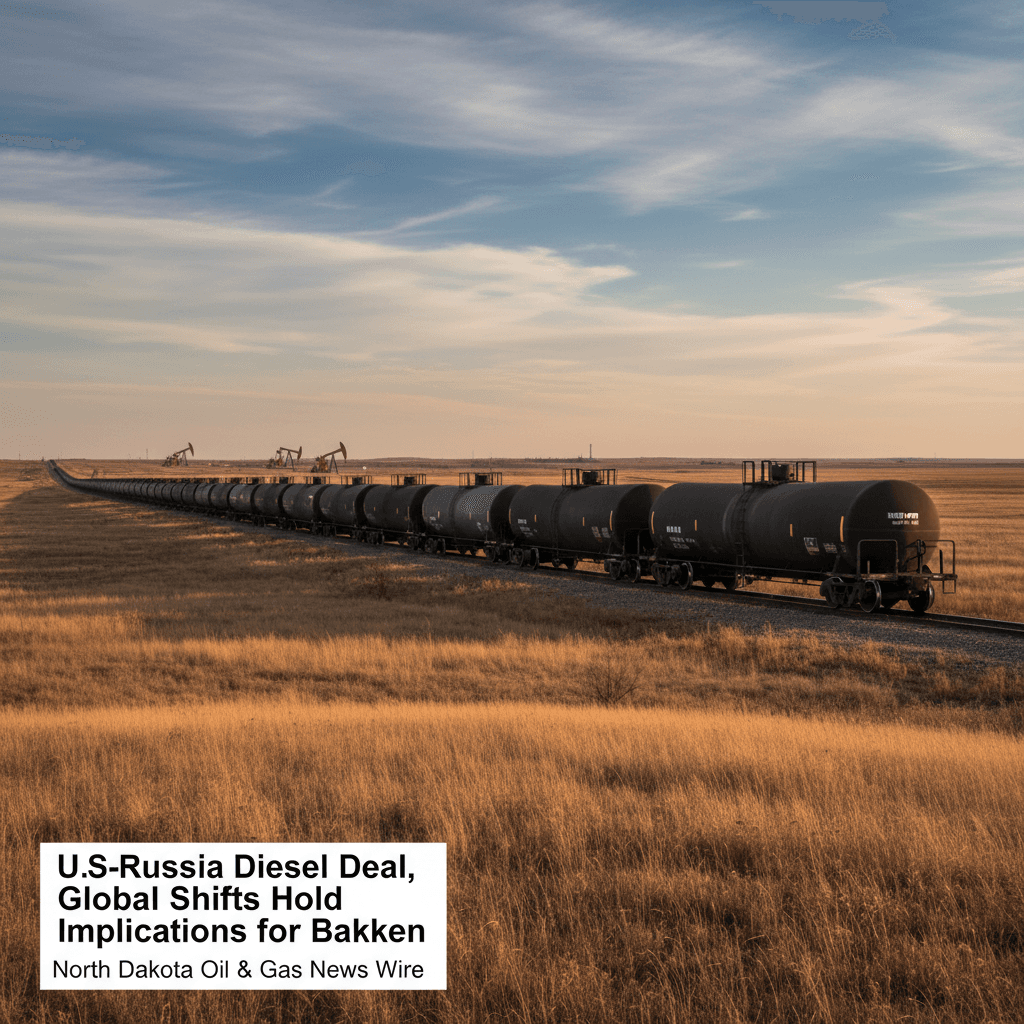
The Trump administration has struck a deal to import significant volumes of Russian diesel into the United States, a move with potential implications for global fuel markets and Bakken crude oil economics, according to an analysis from OilPrice.com. The deal calls for Russia to release 300,000 tonnes (2.24 million barrels) of diesel immediately, followed by 500,000 tonnes in November and a further one million tonnes shortly after. A conditional additional 3 million tonnes could follow.

In total, the first phase would release 1.8 million tonnes, or 13.41 million barrels. If the full conditional volume is delivered, the total would reach 4.8 million tonnes, or 35.76 million barrels. For context, the U.S. averaged 3.91 million barrels per day of diesel consumption in 2025, meaning the initial release covers just over three days of U.S. demand. The full release would cover just over nine days.

According to the OilPrice.com report, the deal is positioned as a response to global diesel supply disruptions caused by the U.S.-Israel war against Iran, which previously accounted for around 20% of global diesel exports. However, the financial impact on Russia is significant. At current wholesale prices, the first phase could pump around $2.8 billion into Russian coffers, rising to over $7 billion if the full deal is executed. Ukrainian President Volodymyr Zelensky criticized the agreement, calling it a "gift" to Russia that would fund its war effort.

For Bakken operators, the influx of diesel could modestly ease domestic diesel prices, a key input cost for drilling and completion operations. However, the report notes the volume is likely too small to make a "discernible difference to the U.S. or global price of diesel over time." The larger impact may be on the geopolitical landscape and subsequent crude oil price volatility, which directly affects Bakken breakevens.

Separately, global oil market dynamics are being influenced by regulatory changes. According to Rigzone, OPEC's smallest member, Equatorial Guinea, is set to pass a new package of favorable terms for oil explorers next week. While not directly impacting the Williston Basin, such moves could encourage increased non-OPEC production over the long term, adding to global supply competition.

For North Dakota, where oil production is closely tied to the price of West Texas Intermediate crude, these international developments introduce new variables. A sustained lower diesel price could marginally improve netbacks for producers, while any geopolitical fallout from the Russia deal or increased global supply could pressure crude benchmarks. Royalty owners watch these shifts closely, as global supply decisions and international tensions ultimately flow through to wellhead economics in the Bakken.

Source

According to OilPrice.com and Rigzone.
dieselrussiaglobal marketsopecgeopoliticsbakkennorth dakota

Share this article

Related Articles

Global Markets

Europe's Lowest Gas Inventory Since 2020s Lifts Global LNG Risk for Bakken

Europe is entering winter with its lowest gas inventory of the 2020s, according to OilPrice.com, a development that keeps global LNG risk elevated even as North Dakota operators face a domestic gas market that remains detached from the rally. EU storage sites were 71.6% full in Gas Infrastructure Europe’s Nov. 11 update, with Germany at 58%, well below the five-year average for the start of the heating season. Asian spot LNG is trading above $30 per million British thermal units, OilPrice.com reported. Rystad Energy’s winter LNG outlook, published this week, stops short of predicting a further rally and tells buyers to plan for a wide range of outcomes instead of one base case. Rystad says Europe will have to pay up to keep US cargoes from being pulled toward Asia, where the loss of Middle Eastern supply has buyers chasing the same Atlantic LNG. The balance sheet is tight. The...

🌅Afternoon Wire·Nov 12
Global Markets

Global LNG, Climate Pledges Shape Bakken Market Signals

Global energy markets are sending mixed signals for North Dakota’s Bakken producers as Europe pays more for Russian LNG ahead of a ban and major governments reaffirm climate commitments while still relying on hydrocarbons, according to OilPrice.com. For Bakken operators and royalty owners, the immediate backdrop is higher global LNG and natural gas prices caused by supply disruptions. OilPrice.com reported that Europe has been paying higher prices for LNG imports after the Iran war and the blocked Strait of Hormuz cut off a large part of Qatar’s LNG supply, sending benchmark LNG and natural gas prices in Europe and Asia soaring. That price environment can matter for U.S. energy demand and export-linked pricing, even as North Dakota’s crude and associated gas markets are driven by many factors. The tightness is reflected in European buying patterns. German campaign group Urgewald said the EU paid $9.6 billion between January and October to...

🔆Midday Wire·Nov 12
The Morning Take - Energy Market Briefing
Global Markets

Energy Market Briefing

Daily Energy Market Briefing Thursday, November 12, 2026 1. Headlines Oil prices are down this morning, with WTI trading at $85.79 (-0.86%) and Brent at $92.14 (-0.67%), according to price data. The market is digesting conflicting signals on global supply flows. Multiple sources, including OilPrice.com and Rigzone, report that crude shipments from the Persian Gulf to India have surpassed Russian flows for the first time since the Iran war began, reaching an estimated 2.1 million barrels per day (bpd) so far this month versus 1.8 million bpd from Russia, per Kpler data. This indicates a material recovery in Hormuz traffic via ship-to-ship transfers. Simultaneously, reports cite Saudi Arabia informing OPEC that its crude production surged 26% last month to the highest level since before the war. On the demand side, U.S. gasoline prices have reportedly fallen below $4 per gallon for the first time since August. In corporate news, Flex...

☀️Morning Wire·Nov 12