
WTI Crude--
Brent Crude--
Natural Gas--
ND Rig Count--
WTI Crude--
Brent Crude--
Natural Gas--
ND Rig Count--
WTI, Brent Crude Rise Over 4% as Trump Floats Gas Tax Holiday, Israel-Iran Tensions Simmer - Bakken Wire
Oil Prices

WTI, Brent Crude Rise Over 4% as Trump Floats Gas Tax Holiday, Israel-Iran Tensions Simmer

Oil prices surge amid political talk of federal fuel tax suspension and ongoing Middle East supply concerns, with Bakken differential holding at a deep discount.

Bakken Wire Staff·🌅Afternoon Wire·

Oil prices climbed sharply Tuesday morning, adding to recent gains as political discussions about a potential federal gasoline tax holiday merged with simmering supply concerns in the Middle East.

West Texas Intermediate (WTI) crude rose $4.11, or 4.11%, to $102.41 per barrel. Brent crude, the international benchmark, gained $3.29, or 3.16%, to trade at $107.59. Natural gas prices also moved higher, up $0.08 to $2.83 per MMBtu.

The Bakken crude differential at Clearbrook, Minnesota, was quoted at $-3.42 per barrel versus WTI, maintaining the wide discount that has characterized the local grade for months.

The price rally coincides with political headlines. Former President Donald Trump told CBS News Monday that he favors the idea of a temporary federal gas tax holiday. “I think it’s a great idea,” he said, suggesting the tax could be removed “for a period of time” until prices recede. Current Energy Secretary Chris Wright echoed that sentiment Sunday, stating the administration is “open to all ideas” for lowering pump prices.

The federal tax on gasoline is $0.184 per gallon, with diesel taxed at $0.244. The revenue funds highway projects. Suspending the tax has been discussed during previous price spikes, including in 2022, but Congress did not act.

Market observers note that prices are already up significantly in recent weeks. Since the start of the Israel-Hamas war, U.S. retail gasoline prices have jumped by roughly 50%. Tensions escalated over the weekend as Iran launched missile attacks on Israel, Israel carried out a retaliatory strike. The key Strait of Hormuz, a vital oil transit chokepoint, remains a focal point for supply fears.

Consumer sentiment has been dampened by the high fuel costs. The latest University of Michigan survey showed sentiment at its lowest level since 1952, with many consumers citing gasoline prices. Analysts suggest that until concrete supply disruptions occur in the Middle East, prices may remain volatile but are unlikely to sustain these peaks long-term. However, the prevailing market mood is one of caution, supporting higher prices for now.

For operators in the Bakken, the wide differential to WTI means realized prices remain substantially lower than the headline benchmark. However, any broad increase in crude benchmarks provides a revenue uplift. The current differential reflects continued pipeline takeaway capacity and regional refining dynamics.

Source

Live price data from oilprice.com; Context from Rigzone article "Another USA Gasoline Price Surge Could be Coming" published May 12, 2026, 11:33 AM ET; Context from OilPrice.com article "Trump Floats Federal Gas Tax Holiday as Pump Prices Surge" published May 12, 2026.

oil priceswtibrent crudenatural gasbakken differentialfederal gas taxtrumpisraeliranstrait of hormuzconsumer sentiment

Share this article

Related Articles

Oil Prices Steady as Market Awaits OPEC+ Decision - Bakken Wire
Oil Prices

Oil Prices Steady as Market Awaits OPEC+ Decision

Front-month WTI crude oil futures were unchanged in Sunday trading, holding at $83.41 per barrel, according to live price data. The global benchmark, Brent crude, was also flat at $89.95 per barrel. The price stability comes as traders await a key decision from the OPEC+ alliance of oil-producing nations. The group is scheduled to meet virtually on December 4 to discuss production policy for 2027. Market analysts widely expect the meeting to focus on whether to extend or deepen existing output cuts into the new year, a move aimed at supporting prices. For Bakken operators, the local price benchmark is the Bakken differential, which represents the price difference between Bakken crude at the Clearbrook, Minnesota hub and the U.S. benchmark, WTI. On Sunday, that differential was reported at a discount of $3.42 per barrel. This means Bakken crude is effectively priced at approximately $79.99 per barrel. A steady WTI price...

🌅Afternoon Wire·Nov 22
WTI Climbs Above $83, Bakken Differential Holds Steady at -$3.42 - Bakken Wire
Oil Prices

WTI Climbs Above $83, Bakken Differential Holds Steady at -$3.42

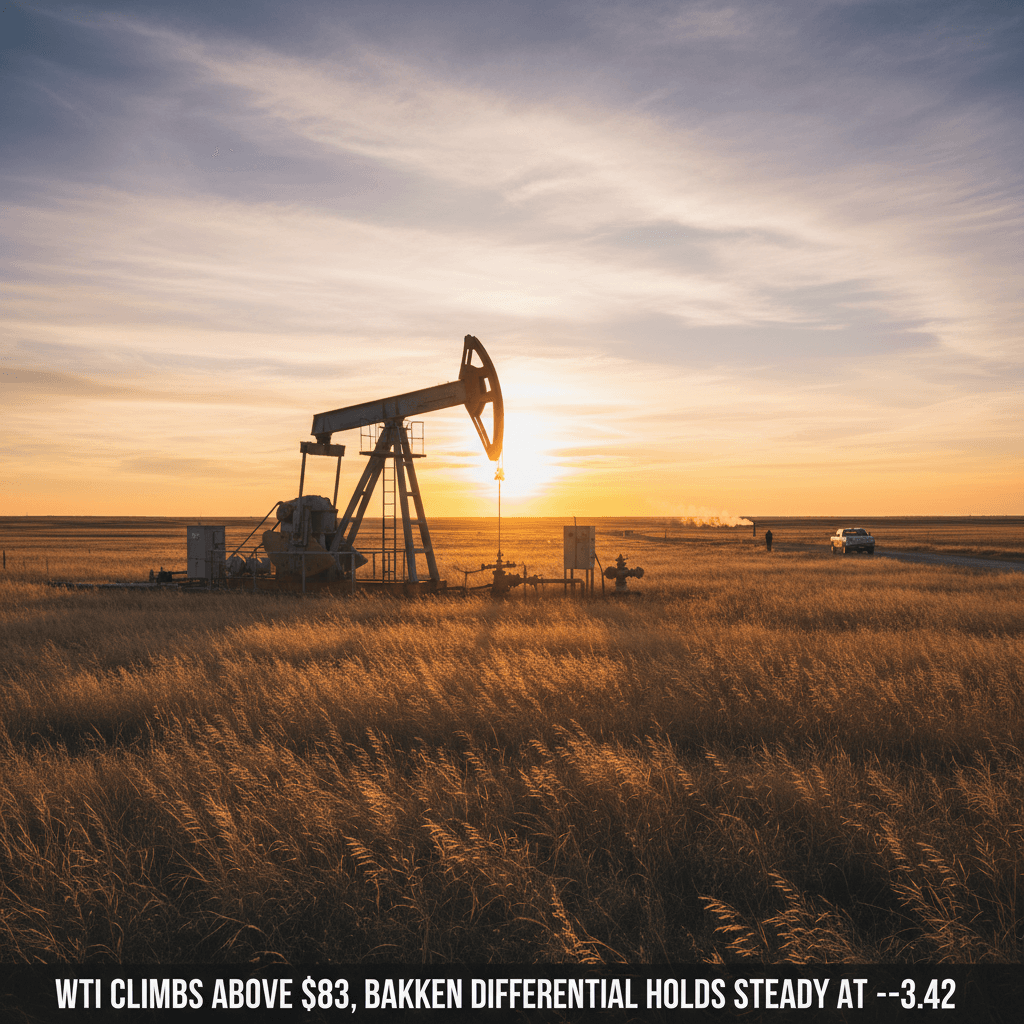
West Texas Intermediate crude oil traded at $83.41 per barrel on Sunday, gaining $0.97 or 1.18% for the session. The global benchmark Brent crude rose to $89.95, a more modest increase of $0.51. The price for Bakken crude, a key indicator for North Dakota producers, held at a differential of $3.42 per barrel below WTI. Natural gas prices also saw upward movement, with the commodity trading at $3.75 per MMBtu, a gain of $0.07. This near-term strength comes despite a longer-term bearish outlook from federal forecasters. According to Rigzone, the U.S. Energy Information Administration projected in its latest short-term energy outlook that the U.S. Henry Hub spot price will drop in both 2026 and 2027. The EIA's outlook, published November 20, suggests downward pressure on natural gas prices in the coming years, contrasting with the current session's gains. For Bakken operators, the current price environment provides a stable revenue outlook....

🔆Midday Wire·Nov 22
WTI Climbs Above $83, Bakken Differential Holds Steady - Bakken Wire
Oil Prices

WTI Climbs Above $83, Bakken Differential Holds Steady

Front-month WTI crude oil futures rose 1.18% to settle at $83.41 per barrel on Sunday, November 22, while Brent crude gained 0.57% to $89.95. The benchmark Bakken differential was recorded at $-3.42 versus WTI. Natural gas prices also moved higher, adding $0.07 to $3.75 per MMBtu. The price increase comes despite bearish U.S. inventory data reported last week. According to Rigzone, commercial crude oil stocks, excluding the Strategic Petroleum Reserve, rose by over 3 million barrels week-on-week to 417.797 million barrels as of November 13. Typically, a larger-than-expected build in inventories places downward pressure on prices. The market's ability to absorb the inventory build and move higher may be linked to shifting global crude dynamics. Rigzone also reported that the "war premium" for USA sour crude grades has vanished, indicating changing supply perceptions that can influence the pricing landscape for all crudes, including the light sweet oil produced in the...

☀️Morning Wire·Nov 22