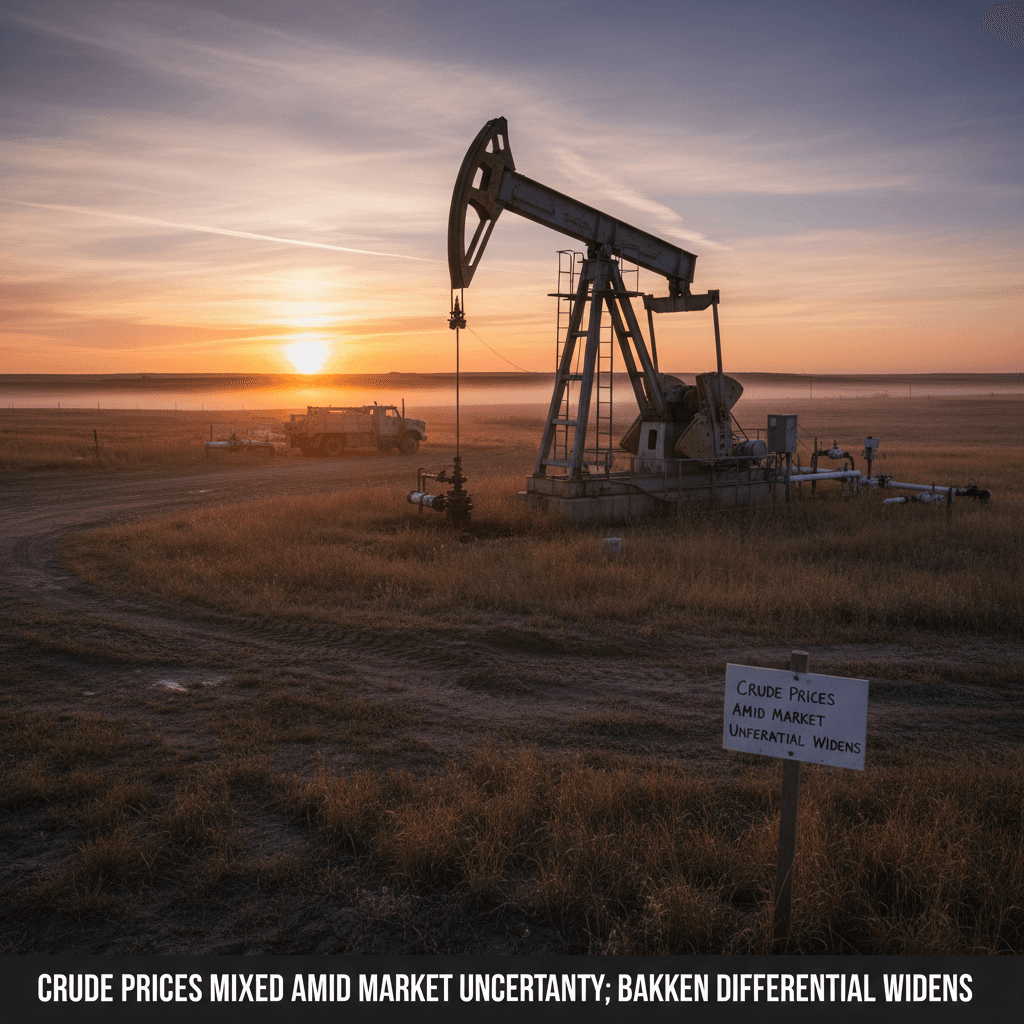
WTI, Brent Edge Lower Despite Russian Production Shortfall
Bakken crude differential holds near -$3.42 as broader market weighs supply dynamics against demand concerns.
Front-month WTI crude futures fell 0.71% to settle at $82.61 per barrel on Wednesday, August 12, while Brent crude declined 0.56% to $88.41. The Bakken crude differential to WTI was reported at -$3.42. Natural gas posted a modest gain, rising $0.03 to $2.80 per MMBtu.
The day's price retreat occurred despite news of ongoing supply tightness from a major OPEC+ producer. According to Rigzone, Russia's crude-only production lagged behind its OPEC+ quota by almost a million barrels a day in July. This significant shortfall, however, was insufficient to counter broader market headwinds pressuring prices.
For Bakken operators, the current price environment presents a stable but cautious backdrop. With WTI above $82 and the local differential relatively narrow, wells in the core of the play remain economically viable. The Bakken price at the wellhead would equate to approximately $79.19 per barrel after accounting for the differential. This level supports ongoing maintenance and some incremental activity but is unlikely to trigger a significant surge in new drilling permits.
The market's muted reaction to the Russian production data suggests traders are balancing geopolitical supply risks against concerns over global economic demand. OPEC+ collective discipline, exemplified by Russia's current underproduction, provides a price floor. Yet, anxieties about fuel consumption growth, particularly from major economies like China, are applying countervailing pressure.
Natural gas prices, while up slightly, remain subdued near $2.80. This continues to pressure margins for operators with significant associated gas production in the Bakken, where gas capture infrastructure and takeaway capacity are perennial considerations.
The overall price action indicates a market in search of a clearer directional catalyst. For North Dakota producers, the focus remains on operational efficiency and cost control to maintain profitability within the current trading band. The stability of the Bakken differential is a positive sign for local market logistics, suggesting consistent pipeline and rail takeaway capacity.
Source
Live price data; Rigzone report from August 12, 2026.