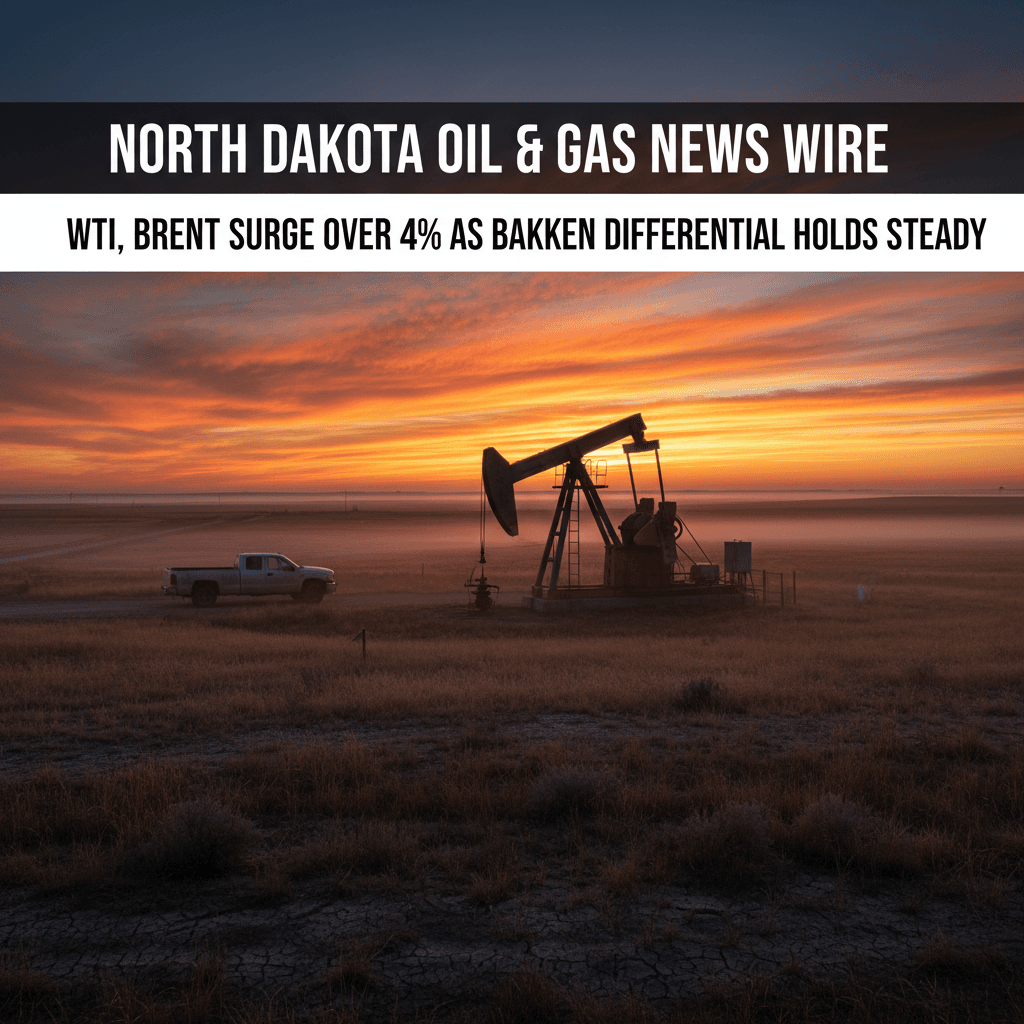
WTI, Brent Surge Over 4% as Bakken Differential Holds Steady
Oil prices rebound sharply in Thursday trading, providing a boost to Bakken operators as the regional discount remains below $3.50 per barrel.
Oil prices surged more than 4% in Thursday trading, with West Texas Intermediate (WTI) crude climbing $3.95 to settle at $92.23 per barrel, according to live price data. The global benchmark, Brent crude, rose $4.45 to $104.65 per barrel.
The price rebound was driven by market fundamentals, according to analysis from Rigzone. Naeem Aslam, CIO at Zaye Capital Markets, outlined the main driver for the intraday move, Rigzone reported.
For Bakken operators, the rally is tempered by a persistent regional discount. The Bakken differential—the price adjustment for crude produced in the North Dakota region—was recorded at $-3.42 per barrel versus WTI. This means Bakken crude is priced at approximately $88.81 per barrel, factoring in the discount from the WTI benchmark.
In the natural gas market, prices saw a modest increase, with the Henry Hub spot price rising $0.05 to $3.25 per MMBtu. Executive sentiment on future natural gas prices was captured in the third-quarter Dallas Fed Energy Survey, Rigzone reported. Executives from oil and gas firms revealed where they expect the Henry Hub natural gas price to be at various points in the future.
The sharp rise in crude prices directly improves cash flow and margins for producers across the Williston Basin. The stability of the Bakken differential, which remains under the psychologically significant $4.00 level, indicates consistent takeaway capacity and favorable pricing relative to the benchmark.
Sustained prices above $90 per barrel for WTI provide significant economic incentive for continued drilling and completion activity in the Bakken formation. The simultaneous, though more subdued, increase in natural gas prices offers additional revenue support for wells with associated gas production.
Market observers will monitor whether this price strength holds through the week, as it influences budgeting and operational plans for North Dakota's oil and gas sector. The price environment remains a key determinant for rig count stability and production growth in the state.
Source
Live Price Data, Rigzone