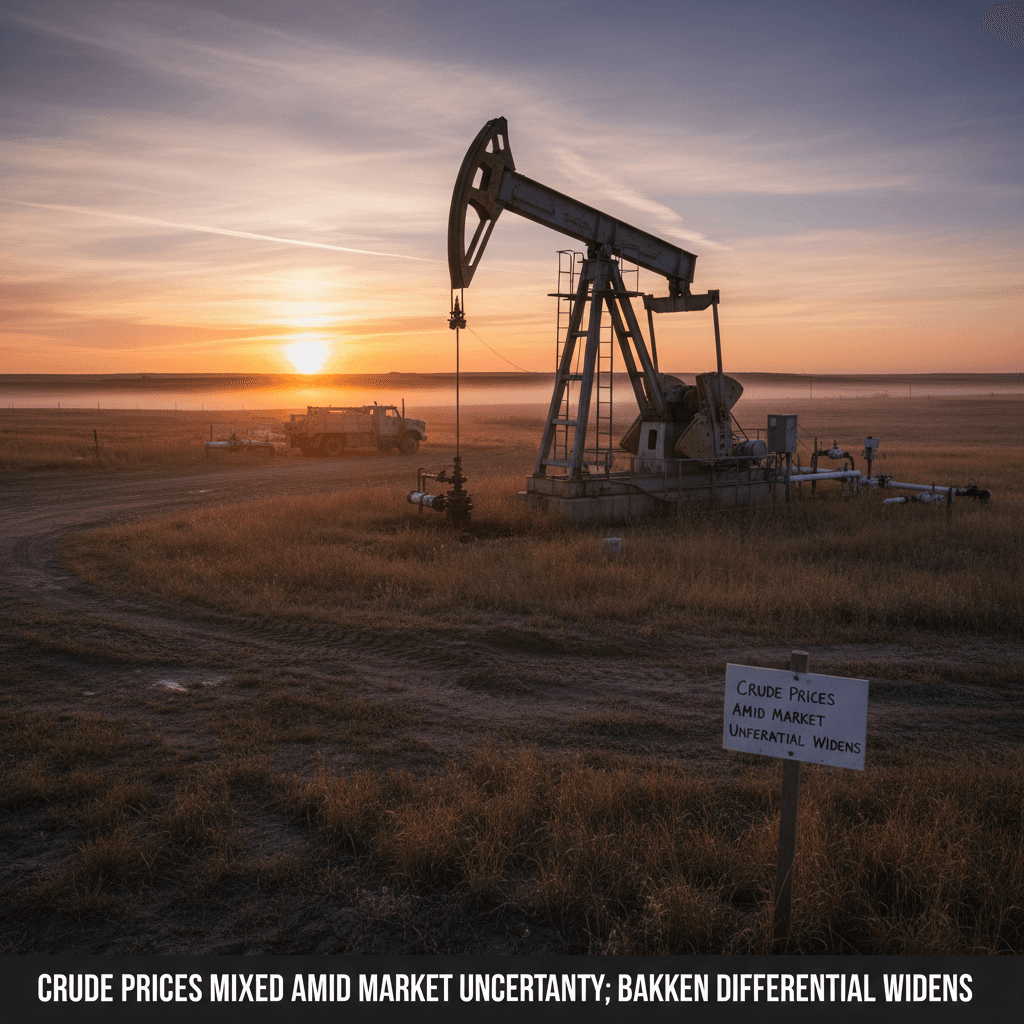
WTI Dips Below $79 as Inventory Draw Meets Russia Export Glut
Geopolitical tensions and a U.S. stockpile decline fail to lift crude, while the EIA boosts its natural gas price outlook.
U.S. benchmark crude prices fell Wednesday, with West Texas Intermediate (WTI) trading down 0.55% to $78.90 per barrel despite a weekly drawdown in domestic inventories and escalating Middle East tensions. The global Brent benchmark also declined, trading at $84.21, according to midday live data. The price for Bakken crude at the wellhead was discounted by $3.42 per barrel versus WTI.
The price slide occurred even as the U.S. Energy Information Administration (EIA) reported commercial crude inventories fell by 1.7 million barrels for the week ending July 10. Stockpiles now sit 6% below the five-year average for this time of year, according to OilPrice.com. Gasoline inventories also drew down by 1.5 million barrels, while distillate stocks, which include diesel, jumped by 4.6 million barrels.
Market observers noted that the bullish inventory data was overshadowed by a significant surge in Russian crude exports creating a global supply overhang. According to a separate OilPrice.com report, nearly 135 million barrels of Russian crude are currently stranded at sea due to Ukrainian airstrikes crippling domestic refining capacity. With roughly one-third of Russia's refining capacity offline, Moscow is being forced to divert more barrels to international markets, creating a traffic jam at key export hubs and pressuring global prices.
"Crude futures were down in morning trading despite escalating tensions between the United States and Iran," OilPrice.com reported, noting that Brent prices are still up roughly $7 a barrel from a week ago amid the geopolitical risk premium.
For Bakken operators, the widening discount for local crude compared to WTI, now at -$3.42, squeezes netbacks even as global benchmarks hold near $80. The combination of ample global crude supply from Russia and steady U.S. production tempers the upside from inventory declines. However, the EIA provided a positive signal for associated gas producers, raising its Henry Hub natural gas spot price forecast for 2026 and 2027, Rigzone reported. Natural gas prices were steady at $2.91 per MMBtu in midday trading.
The EIA data also showed U.S. oil demand, measured by total products supplied, averaged 20.3 million barrels per day over the last four weeks, up 0.3% year-over-year. Distillate demand was down 2.1% over the same period.
Source
Live price data, OilPrice.com, Rigzone