WTI Eases to $88.56 as Bakken Differential Holds at $3.42 Below
Brent holds near $95.84 while natural gas falls to $3.23, squeezing associated-gas revenue in the Williston Basin.
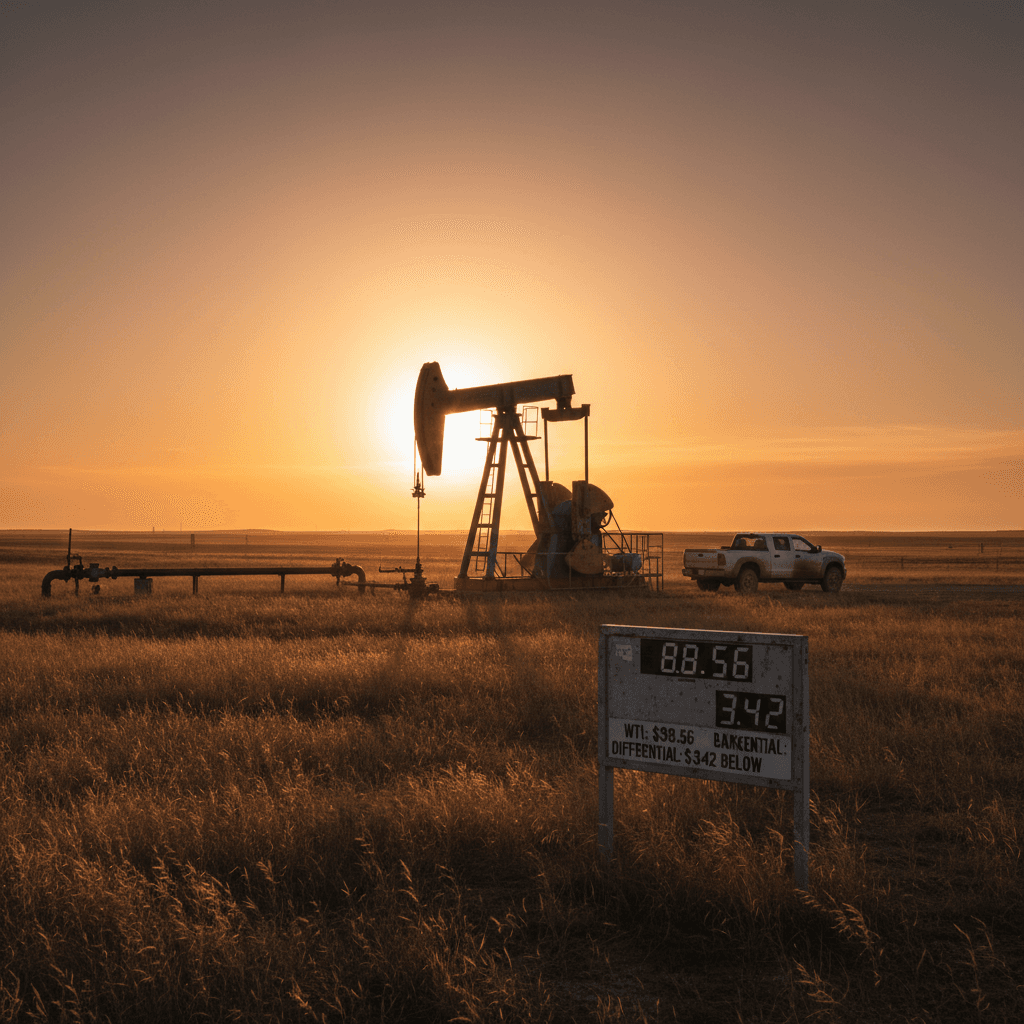
According to live price data, WTI crude traded at $88.56 a barrel in the afternoon edition, down $0.18, or 0.2%. Brent crude was $95.84, up $0.02, or 0.02%. Natural gas fell $0.11 to $3.23 per million British thermal units. The Bakken differential was $3.42 below WTI.
The small moves leave the Brent-WTI spread at $7.28 a barrel. For Bakken producers, the differential implies a realized crude price of about $85.14 a barrel, based on the data. That is still a high absolute price for North Dakota oil, but the discount matters when operators calculate netbacks, royalty checks and wellhead economics. The Bakken formation remains North Dakota’s primary oil-producing region, so benchmark prices and regional discounts are closely watched by lease operators and mineral owners.
Oil markets appeared to be trading within a narrow range rather than chasing a single catalyst. In general, WTI and Brent are shaped by OPEC+ supply discipline, global demand expectations, refinery utilization, inventory trends and geopolitical risk. A flat Brent and slightly lower WTI can indicate that traders are weighing tight supply against softer demand or inventory signals, though the live price data did not identify a specific driver for the day.
For Bakken operators, WTI near $88.56 supports cash flow, particularly where lease operating costs and drilling economics are sensitive to benchmark crude. A negative differential, however, reduces local realizations. Bakken barrels often compete with Canadian heavy crude, Permian crude and imported light crude, so regional discounts can widen when pipeline capacity, maintenance or storage constraints affect Williston Basin crude.
The natural gas move was more notable. Gas at $3.23, down $0.11, matters in the Bakken because many wells produce associated gas alongside oil. Lower gas prices can reduce revenue from casinghead and plant gas, and can make gas capture investments less attractive in the short term. For royalty owners, oil remains the dominant revenue driver, but gas prices can influence the total value of a property, especially when production is gassy or when midstream operators pass through low regional prices.
The data also showed a modest divergence between the two crude benchmarks. Brent’s near unchanged level suggests the global seaborne market remained stable, while WTI’s small decline may reflect U.S. supply, inventory or delivery-point dynamics. The Bakken differential staying negative reinforces that North Dakota crude prices still follow WTI but trade at a discount to the national benchmark.
Operators and royalty owners watching the afternoon tape will likely focus on whether WTI can hold above $88 and whether the Bakken discount narrows as demand improves. With natural gas lower, the day’s message for Williston Basin producers is straightforward: oil prices remain strong enough to support activity, but local discounts and gas revenue are still key to netbacks.
Source
Bakken Wire live price data