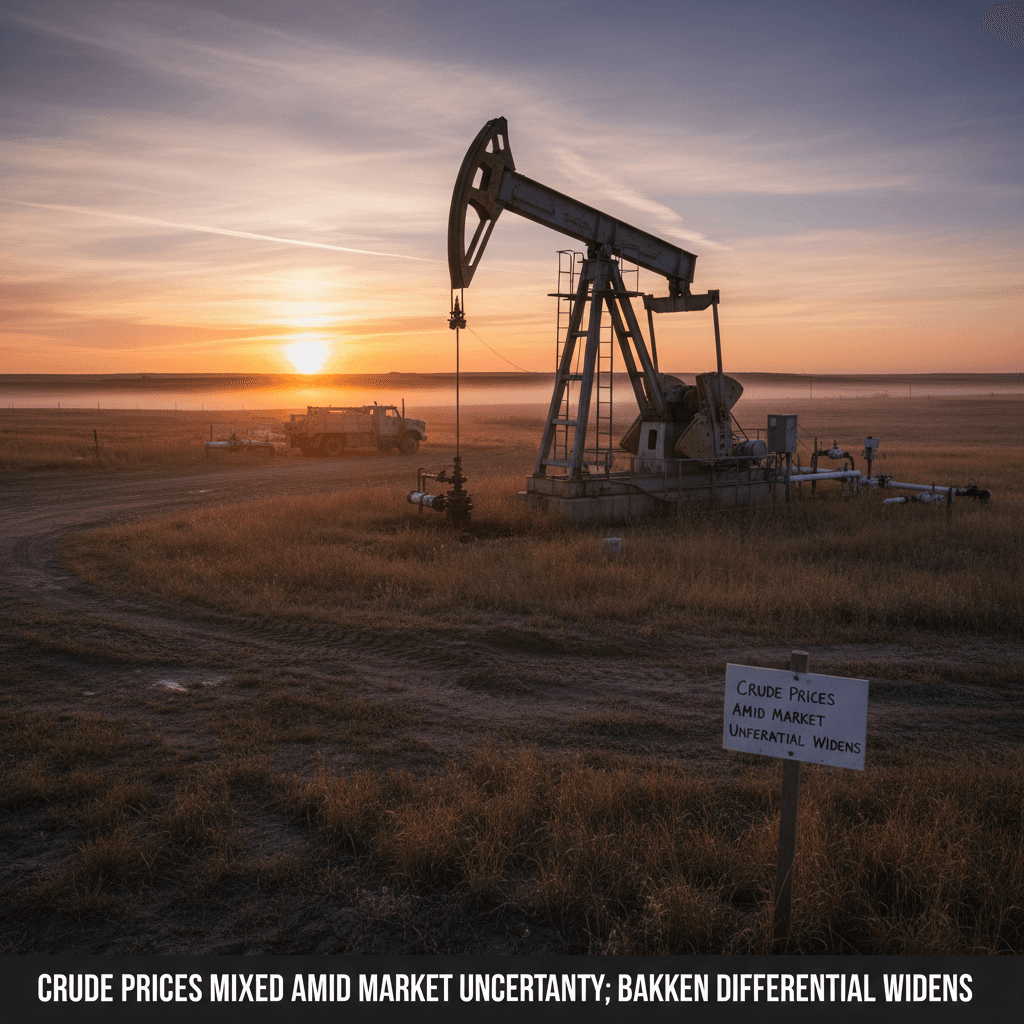
WTI Holds Above $87 as Global Supply Concerns Support Prices
Bakken crude discount widens slightly amid mixed market signals and tightening global crude flows.
Front-month WTI crude futures traded at $87.06 per barrel at midday Saturday, August 22, 2026, posting a modest gain of $0.23 (0.26%). The global Brent benchmark showed stronger movement, rising $0.61 (0.65%) to $94.39. Bakken crude at the wellhead was priced at a discount of $3.42 per barrel below WTI.
The market finds support from ongoing concerns about global crude availability. According to a Rigzone report published today, U.S. refiners are facing a looming supply drop from their biggest foreign crude supplier during a period of high demand. This impending import crunch adds a layer of bullish pressure to the oil complex as domestic refiners may need to compete more aggressively for alternative barrels, including those from U.S. shale basins.
Meanwhile, a separate supply agreement highlights the tightening of Atlantic Basin crude flows. Rigzone reported that Equinor secured a three-year deal to supply between five and more than nine million metric tons of crude oil annually from Norway to ORLEN. Such long-term commitments of non-Russian crude to European buyers reinforce a structurally tight global market, limiting the volume of seaborne crude available for other regions.
For Bakken operators, the current price environment presents a stable revenue outlook with WTI firmly above $85. However, the Bakken differential has widened slightly compared to recent weeks, indicating potential local logistical constraints or a momentary shift in buyer demand for the specific grade. At the current differential, Bakken crude is effectively priced near $83.64 per barrel.
Natural gas prices also saw an uptick, rising $0.05 to $2.81 per MMBtu. While not a primary driver for most Bakken producers who target oil, stronger gas prices can improve the economics of wells with high associated gas output and support gas capture initiatives in the state.
The midday price action suggests a market digesting conflicting signals. The steady climb reflects underlying supply anxieties, but the modest gains indicate traders may be awaiting clearer indicators on U.S. inventory levels or macroeconomic direction. The stronger performance of Brent versus WTI continues to reflect the greater immediate supply pressure on the international market compared to the U.S. domestic scene.
The reported import crunch for U.S. refiners could ultimately benefit Bakken producers if it leads to increased domestic sourcing. North Dakota's output remains a critical component of U.S. supply, and any sustained pull from Gulf Coast or Midwest refiners would help maintain strong differentials or potentially narrow them from current levels.
Source
Live price data as of August 22, 2026; Rigzone article "US Refiners Face Import Crunch from Top Crude Seller" (August 22, 2026); Rigzone article "Equinor Secures Deal to Supply Crude to ORLEN" (August 21, 2026).