
WTI Crude--
Brent Crude--
Natural Gas--
ND Rig Count--
WTI Crude--
Brent Crude--
Natural Gas--
ND Rig Count--
WTI Near $85.49 as Gulf Attacks Offset Surplus Forecasts - Bakken Wire
Oil Prices

WTI Near $85.49 as Gulf Attacks Offset Surplus Forecasts

Bakken crude was discounted $3.42 to WTI as volatile crude markets weighed Iran tensions against expectations of a growing oil surplus.

Bakken Wire Staff·🌅Afternoon Wire·

Williston Basin producers faced a mixed price picture Tuesday afternoon as crude markets swung between geopolitical risk and supply concerns, according to Rigzone. WTI crude was quoted at $85.49 a barrel, down $0.23, or 0.27%, while Brent crude rose $0.50 to $92.94, up 0.54%. The divergence between U.S. and global benchmarks highlighted how regional logistics, international risk and domestic supply forecasts are pulling prices in different directions.

Rigzone reported that crude markets remained volatile as Iran tensions offset forecasts of a growing oil surplus. The outlet's headline, "Oil Prices Swing as Gulf Attacks Continue," pointed to persistent instability in the Gulf region, a key corridor for global crude flows. For North Dakota operators, the takeaway is that global risk premiums can support prices even when broader market forecasts suggest more barrels may become available.

The Bakken differential was $3.42 below WTI. That discount is a practical marker of what North American light sweet crude produced in the Bakken can fetch relative to the Cushing-based WTI benchmark. A discount can reflect local transportation constraints, pipeline capacity, refinery demand and regional crude differentials. For Bakken producers, a wider discount against WTI can compress realized prices even when national benchmarks appear steady.

Natural gas moved higher, rising $0.08 to $3.20. Although Bakken production is primarily oil-driven, associated gas is a meaningful revenue component and a cost consideration for operators. Gas prices can influence wellhead economics, midstream contracts and the pace of development, especially for producers balancing oil and gas volumes from the same acreage.

For royalty owners, the combination of a slightly lower WTI, firmer Brent and a $3.42 Bakken discount creates a nuanced environment. Royalty calculations often depend on the benchmark used in leases and midstream agreements, regional differentials and transportation deductions. When WTI slips modestly but the Bakken discount remains, royalty income may not track headline crude prices one-for-one.

For North Dakota's broader energy economy, Tuesday's price action highlights how fragile sentiment can be. A modest decline in WTI, a firmer Brent and volatile market conditions suggest that neither geopolitical risk nor supply forecasts have decisively resolved the direction of crude prices. The state's producers, who depend on access to national and international markets, are watching whether Gulf-linked tensions can keep a floor under global prices while surplus expectations cap upside.

The immediate implications for Bakken operators are straightforward: cash flow depends not only on WTI, but on regional differentials, gas co-production economics and global benchmark spreads. If Iran-related tensions continue to offset surplus forecasts, oil prices may remain volatile rather than trend sharply lower. But if supply expectations dominate, the modest WTI decline and the Bakken discount could pressure realized revenue.

Source

Bakken Wire live price data; Rigzone, "Oil Prices Swing as Gulf Attacks Continue," Nov. 17, 2026.

bakkenwtibrentoil pricesnatural gasnorth dakotarigzonegulf tensionsiranoil surplus

Share this article

Related Articles

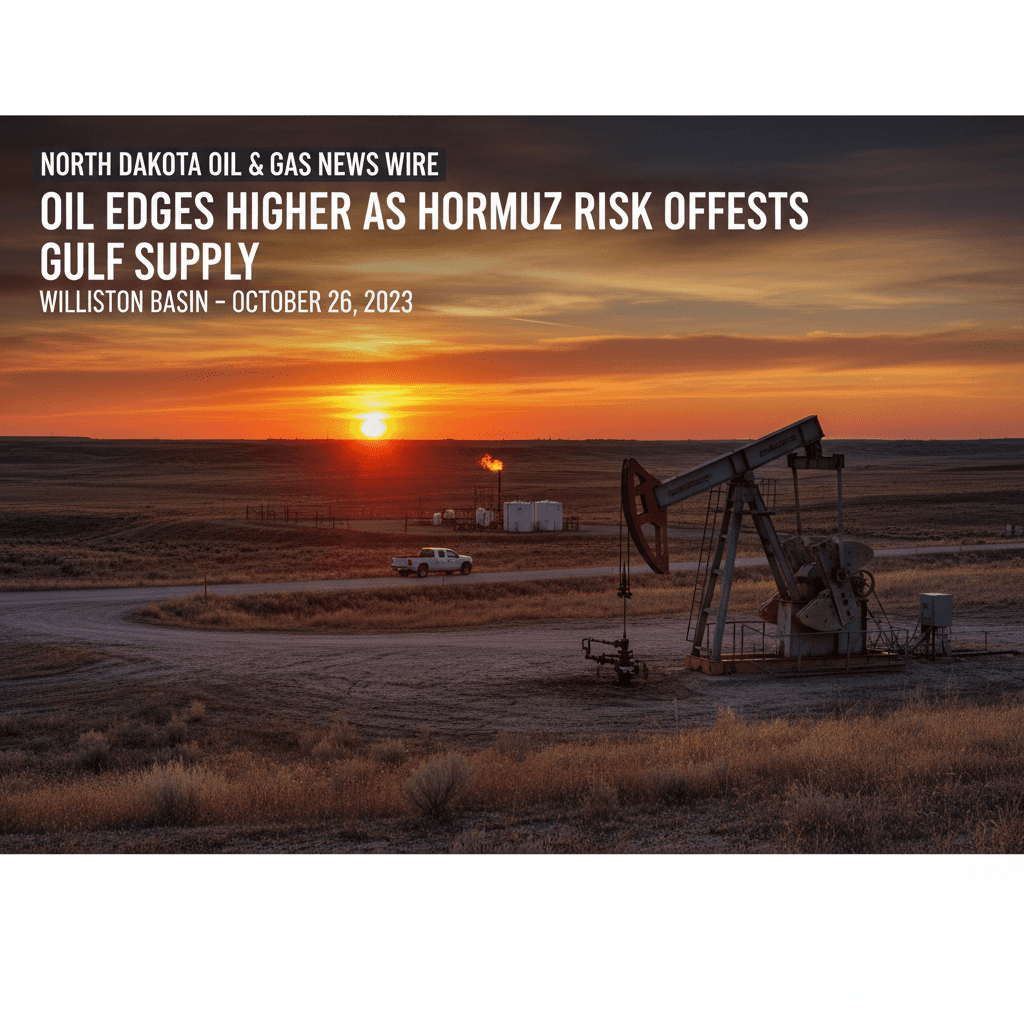
Oil Edges Higher as Hormuz Risk Offsets Gulf Supply - Bakken Wire
Oil Prices

Oil Edges Higher as Hormuz Risk Offsets Gulf Supply

Oil prices rose modestly in Tuesday’s midday update as geopolitical risk in the Middle East offset signs of increased supply, according to OilPrice.com. WTI crude was at $86.45 per barrel, up $0.73, or 0.85%. Brent crude rose $0.77, or 0.83%, to $93.21. Natural gas was $3.15, up $0.03. Bakken crude traded at a $3.42 discount to WTI, implying a regional benchmark near $83.03. The discount underscores the transport and refining factors that can limit how much of a global price gain reaches Williston Basin producers. OilPrice.com reported prices had been somewhat directionless over the past couple of trading days as the physical impact of rising Middle Eastern exports was offset by an unprecedented level of tanker attacks in the Strait of Hormuz. The outlet said Iran’s attack on a US military radar system in Bahrain marked another escalation in the US-Iran conflict, which has been focused on maritime warfare lately....

🔆Midday Wire·Nov 17
Bakken Crude Discount Holds at $3.42 as WTI, Brent Rise - Bakken Wire
Oil Prices

Bakken Crude Discount Holds at $3.42 as WTI, Brent Rise

Bakken Wire - Oil prices rose modestly Tuesday morning, with West Texas Intermediate crude up $0.60, or 0.7%, to $86.32 a barrel and Brent crude up $0.69, or 0.75%, to $93.13, according to live market data compiled by Bakken Wire. The gains were small but broad across the crude complex. Brent remained $6.81 above WTI, a spread that often reflects seaborne supply conditions, global demand expectations and transportation costs between U.S. inland benchmarks and international markets. For North Dakota producers, the key figure was the Bakken differential, which stood at negative $3.42 against WTI. The discount means Bakken crude is priced $3.42 below the U.S. benchmark. At WTI’s $86.32, that implies a Bakken benchmark price of $82.90. That differential matters directly to Bakken operators and royalty owners. Many Williston Basin producers sell crude into regional gathering systems, rail or pipeline markets, where basis levels can move with local throughput, refinery...

☀️Morning Wire·Nov 17
Oil Prices Plunge Amid OPEC+ Delay, Demand Worries - Bakken Wire
Oil Prices

Oil Prices Plunge Amid OPEC+ Delay, Demand Worries

Oil prices fell sharply on Monday, with West Texas Intermediate (WTI) crude closing at $85.22 per barrel, a drop of $3.34 or 3.77%. The global Brent benchmark fell to $91.95, down $3.89 or 4.06%. The sell-off was primarily driven by news that the OPEC+ group of oil producers has postponed its policy meeting scheduled for this weekend. The unexpected delay of the OPEC+ meeting, reportedly due to internal disagreements over production quotas, injected significant uncertainty into the market. Traders interpreted the move as a sign of potential discord within the alliance, which could undermine its ability to manage supply and support prices. This comes at a time when concerns over global economic growth and fuel demand are already weighing on sentiment. For Bakken producers, the price drop is compounded by a widening discount for local crude. The Bakken differential weakened to negative $3.42 per barrel versus WTI on Monday. This...

🌅Afternoon Wire·Nov 16