WTI Crude--
Brent Crude--
Natural Gas--
ND Rig Count--
WTI Crude--
Brent Crude--
Natural Gas--
ND Rig Count--
WTI Slips Below $91 as Bakken Differential Widens to -$3.42 - Bakken Wire
Oil Prices

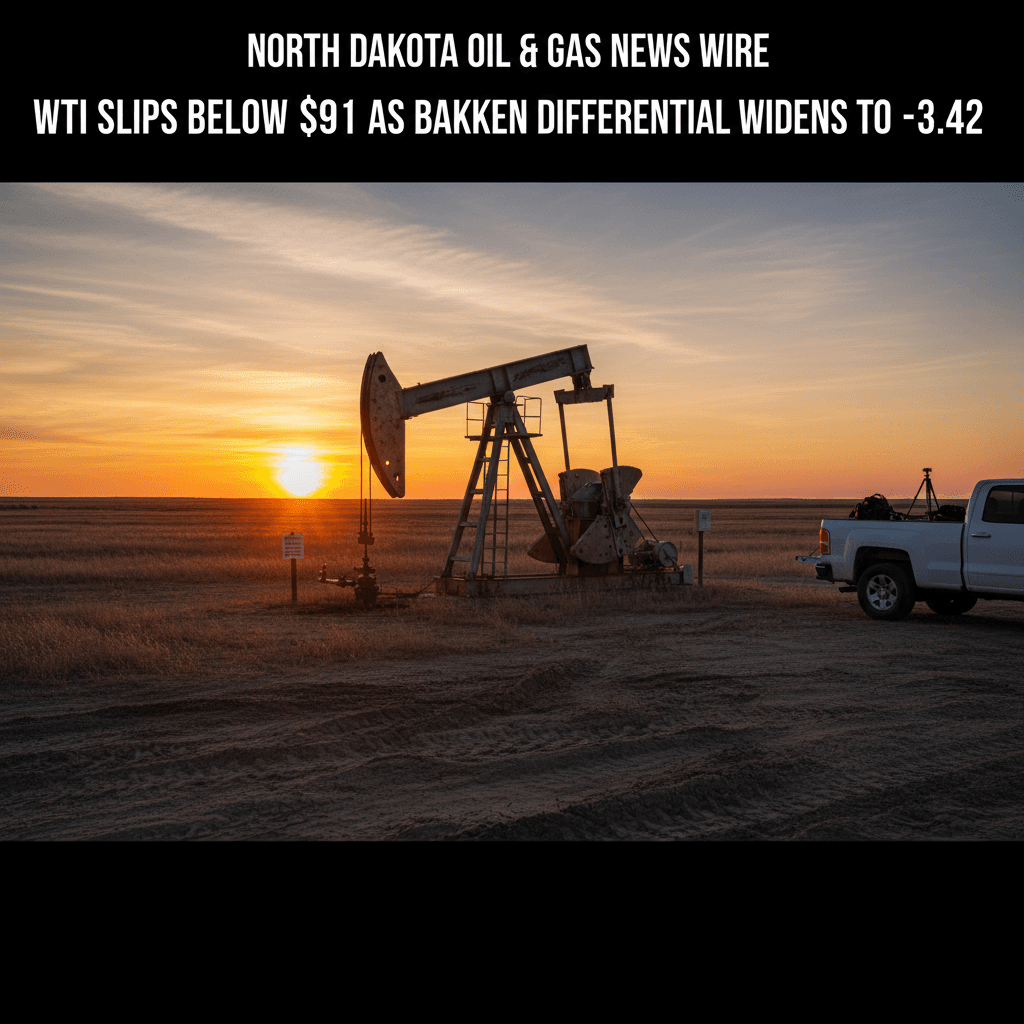
WTI Slips Below $91 as Bakken Differential Widens to -$3.42

U.S. crude inventory draw provides some support, while a major competitor's low-cost potential highlights market pressures.

Bakken Wire Staff·🔆Midday Wire·

West Texas Intermediate crude oil prices edged lower in midday trading Friday, September 4, 2026, while the discount for Bakken crude widened. WTI was trading at $90.9 per barrel, down $0.44 (-0.44%), according to live price data. The international benchmark Brent crude was marginally higher at $95.58.

The price for Bakken-quality crude at the Clearbrook, Minnesota, hub was trading at a $3.42 per barrel discount to WTI, a weakening from recent levels. Natural gas prices saw a modest gain, up $0.05 to $2.96 per MMBtu.

A weekly drawdown in U.S. commercial crude inventories provided underlying market support. According to Rigzone, citing the latest U.S. Energy Information Administration weekly petroleum status report, crude oil stocks, excluding the Strategic Petroleum Reserve, stood at 424.5 million barrels as of August 28.

However, news highlighting the rise of a major international shale competitor may be applying longer-term pressure. A separate Rigzone report detailed that Argentina's Vaca Muerta formation is estimated to hold 9 billion barrels of oil resources that can be produced below $55 per barrel. Andy McConn, a director at the cited energy research firm, stated that "Vaca Muerta's growth potential and low-cost competitiveness are a rare combination in today's upstream market."

For Bakken operators, the midday price action presents a mixed picture. The absolute price of WTI near $91 remains supportive for drilling and completion activity in North Dakota. However, the widening Bakken differential directly reduces the netback for barrels produced in the region, squeezing margins. The expanding discount can be influenced by local pipeline constraints, refinery demand, and competition from other inland crudes.

The emergence of a massive, low-cost resource base like Vaca Muerta underscores the global competitive landscape for shale oil. While not an immediate market mover, the scale and economics of such resources can influence long-term investment flows and place a ceiling on prices, challenging higher-cost basins to continuously improve efficiency.

The midday price weakness suggests traders are balancing the supportive U.S. inventory data against broader macroeconomic concerns and the steady influx of global supply, including from low-cost rivals.

Source

Live price data; Rigzone reports on U.S. crude stocks and Vaca Muerta resources published September 4, 2026.
oil priceswtibakken differentialcrude inventoriesvaca muertanatural gas pricesbakken operators

Share this article

Related Articles

Oil Prices Edge Lower but Remain Elevated Amid Global Supply Fears - Bakken Wire
Oil Prices

Oil Prices Edge Lower but Remain Elevated Amid Global Supply Fears

Front-month crude oil prices were slightly lower in early trading Friday but held near multi-month highs, with global supply fears stemming from the Middle East conflict providing a firm floor under the market. West Texas Intermediate (WTI) crude was trading at $90.82 per barrel, down 0.53%, while the global benchmark Brent crude was at $95.14, down 0.4%, according to live price data. Bakken crude at the Clearbrook, Minnesota, hub was priced at a $3.42 per barrel discount to WTI. The modest pullback follows a sharp weekly gain, with prices driven by escalating conflict between Iran and the United States. According to OilPrice.com, Brent neared $96 per barrel as Iran and the U.S. traded missile strikes this week and Israel’s defense minister threatened to cripple Iranian infrastructure, including energy facilities. Analysts at ING noted the rally may lose traction if shipments keep moving smoothly through the critical Strait of Hormuz, a...

☀️Morning Wire·Sep 4
WTI Tops $91 as Market Weighs Supply Disruptions Against China Demand Shift - Bakken Wire
Oil Prices

WTI Tops $91 as Market Weighs Supply Disruptions Against China Demand Shift

Front-month WTI crude futures settled at $91.73 per barrel on Thursday, September 3, 2026, gaining $0.72 for the day, according to live market data. Brent crude rose $0.20 to $95.83. The price for Bakken crude at the wellhead held at a discount of $3.42 per barrel versus the WTI benchmark. The steady gains come amid ongoing market tension between persistent supply concerns and emerging signs of demand erosion in a key market. The premium for Brent over WTI widened, reflecting continued pressure on seaborne crude supplies following the Iran war and disruptions to Persian Gulf traffic through the Strait of Hormuz, as referenced in related news reports. However, a new analysis highlights a potential counterweight to those bullish supply factors. According to a report from OilPrice.com published Thursday, China's oil consumption fell 9% year-over-year in the second quarter of 2026. The Centre for Research on Energy and Clean Air (CREA)...

🌅Afternoon Wire·Sep 3
Oil Holds Above $91 as Diesel Surge, Asia Demand Tighten Market - Bakken Wire
Oil Prices

Oil Holds Above $91 as Diesel Surge, Asia Demand Tighten Market

Front-month WTI crude oil held above $91 per barrel on Thursday, trading at $91.20 for a modest daily gain of 0.21%, according to midday price data. The global Brent benchmark was slightly lower at $95.48, while the discount for Bakken crude at the wellhead narrowed to $3.42 below WTI. The primary pressure on markets remains a severe global tightening of diesel and other middle distillates. According to OilPrice.com, the U.S. national average diesel price hit $5.7832 per gallon on Thursday, just three cents shy of the all-time record set in June 2022. Patrick De Haan, head of petroleum analysis at GasBuddy, stated the record could fall by Labor Day, with Gulf Coast spot prices already at new highs. The diesel crunch, a major driver for refining margins and crude demand, is attributed to crippled fuel supply from the Middle East and Russia due to ongoing conflicts, coupled with rising seasonal...

🔆Midday Wire·Sep 3