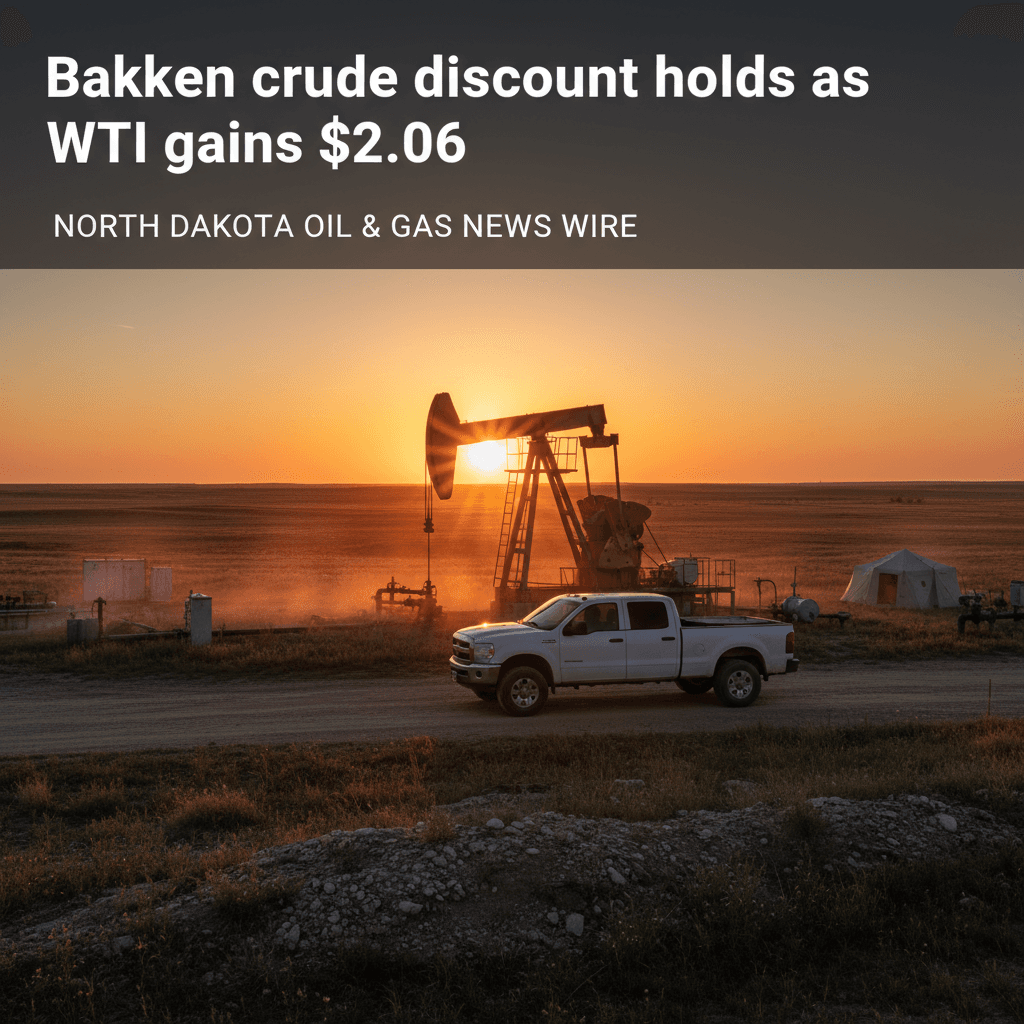
Bakken crude discount holds as WTI gains $2.06
Midday data shows WTI at $104.06, Brent at $113.60 and natural gas lower, with Bakken priced $3.42 below WTI.
Bakken Wire market data showed WTI crude at $104.06 in the midday update on Friday, Oct. 30, 2026, up $2.06, or 2.02%. Brent crude rose $2.80 to $113.60, a 2.53% gain. Natural gas fell $0.06 to $2.90.
The Bakken differential was listed at -$3.42 versus WTI, implying a Bakken crude sale price of about $100.64 when measured against the U.S. benchmark.
The Brent-WTI spread stood at $9.54, with the international benchmark rising more than the U.S. contract. Brent is the global waterborne benchmark, while WTI is a U.S. inland contract, so a larger Brent move is often read as a sign of firmer international crude demand, tighter seaborne supply expectations or heightened risk premia.
The midday update provided price data only and did not identify a single driver such as an inventory report, OPEC decision or geopolitical event.
For North Dakota producers, the higher WTI and Bakken price is a direct revenue tailwind. The Bakken formation is North Dakota’s primary oil-producing region, and Bakken oil sales are commonly priced off WTI, with regional differentials reflecting pipeline capacity, refinery demand, logistics and crude quality.
A -$3.42 discount is relatively modest, keeping wellhead prices near $100 per barrel in the midday snapshot.
Royalty owners can also benefit, since higher oil prices typically increase gross revenue before deductions and can lift royalty payments if production volumes hold. The differential matters because a wider discount can erode the value of a barrel at the lease, even when the national benchmark rises.
The natural gas move points to a softer gas market. At $2.90, associated gas from Bakken production continues to weigh on cash margins, particularly for operators with high gas volumes, gathering and processing costs and compression expenses. Oil strength can offset some of that pressure, but gas remains a separate cash-flow challenge.
For Bakken activity, sustained crude prices above $100 support drilling economics, field maintenance and capital budgets. The current midday levels are not a production forecast, but they show a firmer oil tape entering the weekend, with Brent leading WTI and gas moving lower.
Midday price action often reflects trading momentum rather than finalized daily settlements. Operators and royalty owners typically watch posted prices and contract formulas, which may lag intraday moves.
Still, the directional message is clear: crude benchmarks are rising, while gas is weaker. That combination can improve oil-weighted cash flow but pressure gas-weighted production.
Source
Bakken Wire live price data