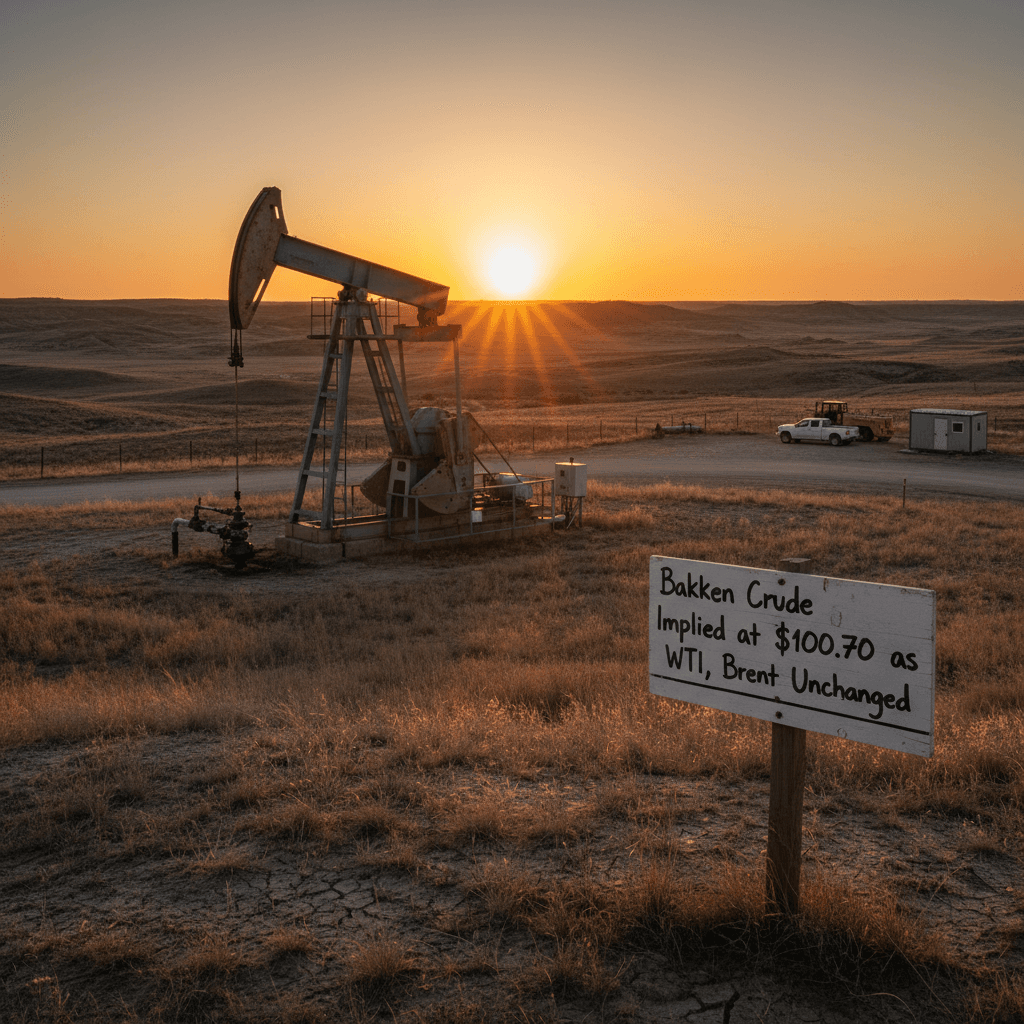
Bakken Crude Implied at $100.70 as WTI, Brent Unchanged
Posted Sunday prices show flat crude benchmarks and a negative Bakken discount, with natural gas below $3.
Oil prices held steady in the live data published Sunday, Nov. 1, 2026, leaving benchmark crude at elevated levels while North Dakota's Bakken formation continued to trade at a discount to West Texas Intermediate.
According to live price data, WTI crude was quoted at $104.12 per barrel, unchanged from the prior posted level, with no dollar move and no percentage change. Brent crude, the global benchmark, was $113.43 per barrel, also unchanged. Natural gas was quoted at $2.90 per million British thermal units, with no change shown.
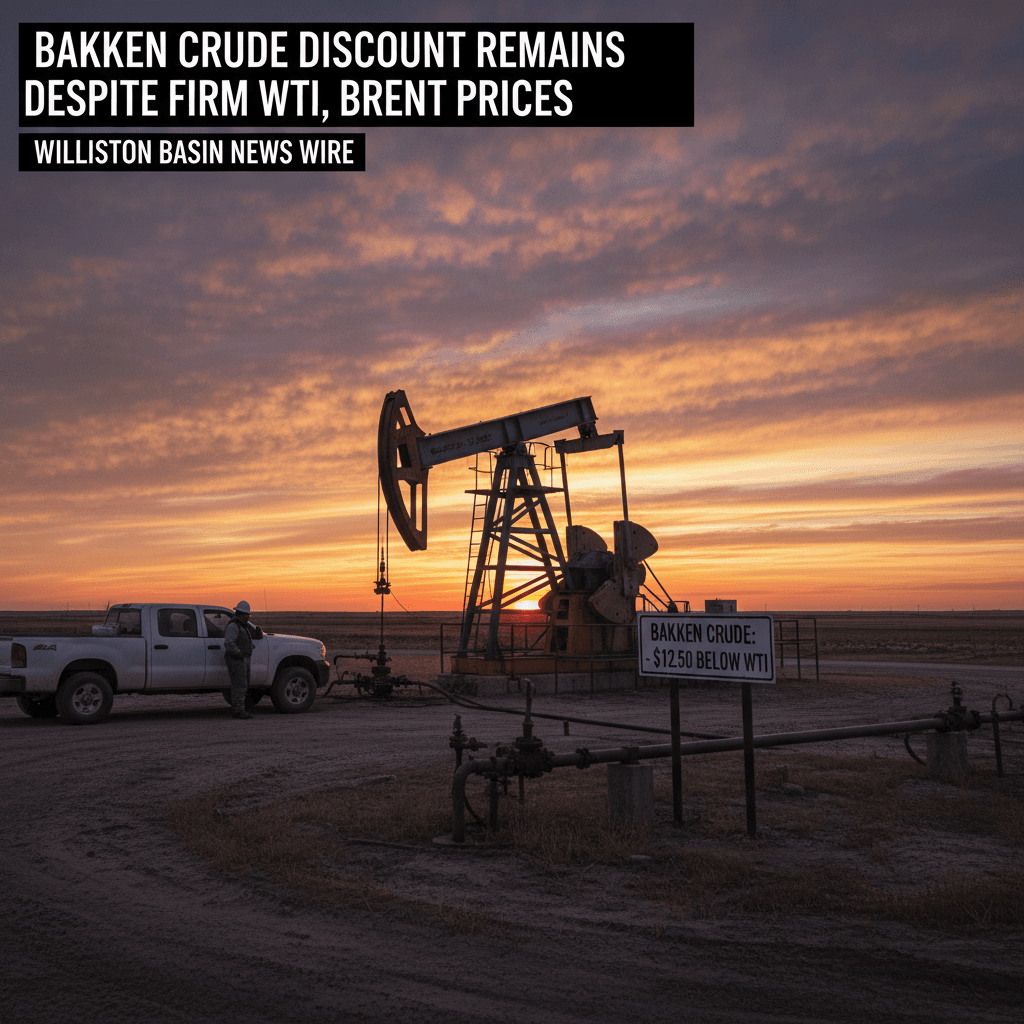
The Bakken differential was negative $3.42 versus WTI. Based solely on that posted spread, a WTI-linked Bakken barrel would price at $100.70 per barrel. The difference between the benchmark and the Bakken quote is important for Williston Basin producers because it represents the discount applied to local crude relative to the U.S. benchmark.
For Bakken operators, the Sunday data shows a high-price environment that has paused rather than reversed. WTI above $100 and Brent above $110 provide a strong gross revenue backdrop for oil-weighted production, but the negative $3.42 differential reduces the realized benchmark price for Bakken barrels. At the posted prices, the implied Bakken level is $3.42 per barrel below WTI, a discount that still matters across high-volume production.
Royalty owners and landowners in North Dakota would see the same arithmetic flow through to revenue calculations. A flat benchmark can still support strong gross oil revenue when WTI remains in the low $100s, while the Bakken discount and natural gas price affect the total value of the wellstream. Natural gas at $2.90 per million British thermal units remains well below the crude benchmarks, underscoring that associated gas production contributes far less per barrel equivalent than oil in the current posted market.
The spread between Brent and WTI was $9.31. That relationship is common in oil markets: Brent reflects global seaborne crude conditions, while WTI reflects U.S. inland supply, pipeline constraints and the Cushing hub. The unchanged Brent-WTI gap suggests no new repricing was embedded in Sunday's posted quotes.
The source data does not include additional catalysts such as OPEC decisions, inventory reports, pipeline outages, geopolitical developments or demand revisions. Without those inputs, the most direct explanation for the day's price action is that the posted market was holding prior levels rather than moving higher or lower. For Bakken producers, that means the immediate signal is stability: crude benchmarks remain elevated, the local discount is unchanged, and natural gas remains inexpensive relative to oil.
The combination of $104.12 WTI, $113.43 Brent and a $3.42 Bakken discount gives North Dakota operators a clear pricing snapshot as the month begins. The next move in the Bakken differential, rather than the headline WTI number alone, can determine how much of the benchmark's strength is captured at the wellhead.
Source
Bakken Wire live price data, Nov. 1, 2026