WTI Crude$--/bbl +0.00 (+0.00%)
Brent Crude$--/bbl +0.00 (+0.00%)
Natural Gas$--/MMBtu +0.00 (+0.00%)
ND Rig Count-- +0 WoW
WTI Crude$--/bbl +0.00 (+0.00%)
Brent Crude$--/bbl +0.00 (+0.00%)
Natural Gas$--/MMBtu +0.00 (+0.00%)
ND Rig Count-- +0 WoW
Bakken Rig Count Holds at 23 as Oil Prices Retreat Sharply - Bakken Wire
Production Data

Bakken Rig Count Holds at 23 as Oil Prices Retreat Sharply

North Dakota's active rig count remains at a multi-year low, suggesting a cautious production outlook despite strong well performance.

Bakken Wire Staff·🌅Afternoon Wire·

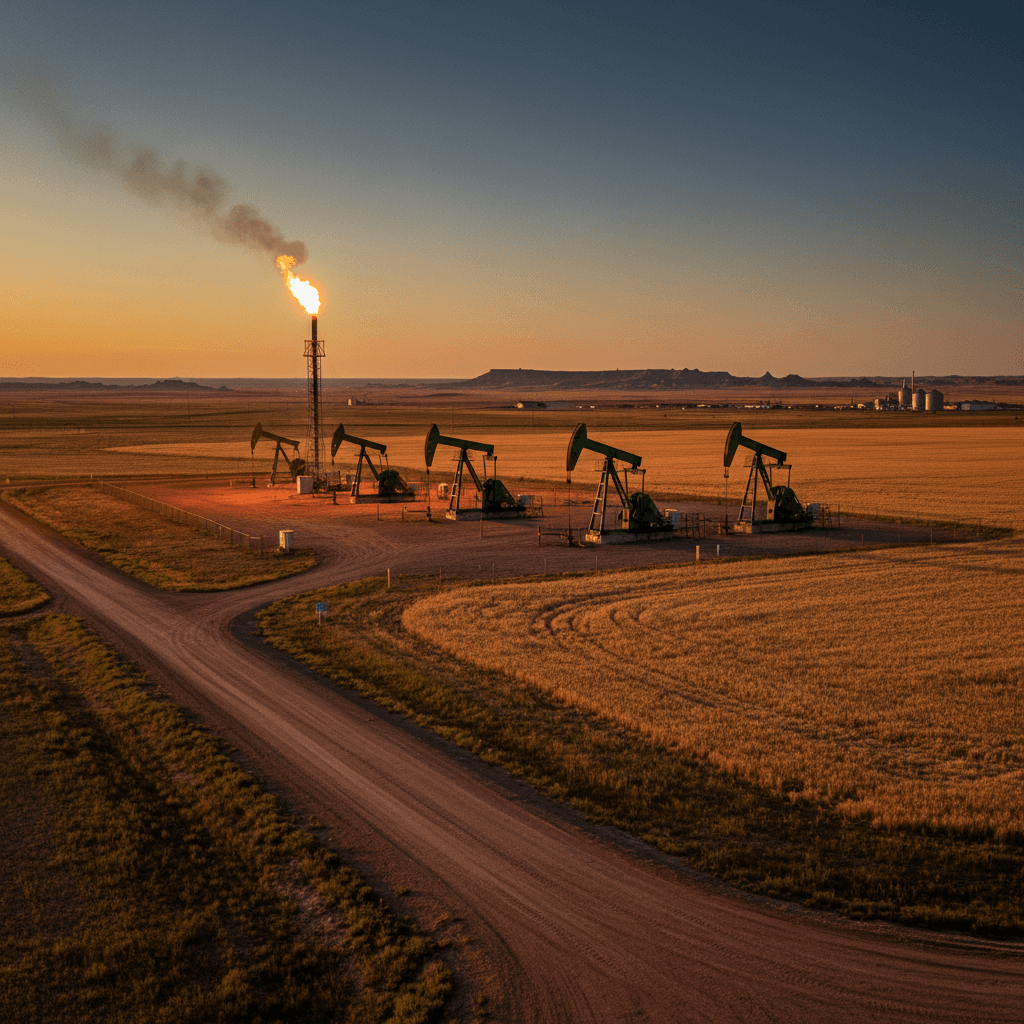
The number of active drilling rigs in North Dakota held steady at 23 this week, according to live Bakken data for July 25, 2026. This historically low rig count coincides with a significant drop in crude oil prices, pointing to a continued conservative approach by operators in the Williston Basin.

The benchmark West Texas Intermediate (WTI) crude price fell to $89.31 per barrel, a drop of $2.88 or 3.12% for the day. The international Brent benchmark also declined sharply to $96.78. The price for Bakken crude at the wellhead is effectively $85.89, reflecting a differential of $3.42 below WTI.

The current rig level, while stable week-over-week, remains near the lowest counts seen in the post-pandemic era. Historically, the active rig count is a leading indicator of future oil production, as it reflects the level of new drilling and well completion activity. A sustained rig count in the low 20s suggests that operators are not currently embarking on significant expansion campaigns.

This restrained activity comes despite the basin's reputation for high initial production rates from modern, long-lateral wells. Operators have focused on capital discipline and maximizing returns from existing drilled but uncompleted wells (DUCs) and enhanced completion techniques, rather than aggressively growing the rig fleet.

The simultaneous retreat in oil prices may reinforce this cautious stance. While prices remain above the breakeven costs for most core Bakken acreage, the volatility and recent drop could make companies hesitant to commit to new, capital-intensive drilling programs without clearer long-term price signals.

Natural gas prices, often a secondary factor in the primarily oil-driven Bakken, were recorded at $2.89 per MMBtu.

The combination of a low, steady rig count and recent price weakness sets the stage for relatively flat to slightly declining production in the coming months. State production figures, which lag real-time activity by several months, will eventually reflect the current subdued level of new well drilling. For now, Bakken operators appear focused on financial resilience and optimizing their existing assets.

Source

Live Bakken Data for July 25, 2026

rig countoil pricewtibrentproduction outlookdrilling activitybakken differentialnorth dakota

Share this article

Related Articles

Bakken Rig Count Holds at 24 as Oil Prices Drop Sharply - Bakken Wire
Production Data

Bakken Rig Count Holds at 24 as Oil Prices Drop Sharply

The number of active drilling rigs in North Dakota held steady at 24 this week, according to live Bakken Wire data. The count comes as crude oil prices fell sharply, with West Texas Intermediate dropping 3.12% to $89.31 per barrel. The current rig count represents a long-term baseline for the state's drilling activity, far below the peak of over 200 rigs seen during the previous boom cycles. Historically, the rig count is a leading indicator for future oil production, with changes typically impacting output volumes several months later. A stable count suggests operators are maintaining, but not aggressively expanding, their drilling programs. The price for Bakken crude at the wellhead is approximately $85.89, calculated using the WTI price of $89.31 and the live Bakken differential of -$3.42 versus the benchmark. The international Brent crude benchmark also fell, settling at $96.78. Natural gas prices were reported at $2.89. The simultaneous drop...

🔆Midday Wire·Jul 25
Bakken Rig Count Holds at 24 as Oil Prices Retreat from Recent Highs - Bakken Wire
Production Data

Bakken Rig Count Holds at 24 as Oil Prices Retreat from Recent Highs

North Dakota's active rig count held steady at 24 on Friday, July 24, 2026, as crude oil prices retreated from recent levels. The stable rig figure suggests operators in the Bakken formation are maintaining a measured pace of drilling activity even with benchmark prices providing a supportive environment. West Texas Intermediate (WTI) crude was trading at $90.50 per barrel, down $1.69 or 1.83% on the day. The international benchmark Brent crude fell 2.41% to $98.26. The price for Bakken crude at the wellhead is typically discounted against WTI; the current differential is -$3.42. Natural gas prices were at $2.90 per MMBtu. The current rig count of 24 serves as a key indicator for future oil production in the state. Historically, the number of active drilling rigs is a leading indicator, with changes in the count preceding shifts in overall production volumes by several months. A stable rig count at this...

🌅Afternoon Wire·Jul 24
Bakken Rig Count Holds at 25 Amid Sharp Oil Price Drop - Bakken Wire
Production Data

Bakken Rig Count Holds at 25 Amid Sharp Oil Price Drop

North Dakota's active rig count held at 25 on Friday, July 24, 2026, a level that industry analysts often view as supportive of a production plateau in the short term. However, the steady rig count was met with a significant drop in oil prices, with WTI crude falling $3.79 to settle at $88.4 per barrel. The sharp price decline of over 4% saw the Bakken crude differential widen to a discount of $3.42 per barrel below the WTI benchmark. Concurrently, natural gas prices were reported at $2.94 per MMBtu. Historically, the rig count is a leading indicator for future oil production in the Bakken formation, with a lag of several months between drilling activity and new wells coming online. The current count of 25 rigs is significantly lower than the boom-era highs, which frequently exceeded 200, but has been relatively stable over recent quarters. This stability suggests operators are maintaining...

🔆Midday Wire·Jul 24