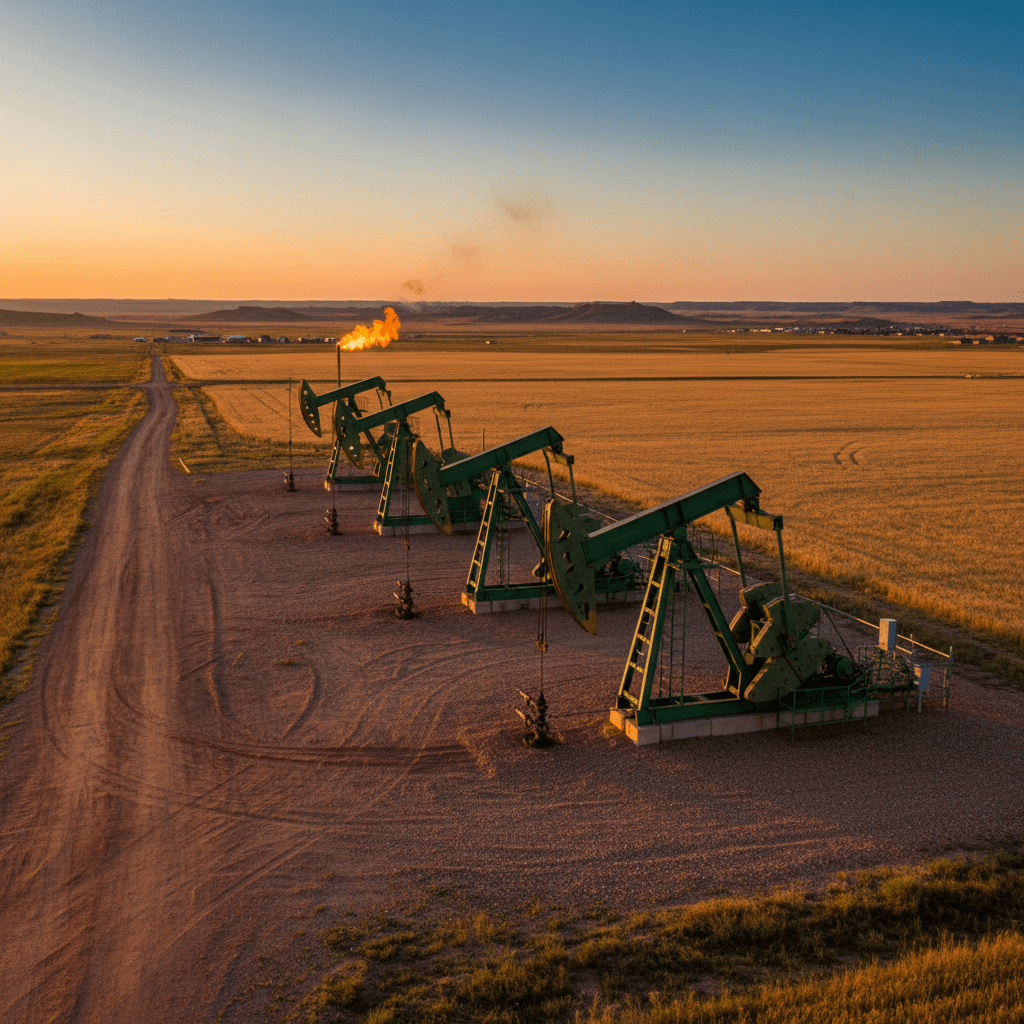
Bakken Rig Count Holds at 27 as Oil Prices Retreat from Highs
Steady drilling activity suggests operators are maintaining production discipline despite a dip in crude benchmarks.
North Dakota's active rig count held steady at 27 on Thursday, a level signaling continued but measured investment by operators in the Bakken formation. The stability comes as crude oil prices retreated from recent highs, with WTI trading at $84.03, down 0.51% for the day, according to midday Bakken Wire data.
The current rig count remains near the lower end of its historical range for the state. Historically, the number of active drilling rigs serves as a leading indicator for future oil production, with changes typically impacting output several months later. A sustained count in the high 20s suggests operators are focusing on completing drilled but uncompleted wells (DUCs) and maximizing efficiency from existing pads, rather than embarking on aggressive new drilling campaigns.
The price environment provides a key context for this activity. While West Texas Intermediate (WTI) crude remains above $80 per barrel, the Bakken crude differential—the discount at which local crude trades versus the WTI benchmark—was recorded at -$3.42. The global benchmark Brent crude also fell, trading at $89.70, down 1.15%. Natural gas prices were at $2.77 per MMBtu.
Analysts often view a rig count in this range as indicative of a "maintenance mode" for production. Operators are likely deploying capital to sustain core production levels from the Bakken's high-quality assets, but significant production growth would generally require a higher and sustained rig count alongside supportive commodity prices. The current price deck, while healthy, may not be sufficient to justify a major expansion given increased focus on shareholder returns and capital discipline across the sector.
The outlook for North Dakota's oil production in the coming months is therefore likely one of stability. With 27 rigs actively drilling new wells, the state should avoid a steep production decline. However, without a material increase in drilling activity, significant month-over-month production gains are improbable. The state's output will continue to depend heavily on the completion rate of wells already drilled and the productivity of new wells brought online.
For royalty owners and service companies, the steady rig count offers a degree of predictability. It suggests a stable, though not booming, level of field activity through the end of the summer. Market attention will now turn to the next monthly production report from the North Dakota Department of Mineral Resources to see how the current drilling pace translates into actual barrels.
Source
Bakken Wire live market and rig count data for July 30, 2026.