WTI Crude--
Brent Crude--
Natural Gas--
ND Rig Count--
WTI Crude--
Brent Crude--
Natural Gas--
ND Rig Count--
Operator News

Chevron, Exxon Post Massive Q3 Profits on Refining Strength

Record downstream earnings offset upstream pressures as majors detail spending plans.

Bakken Wire Staff·🌅Afternoon Wire·

Chevron and ExxonMobil reported massive third-quarter profits Friday, driven by record-breaking refining margins as global capacity remains constrained by geopolitical conflict, according to reports from OilPrice.com.

Chevron's profit nearly tripled to $9.9 billion, or $5.06 per share, up from $1.82 a share a year ago, OilPrice.com reported. ExxonMobil's earnings more than doubled to $15.4 billion, or $3.72 per share. Both companies' adjusted earnings comfortably beat Wall Street estimates.

The staggering profits were powered by downstream operations. Chevron's U.S. refining profits jumped to $3.59 billion from $638 million a year earlier, despite fuel sales holding steady at 1.3 million barrels per day. Its U.S. refineries ran at 98% capacity. Exxon's energy products business earned an adjusted $9.05 billion, up sharply from $4.1 billion the prior quarter, with its U.S. Gulf Coast refineries operating at 100% utilization.

OilPrice.com attributed the refining windfall to global capacity shortages, noting that "roughly 10% of global fuel-making capacity [is] sidelined by the Iran war and Ukrainian attacks on Russian refineries." This has left remaining plants like those operated by the majors to supply a tight market, particularly for diesel.

Upstream performance was mixed. Higher crude prices, with Brent averaging $97 per barrel versus $69 a year earlier, helped Chevron's upstream earnings climb to $5.7 billion from $3.3 billion. However, its worldwide production fell to 3.98 million barrels of oil equivalent per day. Exxon's upstream adjusted earnings fell to $7.3 billion from $9.2 billion in Q2 as crude prices eased, though production held near 4.5 million boe/d. Chevron noted its U.S. production remained above 2 million boe/d for the fifth consecutive quarter.

Both companies generated enormous cash flow. Chevron produced $16 billion in operating cash flow and $12 billion in free cash flow, using it to reduce debt by $3.5 billion and maintain $2.5 billion in share repurchases. Exxon generated $25.7 billion in operating cash flow, returning $9.4 billion to shareholders and announcing plans for another $20 billion in share repurchases in 2027.

Looking ahead, ExxonMobil CEO Darren Woods told CNBC the company plans to invest more than $100 billion over the next few years to augment global energy supplies, Rigzone reported. Chevron is also planning additional investment, with its joint ventures in Venezuela expecting to spend $7 billion over the next five years, according to OilPrice.com.

For Bakken operators and North Dakota, the results highlight a market where refining bottlenecks are creating historic profit margins for integrated majors with U.S. refinery capacity. While upstream earnings benefited from higher oil prices, the majors' focus on shareholder returns and large-scale, long-cycle capital investments underscores the financial power concentrated in the largest players as they navigate a volatile geopolitical landscape.

Source

OilPrice.com, Rigzone
chevronexxonmobilearningsrefiningdownstreamupstreamcapital expenditure

Share this article

Related Articles

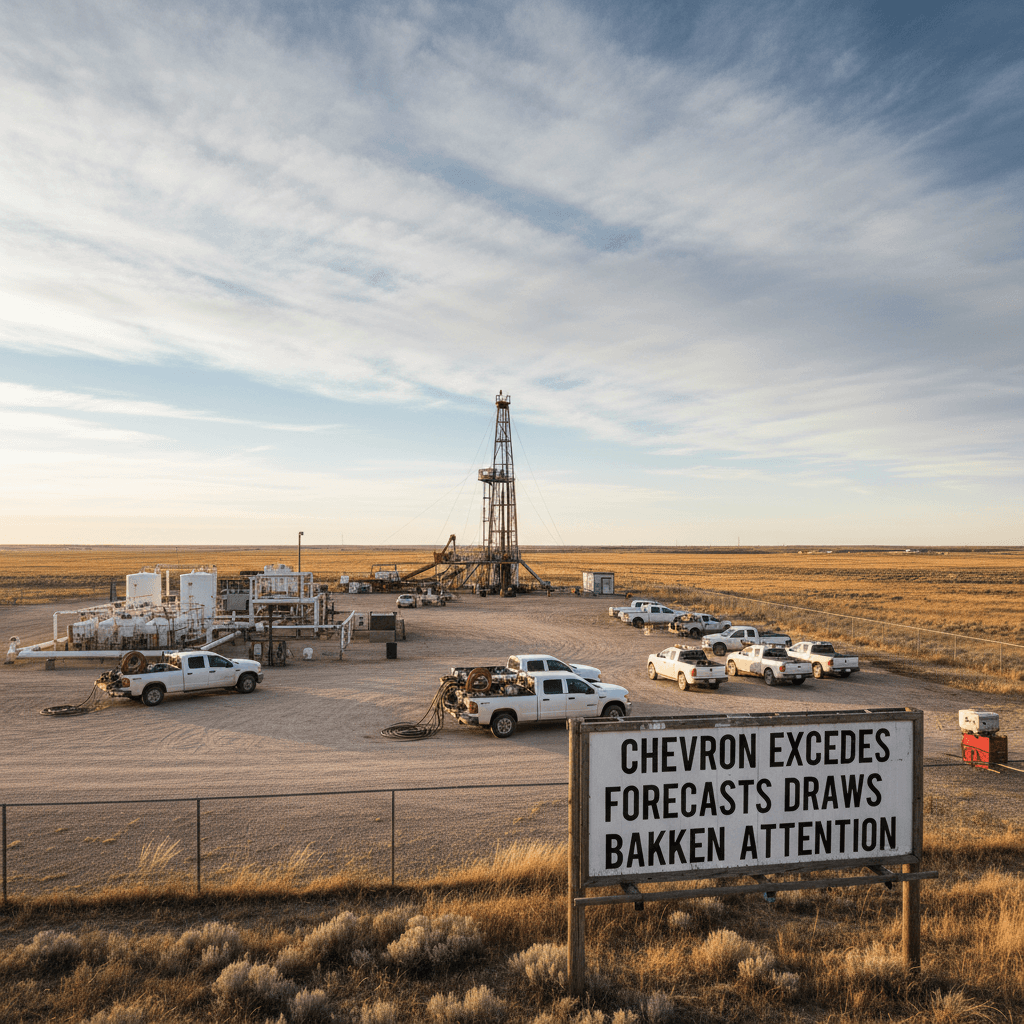
Chevron Exceeds Forecasts Draws Bakken Attention - Bakken Wire
Operator News

Chevron Exceeds Forecasts Draws Bakken Attention

A Rigzone headline published Friday said "Chevron Exceeds Forecasts." The headline did not specify which forecasts were exceeded or provide additional details, but the wording signals that Chevron performed better than expectations in at least one area tracked by the oil and gas industry. For Bakken operators, royalty owners and service providers, Chevron's performance matters because the company is one of the region's major players. The Bakken formation, centered in North Dakota's Williston Basin, remains a key U.S. shale oil area, and large operators there often influence development pace, infrastructure use, leasehold activity and investor expectations across the play. When a major operator exceeds forecasts, the result can be read in several ways, depending on the underlying metric. If the outperformance is tied to production or well results, it could suggest that drilling, completions or reservoir management are running ahead of expectations in areas where Chevron operates. For Bakken royalty...

🔆Midday Wire·Oct 30
Operator News

TotalEnergies, EQT Deals Signal US Consolidation Watched by Bakken

Two corporate transactions reported Thursday by Rigzone underscored continued consolidation and partnership activity among major US energy companies, with implications for operators in the Bakken formation and Williston Basin. According to Rigzone, TotalEnergies executed a swap transaction with Chevron that gives the French company a 25 percent stake in 26 leases operated by its United States rival in the Gulf of America. The headline describes the move as an expanded exploration partnership in the US Gulf. The transaction places TotalEnergies alongside Chevron in a defined set of leases, according to Rigzone. For Bakken operators, the reported deal does not directly change North Dakota lease operations, but it highlights how large companies allocate capital across basins and regions. Chevron and TotalEnergies are significant US energy players, and their partnership activity can influence investor views on where growth dollars are being prioritized. In a basin where operators compete for drilling capital, service...

☀️Morning Wire·Oct 30
Operator News

Global EV, Gulf Security Risks Draw Bakken Attention

Two global energy stories published Thursday touch issues relevant to North Dakota's Bakken operators and royalty owners: oil demand outlook and Middle East security, according to OilPrice.com reports. Chinese electric vehicle maker BYD reported weaker-than-expected third-quarter earnings on Thursday, with net profit rising 28% year-over-year to 10.02 billion yuan ($1.5 billion), missing analysts' expectations of about 11.1 billion yuan. Revenue increased 13.6% to 221.5 billion yuan ($33.3 billion), also falling short of forecasts, OilPrice.com reported. For the first nine months of 2026, BYD's net income declined 4.2% to 22.34 billion yuan, while revenue remained virtually unchanged at 566.3 billion yuan. The article said the company is increasingly relying on higher-margin international sales to support profitability amid fierce domestic competition and slowing demand in China. The BYD results reflect broader changes in transportation demand. OilPrice.com reported that record gasoline and diesel prices accelerated Europe's transition toward electric vehicles, with battery-electric vehicle...

🌅Afternoon Wire·Oct 29