
WTI Crude--
Brent Crude--
Natural Gas--
ND Rig Count--
WTI Crude--
Brent Crude--
Natural Gas--
ND Rig Count--
Crude Falls, Gas Rises as European Power Prices Spike - Bakken Wire
Oil Prices

Crude Falls, Gas Rises as European Power Prices Spike

WTI slips to $87.65 while natural gas gains $0.17; Bakken differential sits $3.42 below WTI.

Bakken Wire Staff·🔆Midday Wire·

Oil prices moved lower on Monday, while natural gas rose and European electricity markets tightened as weak wind and solar output pushed some day-ahead and peak prices to 2022 highs.

WTI crude was $87.65 a barrel, down $3.18, or 3.5%. Brent crude was $93.73, down $4.59, or 4.67%, according to live market data. Natural gas was $3.17, up $0.17.

For Bakken producers, the key local gauge was a differential of $3.42 below WTI. That spread helps determine how much North Dakota crude realizes after transportation and regional market conditions, and a wider discount can compress margins on oil barrels even when WTI remains in the high-$80 range.

The natural gas gain provided a partial offset. Bakken wells typically produce associated gas, so higher natural gas prices can improve cash flow from gas sales, even as oil revenue softens.

The clearest market stress in the related source data came from Europe. OilPrice.com reported that a weather front brought still and cloudy conditions across the UK, Germany and France, causing wind and solar generation to slump Monday and expected to remain below normal at least until midweek.

According to OilPrice.com, day-ahead electricity prices in France settled at $374, or 334 euros, per megawatt-hour on Monday, the highest since December 2022, based on Bloomberg data. Germany settled at $386, or 345.64 euros, per MWh, with spikes above $672, or 600 euros, per MWh for some peak evening slots.

The report said wind speed slumps were especially pronounced in Germany, the UK, Belgium and the Netherlands, meaning electricity prices were predominantly set by natural gas-fired plants using the most expensive gas in Europe in four years.

In the UK, the National Energy System Operator issued a routine margin notice Sunday warning of tight supply Monday morning. The notice was canceled Monday morning, but the warning followed a weekend dip in wind generation.

The pressure was not limited to Western Europe. OilPrice.com reported that low water levels in hydropower reservoirs and soaring natural gas prices are putting upward pressure on power prices in Nordic countries as winter approaches, according to Danish trader Mind Energy.

Mind Energy said in a November recap that “Winter is upon us, and panic is evident across the European energy markets, which had clearly underestimated the seriousness of the situation earlier in the year.”

For North Dakota royalty owners and operators, the mix means a more divided price picture. Crude was down on the day, while gas and European power markets showed stress that can support demand for LNG and gas-linked barrels.

The Bakken differential of $3.42 below WTI remains a closely watched number because it translates global benchmarks into wellhead economics. A negative differential is common for inland production, but its size can influence whether operators prioritize oil wells, gas sales, workovers or capital discipline.

The European electricity spike also underscores how weather can move energy prices across fuels. When renewables underperform, gas-fired generation can set the price at the margin, increasing demand for gas and potentially tightening global LNG markets, a backdrop that matters to U.S. producers selling into a linked world market.

Still, Monday’s live data showed the immediate oil response was negative, with Brent down more than WTI. That relative move can affect export economics and regional spreads.

Source

Live price data; OilPrice.com, “Europe’s Power Prices Jump to 2022 High as Wind and Solar Falter,” by Michael Kern, Nov. 9, 2026
bakkenoil priceswtibrentnatural gaseuropepower priceswilliston basinroyalties

Share this article

Related Articles

WTI Falls 3.9% as Oil Prices Retreat; Bakken Differential at $-3.42 - Bakken Wire
Oil Prices

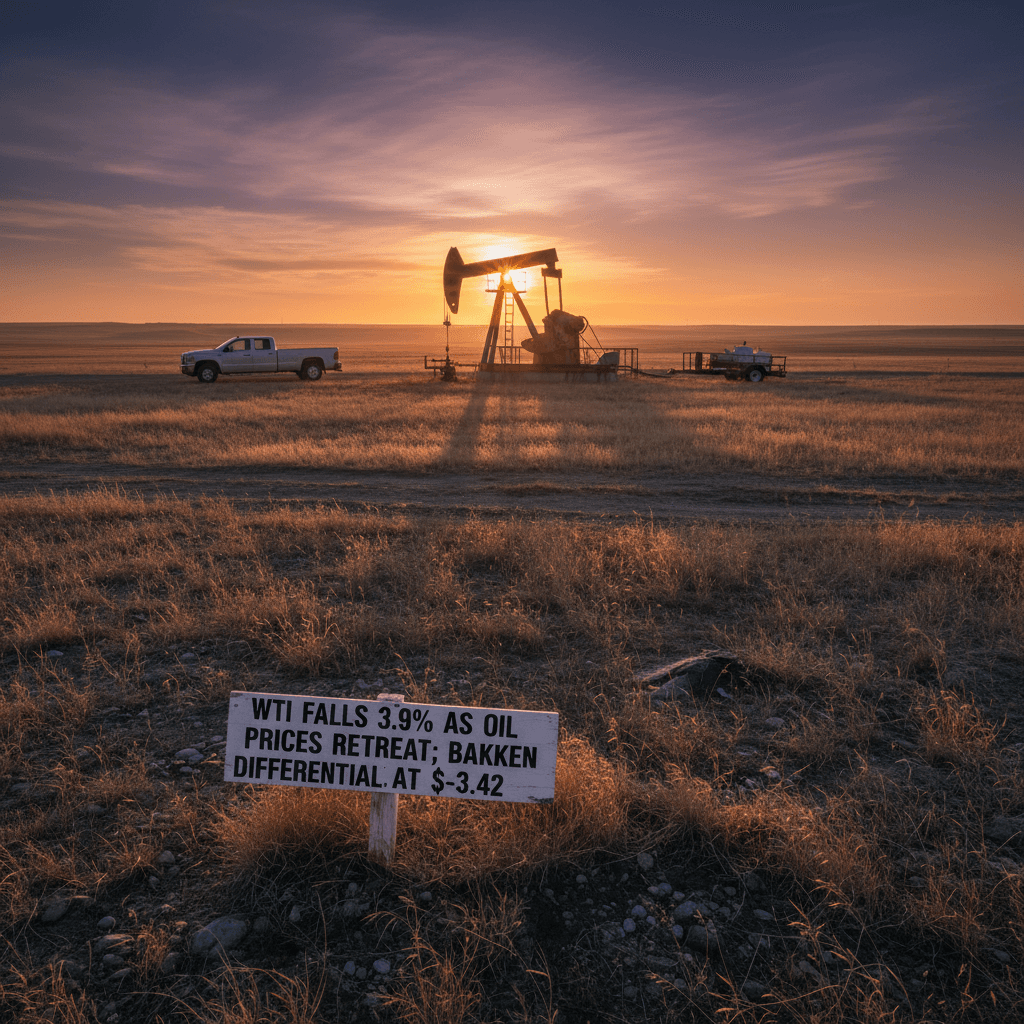
WTI Falls 3.9% as Oil Prices Retreat; Bakken Differential at $-3.42

North Dakota crude producers opened the week with lower oil prices and a slightly higher natural gas benchmark. WTI Crude traded at $87.32, down $3.51 or 3.86%, while Brent Crude fell $4.41, or 4.49%, to $93.91. Natural Gas rose $0.07 to $3.07. The Bakken differential stood at $-3.42 versus WTI. The decline in crude came amid an OilPrice.com headline that said oil prices fell after Trump signaled no new attacks on Iran. The same OilPrice.com coverage also pointed to easing European energy prices, with European natural gas futures dropping from over €100 per MWh to €86.80, likely reflecting renewed optimism about the Middle East after Democrats won control of both houses in the United States. For Bakken operators, the immediate impact is straightforward: lower benchmark crude prices reduce revenue per barrel at the wellhead, while the Bakken differential shows the local price discount against WTI. Royalty owners also watch that...

☀️Morning Wire·Nov 9
Oil Prices Flat in Afternoon Update; Bakken Crude Sits $3.42 Below WTI - Bakken Wire
Oil Prices

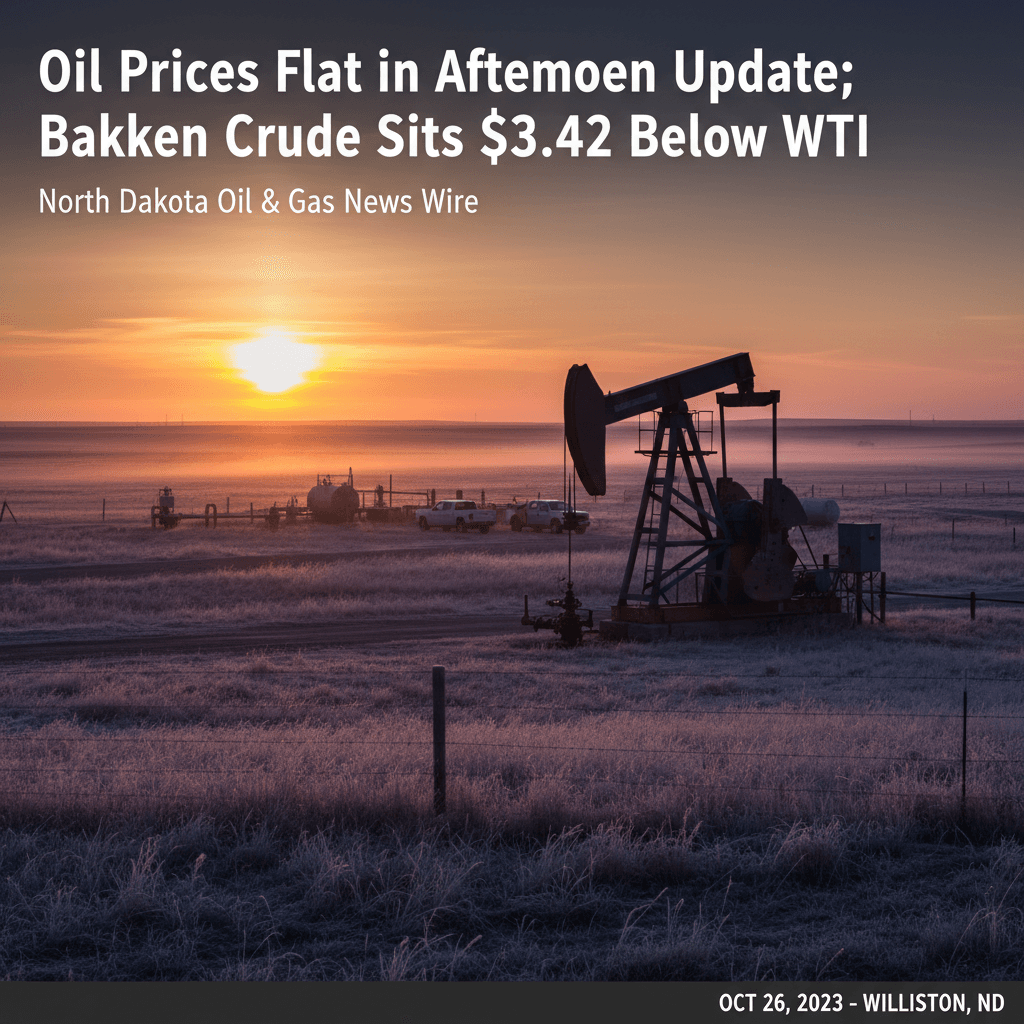
Oil Prices Flat in Afternoon Update; Bakken Crude Sits $3.42 Below WTI

Bakken Wire's afternoon oil and gas price update on Sunday, Nov. 8, 2026, showed crude benchmarks holding steady, with WTI crude at $90.83 and Brent crude at $98.32. Both benchmarks were listed with no change, +$0 and 0%, according to the live price data. Natural gas was listed at $3, also unchanged. For North Dakota producers, the more direct revenue marker was the Bakken differential, which the data placed at -$3.42 against WTI. That spread means Bakken crude was priced below the WTI benchmark, implying a Bakken reference level of $87.41 when measured against the WTI price in the update. The differential matters because Bakken operators and royalty owners typically track realized prices relative to WTI, not just the headline benchmark. The flat price action gave no indication of a new move in the oil complex based on the source data. The update did not include additional market-moving details such...

🌅Afternoon Wire·Nov 8
WTI Edges Higher as Bakken Crude Discount Holds at $3.42 - Bakken Wire
Oil Prices

WTI Edges Higher as Bakken Crude Discount Holds at $3.42

Oil prices moved modestly higher in midday market data Sunday, Nov. 8, 2026, according to Bakken Wire's live market data. WTI crude rose $0.31, or 0.34%, to $90.83. Brent crude edged up $0.03, or 0.03%, to $98.32. The two global benchmarks were separated by $7.49, with Brent trading above WTI. Natural gas gained $0.05 to $3.00. The move was smaller than WTI's $0.31 advance, but it added to the day's firmer energy pricing. For Bakken producers, the most important local number was the regional differential. Bakken crude was quoted at -$3.42 versus WTI, implying a regional benchmark price of $87.41. The discount means Bakken operators and royalty owners are not receiving the full WTI price, a difference that directly affects netbacks, leasehold economics and royalty calculations. The Bakken differential is a basis measure rather than a company statement or production report. In general oil markets, regional discounts can reflect transportation...

🔆Midday Wire·Nov 8
Crude Falls, Gas Rises as European Power Prices Spike — Bakken Wire