WTI Crude--
Brent Crude--
Natural Gas--
ND Rig Count--
WTI Crude--
Brent Crude--
Natural Gas--
ND Rig Count--
Devon-Coterra Merger Finalizes, Creating Major Shale Operator - Bakken Wire
Operator News

Devon-Coterra Merger Finalizes, Creating Major Shale Operator

The $58B deal combines two large-cap producers, with implications for Bakken basin operations and industry consolidation trends.

Bakken Wire Staff·🔆Midday Wire·

Devon Energy Corporation and Coterra Energy Inc. have completed their $58 billion merger, according to a statement posted on Devon's website Thursday. The deal, approved by stockholders on May 4, creates a new "premier large-cap shale operator," according to the company.

The combined entity will operate under the Devon Energy name and trade on the NYSE as 'DVN'. Devon shareholders will own approximately 54 percent of the company, while former Coterra shareholders will own approximately 46 percent. Each share of Coterra common stock was converted into 0.70 shares of Devon common stock, and Coterra stock will no longer be listed, the statement confirmed.

Clay M. Gaspar will be President and CEO of the combined company. The statement outlined a new executive team, including Michael D. Deshazer as Executive Vice President, Exploration & Production – Anadarko, Eagle Ford, Marcellus & Rockies, and John D. Raines as Executive Vice President, Exploration & Production – Permian. The new board of directors will consist of 11 members: six from Devon and five from Coterra.

"This transformative merger marks a defining moment for Devon Energy," Gaspar said in the statement. "We have brought together two companies with proud histories and cultures of operational excellence to create a premier shale operator with the scale, inventory depth and financial strength to deliver differentiated returns for shareholders through any commodity cycle."

While the statement highlighted the combined company's leading position in the Delaware Basin, the merger's creation of a larger, financially stronger entity with diversified assets across several major basins—including the Anadarko, Eagle Ford, Marcellus, and Rockies—could influence capital allocation and operational strategies across the industry, including in the Bakken formation.

Separately, a shareholder challenge to another major operator's corporate move emerged. New York City Comptroller Mark D. Levine, trustee for city pension funds including the New York City Police Pension Fund—a substantial ExxonMobil shareholder—has urged investors to vote down ExxonMobil's proposed redomicile to Texas at its May 27 annual meeting. According to a letter published online, Levine said the move, along with a retail voting program expansion, "both appear designed to insulate Exxon's Board from accountability to shareholders."

ExxonMobil announced the move on March 10, stating that Texas offers an enabling environment for the oil and gas industry and provides greater legal certainty. The company said the redomicile "will not affect business operations, management, strategy, assets or employee locations." CEO Darren Woods stated, "Over the past several years, Texas has made a noticeable effort to embrace the business community. In doing so, it has created a policy and regulatory environment that can allow the company to maximize shareholder value."

In other Bakken operator news, Vitesse Energy, Inc. highlighted its use of oil hedges to manage commodity price volatility in its Q1 2026 earnings summary, published May 5. According to the summary, the company has "opportunistically extended" oil hedges through 2028 to protect its dividend, with 73% of its 2026 oil production currently hedged. This strategy reflects a disciplined financial approach common among Bakken producers facing market fluctuations.

Source

Rigzone (Sources 1 & 2), Bing News (Source 3)
devon energycoterra energymergers & acquisitionsexxonmobilcorporate governancevitesse energyhedgingbakken operators

Share this article

Related Articles

Operator News

Major Oil Companies Issue Updates as Hurricane Isaias Threatens Gulf

Major integrated oil companies Shell, Chevron, and Occidental Petroleum have issued operational updates in response to Hurricane Isaias, according to a report from Rigzone. The storm's progression in the Gulf of Mexico is being closely monitored by the energy sector. While the Bakken formation in North Dakota is geographically distant from the Gulf Coast, its crude oil market is directly connected. A significant portion of Bakken crude is transported to Gulf Coast refineries via pipeline and rail. Operational disruptions in the Gulf, including production shut-ins or port closures, can impact the destination and pricing of Bakken barrels. For Bakken operators, these updates from companies with major Gulf of Mexico assets serve as an early indicator of potential market volatility. Shut-in production in the Gulf can tighten overall U.S. supply, potentially providing support for inland crude prices, including the Bakken benchmark. Conversely, prolonged refinery outages or export terminal closures could temporarily...

☀️Morning Wire·Oct 8
Operator News

Gulf Hurricane Threat Evacuates Workers, Could Tighten Oil Markets

Major oil companies are evacuating workers from the Gulf of Mexico ahead of a strengthening tropical storm, a move that could introduce new volatility to crude markets with potential implications for Bakken producers. Chevron is evacuating workers from all its Gulf platforms, while Shell is pulling non-essential personnel from six offshore platforms and BP is also conducting evacuations, according to reports from Reuters and CNN. While production at the facilities currently remains normal, the storm is forecast to reach the Gulf Coast by Friday, potentially as a Category 2 hurricane. Analysts warn the storm is an "unwelcome complication for crude, raising the prospect of production and refining disruptions at a time when the market already has enough supply-side headaches," KCM Trade chief analyst Tim Waterer told Reuters. The potential impact on Gulf Coast refineries is a primary concern for the broader oil market, including Bakken crude which often flows to...

☀️Morning Wire·Oct 7
Supreme Court Hears Climate Suit, Industry Warns of 'Judicially Ordered Carbon Tax' - Bakken Wire
Operator News

Supreme Court Hears Climate Suit, Industry Warns of 'Judicially Ordered Carbon Tax'

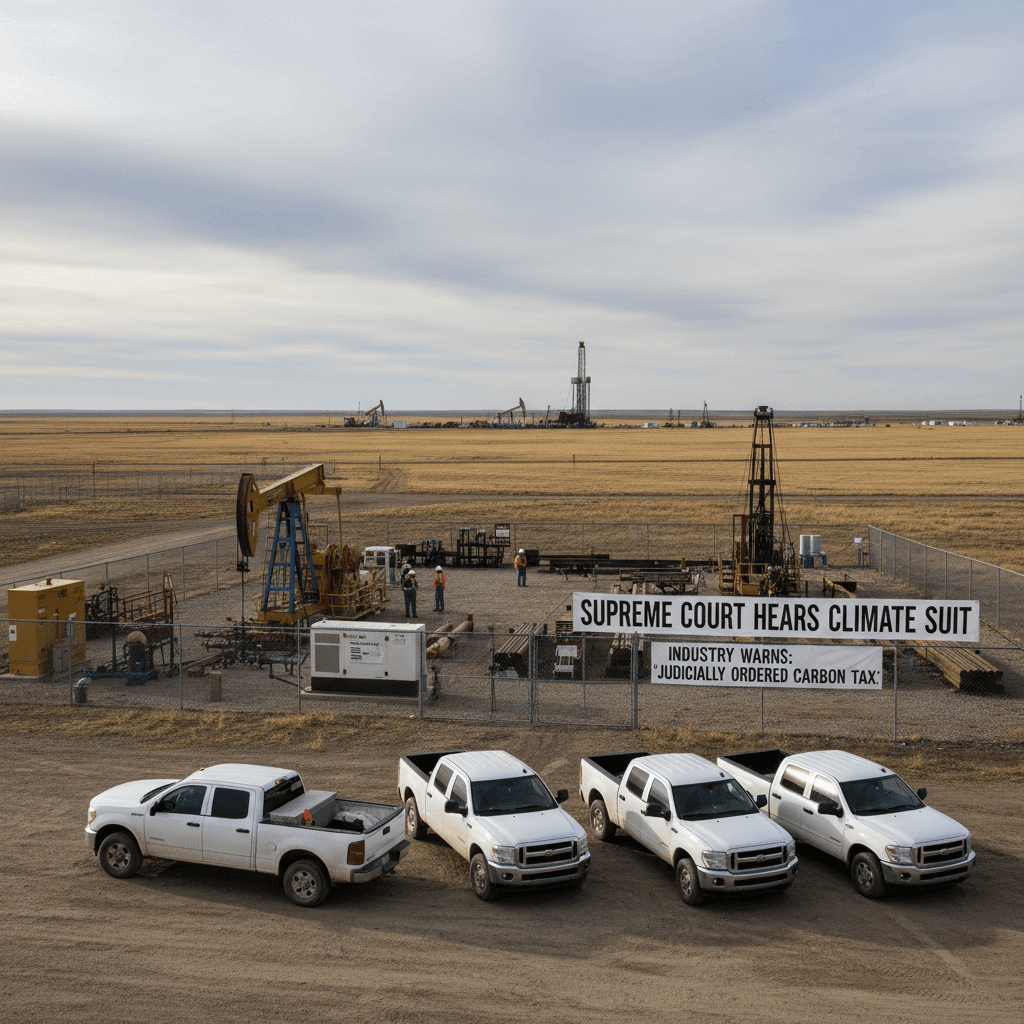
The U.S. Supreme Court heard arguments Monday in a pivotal climate liability case that could open the door to state-level lawsuits against oil and gas companies, a prospect the industry warns could act as a "judicially ordered carbon tax," according to a report from OilPrice.com. The case involves a lawsuit filed by Boulder County, Colorado, against ExxonMobil and Suncor Energy Inc., seeking damages for local climate-change-related impacts. The Canadian-based Suncor and Texas-based ExxonMobil argue that climate policy and alleged damages are exclusively federal matters, and the state suit should be dismissed. Boulder County contends it is only seeking compensation for local damage from decades of emissions, not aiming to change federal policy, OilPrice.com reported. For Bakken operators, the case represents a significant liability threat. The industry argues that a victory for Boulder County would allow a flood of similar lawsuits to proceed, potentially targeting producers based on their historical emissions....

🔆Midday Wire·Oct 5