
WTI Crude--
Brent Crude--
Natural Gas--
ND Rig Count--
WTI Crude--
Brent Crude--
Natural Gas--
ND Rig Count--
European Green Hydrogen Push Gains Momentum with German Aid Approval - Bakken Wire
Regulatory

European Green Hydrogen Push Gains Momentum with German Aid Approval

The EU's approval of a $1.5 billion German subsidy signals continued long-term policy support for energy transition fuels.

Bakken Wire Staff·🔆Midday Wire·

The European Commission has approved a $1.5 billion German state aid scheme to support green hydrogen production, according to a report from Rigzone. The approval, published on May 26, 2026, underscores the European Union's continued policy commitment to developing alternative energy sources.

The approved scheme will support the construction of up to 1,000 MW of installed electrolyzer capacity and the production of up to 10 million tonnes of renewable hydrogen, Rigzone reported. This large-scale investment is part of a broader European strategy to decarbonize industrial and energy sectors.

For Bakken operators, developments in the global hydrogen market represent a long-term strategic consideration. While the immediate impact on North Dakota crude oil demand is negligible, such policies reinforce a sustained international push towards lower-carbon energy systems. The Bakken formation, as a major oil-producing region, operates within this evolving global energy landscape.

Major investments in hydrogen, particularly in key export markets like Europe, could influence future demand scenarios for fossil fuels over the coming decades. Operators are increasingly monitoring these trends as part of long-term planning and environmental, social, and governance (ESG) strategies. The focus on "green" hydrogen, produced using renewable electricity, highlights the premium placed on low-carbon energy pathways.

The regulatory approval in Germany follows a pattern of significant public funding being directed towards energy transition technologies worldwide. For royalty owners and service companies in the Williston Basin, understanding these macro shifts is important for assessing the long-term outlook for hydrocarbon production. The immediate business of drilling and completing wells in the Bakken continues, but the energy mix of key global economies is gradually changing.

Source

Rigzone
regulationhydrogeneuropeenergy transitionpolicy

Share this article

Related Articles

Regulatory

Global Energy Security Concerns Highlight Need for Robust Bakken Production

The rapid digitalization of power grids is outstripping regulatory frameworks, creating energy security vulnerabilities, according to a recent report from European energy experts. This global dynamic underscores the continued strategic importance of reliable, domestic hydrocarbon production from regions like the Bakken. Elena Boskov-Kovacs, co-founder of Blueprint Energy Solutions, stated that regulatory processes lag behind technological deployment in the energy sector. "There’s a mismatch in speed rather than a gap in technology – in making digital solutions useful and deployable quick enough to keep pace with the physical transformation of the grid," she was quoted in a report for Enlit. She cited the rapid connection of solar, EVs, and heat pumps as creating "very practical concerns for system operators: unobservability at the edge of the grid, limited hosting capacity, congestion and ultimately the risk of blackouts." These challenges in grid management and energy security are particularly acute in Europe, which is...

🌅Afternoon Wire·Oct 6
EPA Relinquishes Power Plant GHG Authority, Citing Economic Benefits - Bakken Wire
Regulatory

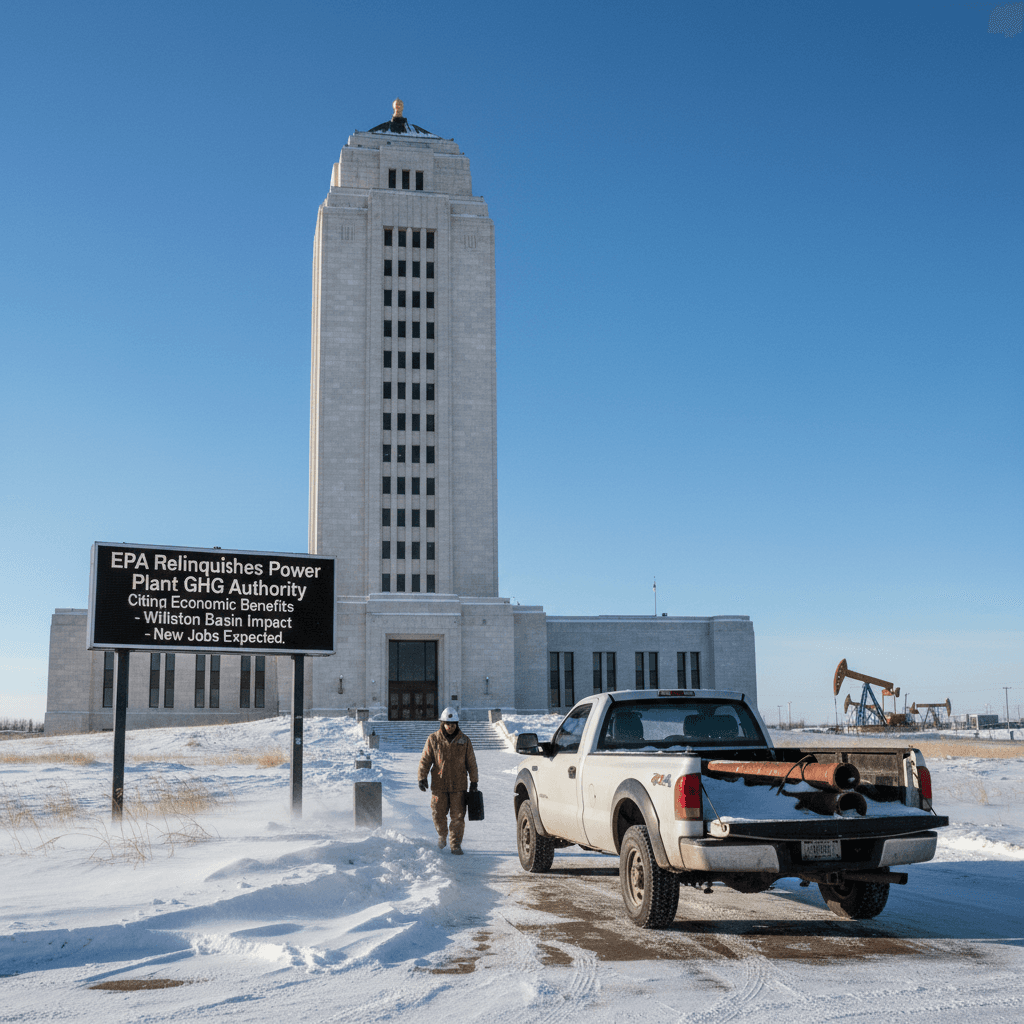
EPA Relinquishes Power Plant GHG Authority, Citing Economic Benefits

The U.S. Environmental Protection Agency (EPA) announced in September that it will relinquish its authority to regulate greenhouse gas emissions from power plants under the Clean Air Act, according to OilPrice.com. The move effectively removes federal limits on emissions from coal and natural gas plants. The EPA expects the decision to result in an additional 123 million metric tonnes of carbon dioxide released into the atmosphere over the next decade, OilPrice.com reported. The agency's analysis estimates the change will save power plant operators $370 million in direct compliance costs, but does not factor in the financial benefits of reduced air pollution. For North Dakota, a major coal-producing and natural gas-fired power state, the policy shift could impact the operating environment for associated energy infrastructure. The decision follows President Trump's earlier move to overturn the foundational 2009 EPA endangerment finding that greenhouse gases threaten public health and the environment, and a...

🔆Midday Wire·Sep 27
Regulatory

EIA Projects Record US Gas Output Amid Rising Demand, AI Data Center Buildout

U.S. natural gas production is on track to hit new record highs in 2026 and 2027, with surging demand from liquefied natural gas (LNG) exports and a wave of gas-fired power plants for AI data centers driving the outlook, according to U.S. Energy Information Administration (EIA) data released in September 2026. For North Dakota's Bakken formation, a major gas-producing region, the forecasts reinforce a strong market for associated natural gas, despite a recent regulatory setback for a gas plant project in North Carolina. The EIA now expects dry natural gas production to rise from a record 107.6 billion cubic feet per day (bcfd) in 2025 to 111.7 bcfd in 2026 and 115.9 bcfd in 2027, OilPrice.com reported. Domestic gas consumption is projected to increase from 91.9 bcfd in 2025 to 92.2 bcfd in 2026 and 94.3 bcfd in 2027. Average U.S. LNG exports are forecast to climb from 15.1 bcfd...

☀️Morning Wire·Sep 27