WTI Crude--
Brent Crude--
Natural Gas--
ND Rig Count--
WTI Crude--
Brent Crude--
Natural Gas--
ND Rig Count--
Federal Hydrogen Hub Stalls, Global Oil Supply Disrupted - Bakken Wire
Global Markets

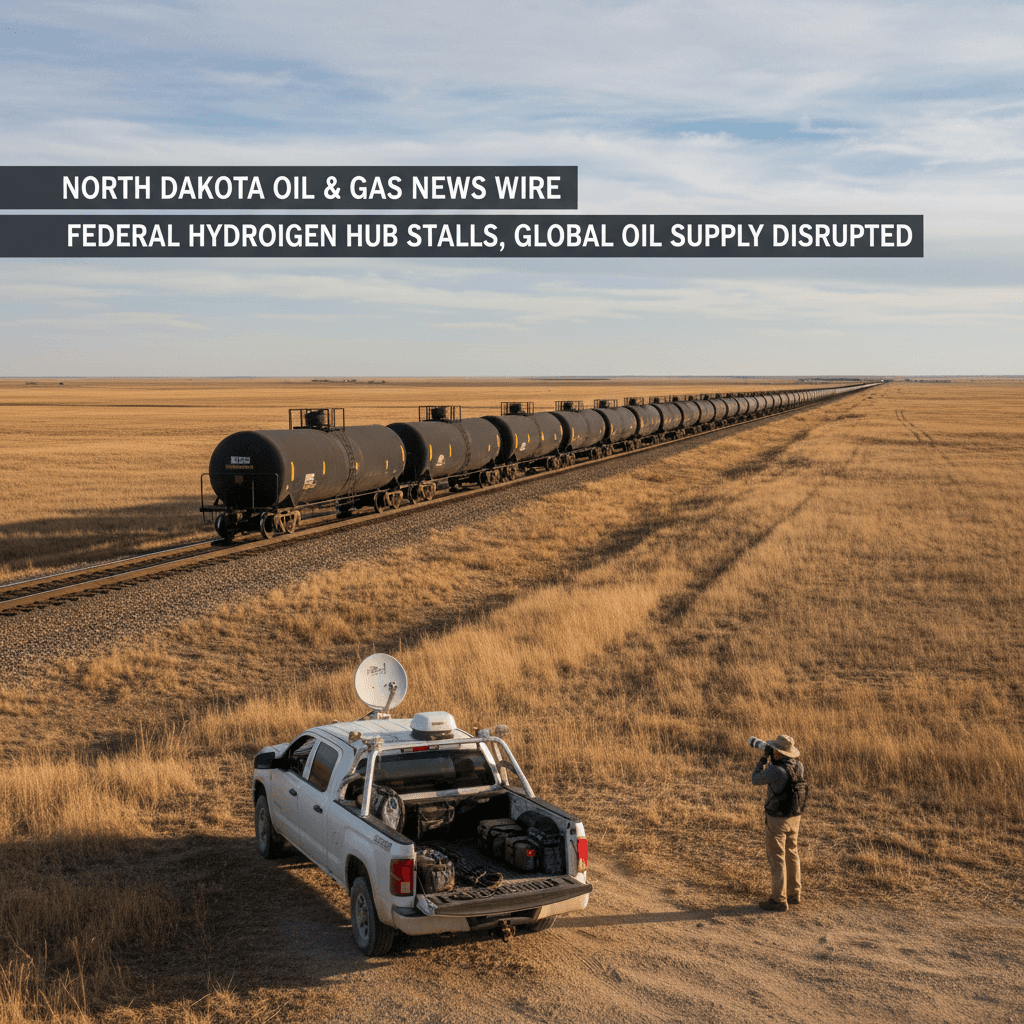
Federal Hydrogen Hub Stalls, Global Oil Supply Disrupted

Biden-era funding uncertainty halts major Appalachian hydrogen projects, while Ukrainian strikes on Russian refineries and new LNG deals impact global energy flows.

Bakken Wire Staff·🔆Midday Wire·

Major U.S. hydrogen hub projects in the Appalachian region have stalled due to federal funding uncertainties under the current administration, according to a report from OilPrice.com. This slowdown in a potential competing energy source comes as global oil and gas markets face new supply disruptions and long-term deals that could influence demand for Bakken crude.

The development of Regional Clean Hydrogen Hubs (H2Hubs), which received up to $7 billion in federal funding commitments under the Biden administration, has not proceeded as expected. Two key projects, the Mid-Atlantic Hydrogen Hub (MACH2) in Philadelphia and the Appalachian Hydrogen Hub (ARCH2) based in West Virginia, have halted development as operators await news on financing. ARCH2, covering parts of West Virginia, Ohio, and Pennsylvania, was expected to receive $925 million to manufacture blue hydrogen from fossil fuels using carbon capture technology.

“Until I see significant evidence to the contrary, I just don’t think the hubs are happening,” stated Tom Torres, chief of staff at the Ohio River Valley Institute, according to the OilPrice.com report. The stalling projects represent a setback for energy diversification efforts that were once seen as a way to decarbonize hard-to-abate industries. Pennsylvania Governor Josh Shapiro had previously said the hubs would “ensure Pennsylvania continues to be an energy leader for decades to come,” but last year noted that losing the funding would “harm Pennsylvania” and result in producing less energy.

Separately, global oil supply faces fresh disruptions. Ukraine struck a sixth Russian oil refinery in a week, Rigzone reported on November 6. Such repeated attacks on Russian refining capacity can tighten global refined product markets and create volatility that often supports crude oil prices, a potential positive for Bakken producers.

In a move that could affect long-term gas market dynamics, Abu Dhabi National Oil Company (ADNOC) signed a deal to supply Gujarat Energy with 4 million metric tons per annum of LNG for 10 years, Rigzone also reported on November 6. This is ADNOC's fifth LNG supply agreement in India, cementing long-term demand for natural gas in a key growing market. While not directly impacting crude, strong global LNG demand can influence associated gas economics in oil-producing regions like the Bakken.

For North Dakota's oil industry, the halting of large-scale hydrogen projects in competing fossil fuel regions may reduce future competition for market share and federal energy subsidies. Meanwhile, ongoing geopolitical instability impacting Russian oil refining and new long-term LNG contracts underscore a still-robust global demand for hydrocarbons, providing a stable backdrop for Bakken production.

Source

OilPrice.com, Rigzone
hydrogenfederal policyglobal marketsgeopoliticslngrefining

Share this article

Related Articles

The Midday Take - Energy Market Briefing
Global Markets

Energy Market Briefing

Daily Energy Market Briefing Saturday, November 7, 2026 1. Headlines Oil prices are showing minimal movement in a quiet Saturday session. As of midday, WTI crude is trading at $90.83, up a slight 0.34%, while Brent crude is essentially flat at $98.32. The Bakken differential to WTI is -$3.42. Natural gas is up $0.05 to $3.00. A Bloomberg survey reported by Rigzone indicates OPEC's crude production rose in October, nearing pre-war levels as Saudi Arabia led a recovery in Persian Gulf supplies. This comes after oil posted its biggest weekly drop since 2022, according to a separate Rigzone report, with traders weighing Iran diplomacy and recovering Gulf exports. In inventory news, the EIA's latest report showed U.S. commercial crude stocks, excluding the SPR, stood at 409.760 million barrels as of October 30. In other news, major oil traders including Trafigura and Vitol are asking U.S. officials for licenses to use...

🔆Midday Wire·Nov 7
The Morning Take - Energy Market Briefing
Global Markets

Energy Market Briefing

Energy Market Briefing Saturday, November 7, 2026 1. Headlines Oil prices showed marginal gains today after a week of significant losses. WTI crude settled at $90.83, up 0.34%, while Brent crude saw a negligible 0.03% increase to $98.32. According to Rigzone, oil posted its biggest weekly drop since 2022, with traders citing factors including Iran diplomacy and recovering Persian Gulf exports. A Bloomberg survey, cited by Rigzone, indicates OPEC's crude production rose toward pre-war levels last month, led by Saudi Arabia. In supply chain news, OilPrice.com reports that major oil traders including Trafigura, Vitol, Mercuria, and ADNOC are in talks with U.S. officials to secure licenses to use sanctioned tankers, seeking relief from soaring freight costs. On the data front, the EIA reported U.S. crude oil production reached a new record of 14.003 million barrels per day for the week ending October 30, while commercial crude stocks fell by almost...

☀️Morning Wire·Nov 7
Global Markets

Global Tanker Shortage, OPEC Supply Pressure Bakken Crude Exports

A severe global tanker shortage, driven by the war in Iran, is dramatically increasing the cost of shipping U.S. crude to Asia and threatening a key outlet for Bakken production. According to an OilPrice.com report, the cost of chartering a supertanker from the U.S. Gulf Coast to China reached nearly $80 million in October, roughly ten times the average rate before the conflict. Valero estimated last month that shipping U.S. crude to Asia had reached $30 to $35 per barrel, compared with approximately $5 a year earlier. These soaring costs have direct consequences for Bakken crude flows. Asian orders for U.S. crude for November delivery fell roughly 50% in October, potentially pushing shipments to their lowest level in seven years, OilPrice.com reported. With the Williston Basin relying on pipeline and rail infrastructure to connect its light sweet crude to coastal export terminals, such a sharp decline in trans-Pacific demand could...

☀️Morning Wire·Nov 7